

Still not convinced rowing has work to do when it comes to universality? Consider this year’s shortlist for FISA’s Thomas Keller Award. All six finalists for the annual award, which celebrates athletes who have had an outstanding career in rowing, hail from either the United States or Great Britain. Among the nominees are U.S. women’s Olympic sweep stalwarts Elle Logan and Caryn Davies, with Britons Andrew Triggs Hodge, Greg Searle, and Kath Grainger also making the cut. This year’s shortlist did break from tradition in one area. For the first time ever, a para-rower is in the hunt: Team GB’s Tom Aggar, a 2008 Paralympic gold medalist.
A Way Forward
2017 has seen sweeping changes within USRowing in the wake of the Rio Games, and the recent release of the High Performance Task Force summary report is the latest attempt to reset the table for Tokyo 2020. The report, the product of a series of recommendations and interviews with the High Performance Task Force, a body made up of athletes and coaches, offers insight into eight subject areas, from defining what success will mean over the next four years, to governance, to external relationships and funding.
Of course, one part of defining success is medal count. The U.S. came away with two medals from Rio, with one coming from a USRowing training center boat (the women’s eight), and one from a non-training center boat (Gevvie Stone in the women’s single). Needless to say, these results fell short of expectations. The High Performance Report sets new ones for 2020: three medals from training center boats (men’s and women’s combined), and one from a non-training center boat. These are based on past experience, as well as an understanding of the international playing field in elite rowing at this time.
“Not that it’s unrealistic to want to expect higher [medal counts],” explains 2016 Olympian, former interim USRowing board chair, and task force member Meghan O’Leary, “but given our history, as well as the results that other countries have had, we are trying to take a very realistic approach and then of course building from there.”
But the document goes well beyond the numbers. It also looks to redefine key roles within USRowing’s administration, more clearly outlining those of CEO and high-performance director, as well as recommending that USRowing move away from the dual head coach system for the men’s team. The report also aims to redefine the criteria for high-performance committee membership. In general, the theme appears to be a much more hands-on approach.
“I think that the task force’s goal [for the high-performance director] was to make sure that the role was clearly defined,” O’Leary says. “The position is one that the USOC strongly encourages every national governing body to have, and [creating a new position] was part of our falling in line with that, along with the growth of the national team infrastructure. Now this is taking it another step forward, saying let’s make sure to clearly define the needs and the role for a high-performance director within our program.” While Curtis Jordan filled the role over the past four years, O’Leary says she feels the role was not as thoroughly outlined as it will be going forward.
“We’re making sure that we’re clearly defining—based on our expectations for medals, prioritization of boats, our system of inside and outside the training center—the high-performance director’s role. Like any evolution of any job description, or just growth, you live and learn a little bit and you can then say OK, these are the areas we really want to focus on, and these are this person’s responsibilities.”
Two more major focuses of the document cover coach and athlete development and retention, a top priority for USRowing building toward the next Olympic Games. First up will be finding a replacement for U.S. men’s coach Luke McGee, who recently announced that he would be stepping down from his role with the national team. Regarding the athletes, the task force recommends that more investment be made in the under-23 system to “diminish the financial obstacles” to participation. The under-23 system is seen as key cog in preparing the next generation of Olympians for the elite level.
Also recommended is a reshuffling of boat classes and priority boats in the form of a four-tiered structure, with Group I made up of training center medal targets (here defined as the women’s eight, men’s eight, women’s four, and women’s pair); Group II as training center development (for 2017, defined as the women’s quad, men’s four, and men’s pair); Group III as high-performance club medal targets (women’s double, men’s and women’s lightweight double); and Group IV as club development boats (men’s and women’s single, men’s double and quad).
Athlete support and external funding are further features of the report, not just in terms of direct athlete support, but also physical therapy and nutrition. This touches on the significant financial implications of achieving the goals outlined within the recommendations, as well as a search for sponsorship that has long been a feature of USRowing’s strategy for sustainability and growth.
“The task force recommended a lot of great things,” O’Leary says, “but a lot of them have a big dollar sign next to them, and we can’t do them all at once. As our budget continues to improve we can increase the national team budget, we can continue to peck away at the recommendations, but we’re acting responsibly in terms of implementing them.”
She continues: “Increased sponsorship is a priority for any national governing body. And that’s an area where USRowing will always want and need to continue to grow, not only to grow the sport, but also to better support our national team and our membership. I think what a lot of members don’t realize at times is that any sponsor that comes to USRowing, the money actually goes into membership—the national team athletes aren’t the only ones receiving benefit. So of course, it’s our goal to grow revenue and sponsorship has a direct impact that way.”
While there are many challenges facing USRowing with a view toward Tokyo, the hope is that by outlining a path to achieving success at this early stage, administrators, coaches, and athletes will have a race plan going forward.
2017 IRA Field Announced
BOSTON, Mass. – With the last weekend of National Championship qualifiers in the books the Intercollegiate Rowing Association (IRA) has announced the field for the 2017 IRA National Championship. A total of 35 institutions will be represented at this year’s regatta on Lake Natoma from June 2 through June 4.
The men’s heavyweight division has a full-field of 24 crews in the Varsity Eight and Second Eight Categories while the Third Varsity Eight has a record 20 entries. The Varsity Four event will field 25 crews.
The men’s lightweights will see eight crews compete for the National Championship title, while 11 and ten crews will compete in the Lightweight Four and Straight Four respectively.
Eight programs will battle for the Women’s Lightweight National Championship crown with seven and six programs set to race in the Lightweight Four and Double Scull events.
17 Men’s Heavyweight programs earned automatic qualification into the regatta, with seven at-large berths being awarded. The top nine crews from Eastern Sprints punched their ticket to Gold River on Sunday with Yale, Harvard, Princeton, BU, Dartmouth and Brown earning a trip after advancing to the Varsity Eight Grand Finals. Cornell, Syracuse and Wisconsin also earned automatic qualification after placing in the top three in the afternoon’s Petite Final.
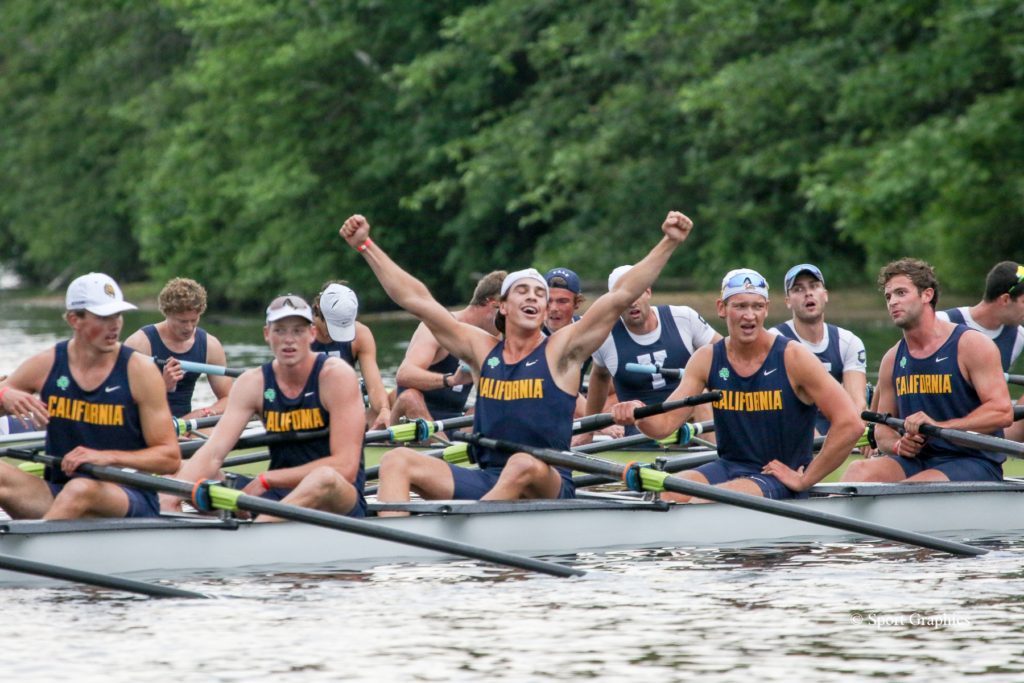 Over on the West Coast, the top three finishers from the Pac-12 Championships in Washington , Cal and Stanford earned the right to represent their program on the national stage while Santa Clara and UCSD qualified out of the Western Sprints regatta.
Drexel captured the automatic-qualifier out of the Dad Vail field while Hobart will once again represent the programs from the National Invitational Rowing Championships (NIRC). FIT captured the SIRA qualifier earlier in the season.
Penn, George Washington, Columbia, Northeastern, Navy, Oregon State and Saint Joseph’s all earned at-large selections to the National Championship after their strong performances over the course of the season.
For a full list of competing crews by event please follow the below link.
2017 IRA Accepted Entries
Going Overboard
Spring has officially arrived, but if you accidentally find yourself in the water, it won’t feel that way. Hypothermia, a subnormal temperature within the central body, is a risk this time of year. Knowing what to do quickly if you fall overboard will improve your safety. Water conducts heat fast. If you flip or are ejected, get as much of your body out of the water as possible. Remember to stay with the boat. Not only is it safer—most boats float, even if swamped or capsized—but by doing so you will also increase your odds of being spotted by a rescue craft. About 50 percent of heat is lost through the head, so try to keep your head out of the water, too. Swimming or treading water also contributes to heat loss. In the event that someone does go overboard, listen for your coxswain to call way enough and then help back the boat down to the person in the water. As this is happening, the stroke should throw his or her oar to the submerged athlete so they have something to help keep them afloat. Once they are back in the shell, immediately return to the boathouse and help locate dry clothes. Have the athlete seek medical attention if they display signs of hypothermia.
Cottage Cheese
It’s on the menu for many athletes, and for good reason. Cottage cheese is packed with protein—one cup contains roughly 28 grams of it—which makes the dairy aisle staple an ideal pre- and post-recovery fuel. It’s also high in calcium and vitamin B12, which helps prevent cardiovascular disease, and easily portable for the busy athlete. Enjoy it on its own or mixed with fruit.
Step and Repeat
The word “puke” was painted at the top of the paved hill, a training ground all Brown Crew members knew too well. It was part of Scott Roop’s dry-land training protocol, a straight shot from the bottom of College Hill to the top, 10 times in a row. The goal was to run up at full tilt and then jog down, attempting to replenish lost air and alleviate the leg burn. The ultimate commitment to the team, however, was to fulfill the request spray painted on the pavement by past Brown oarsmen. It rarely happened; but shooting for that simple (and arguably gross) goal motivated us to perform our best. The harder we pushed ourselves on those hills, the more prepared we would be to do battle with the likes of Harvard, Princeton, Cal, and UW—their names were all written on the pavement too. Hill repeats are still part of my routine today to keep me fit or ready for my next race. Give them a shot yourself with the below hill routine. Not a runner? No worries. I got you covered.
The Workout:
This is geared toward running, but remember that impact can be minimized because you are running up and walking or jogging down. If you can’t run, find a steeper incline and “speed hike” at a fast clip. Find a hill in your area that would take you 70-90 seconds to jog up. For efficiency, use the time it takes you to travel to the hill from your house or gym as part of your warm-up and cool-down jog.
Warm up for 10 minutes, starting with a jog and then building to a run. If planning to speed-hike hills, build from steady walk to speed-hike pace.
Set 1:
Run or speed hike up the hill for 45 seconds at hard intensity. Mark your finishing point.
Walk or jog down, staying light on your feet and prevent hammering your heels into pavement.
Repeat four times. See if you can get to the same point or farther up the hill with each repeat.
Rest for three minutes, hydrate, and stretch.
Set 2:
Run or speed hike up the hill for 60 seconds. Mark your finish point.
Repeat four times, trying to match or beat your distance with each sprint.
Cool down by walking or jogging for five to 10 minutes.
The Art of the Cold Call
The best way to get recruited is to contact college coaches, express your interest, and tell them about yourself. Rowers cannot sit back and wait to be discovered. If you want the college rowing opportunity, then take the initiative and reach out.
No universal best time to contact college coaches exists, but there is a sweet spot to reach out to each program. Coaches are generally not ready to hear from freshmen, but they all want to know about prospects before they’re seniors. Early summer following sophomore year is a good time to reach out, but later can work too.
That said, if you receive an email from an interesting college asking you to submit their recruiting questionnaire then do so. Get yourself included in a team’s database rather than wait until you have more to share. As you acquire new results you should update your questionnaire and/or email the coach.
The recruiting questionnaire is where it begins for prospects initiating contact, too. Even if you create a beautiful resume and write a terrific email, the college coach is still going to direct you to their questionnaire. Best to submit the questionnaire and also email the coach. You can expand upon the questionnaire and make a more personal connection too.
Here are some tips to help you get started:
1. Use an appropriate email address. If you picked your email back in sixth grade you may want to create a specific email address for recruiting purposes. “ILikeToParty@hotmail” won’t win you any points (True example!)
2. Email the head coach or the recruiting coordinator. If in doubt, cc the entire coaching staff.
3. Address the coach as “Coach” or “Mr./Ms”. Do not use their first name unless invited to do so.
4. Own your erg time. No excuses. Also, when reporting your erg time always indicate your weight and when it was done.
5. Own your GPA. Again, no excuses. Make it clear whether you’re reporting an Un-weighted or a Weighted GPA. It’s fine to highlight improvement and that your recent GPA is stronger but coaches need to know your cumulative high school GPA.
6. Do not send a resume filled with extra-curricular activities that are non-athletic. Coaches are looking for athletes who want to row; not do a million different things on campus.
7. Always sign your first AND last name; never just your first. Better still: include the name of your school or club team beneath your name.
8. Proofread your email; especially if you have attempted to personalize it for each individual program you write to. It’s shocking how often coaches receive emails intended for other programs.
