

Belorussia’s Ekaterina Karsten is proving that age may only be a number after all. On June 2, the two-time Olympic singles champion celebrated her 45th birthday. Less than a week earlier, she fought her way to within a half second of the European championship in the women’s single. The winner—Victoria Thornley of Great Britain—is incredibly nearly 15 years her junior. That age gap is nothing new for Karsten, who made her senior team debut with the Soviet Union in 1991, and apart from 1998 when she took a year off to give birth, has raced internationally every year since.
Di Ellis, 1938-2017
British Rowing has lost a legend. Dame Di Ellis, the longtime chairman of the national federation, passed away May 18 following a short illness. It is impossible to overstate Ellis’ impact rowing in her native country. A successful athlete in her own right, Ellis stroked the British women’s eight at the 1966 European championships before embarking on a career a sports administrator, chairing the Amateur Rowing Association (now British Rowing) from 1989 to 2013 and serving as the first woman steward of the Henley Royal Regatta. For her services to rowing, Ellis was awarded the Commander of the British Empire in 2013.
Bringing Blazers Back
U.S. national team coxswain Jack Carlson first raced at the Henley Royal Regatta in 2004 as a high school junior. His boat, unfortunately, was eliminated in the first round. Yet the free time Carlson found himself with afterward led to a fascination with one of rowing’s most stylish and visible traditions: the blazer.
Carlson spoke with rowers from all over the world about the traditions behind their blazers; he published a book on the subject back in 2014. Now he has launched a company that will try to bring the blazer into the mainstream in the United States.
“I think there’s a little bit of misunderstanding in America about the role of the blazer in the sport,” he says. “Some people say, ‘I don’t want to get a blazer because I’ve never been to Henley.’ But in Britain, where the blazer originated, if you’re a rower in a rowing club, you have a blazer.”
Throughout his research for his book, Carlson found that different teams have their own traditions surrounding their blazers. His company, Rowing Blazers, will manufacture blazers in the traditional fashion—and its products will be made entirely in the United States.
“A big part of the idea was to take the blazer back to its origins, to look at originals, how they fit and hang and replicate that, and with a modern fit.”
Carlson’s book and his fledgling company have attracted the attention of major style publications like GQ and manufacturers such as Tommy Hilfiger. He’s been able to tell the story about the blazer—“the hoodie of its time”—serving as a practical way to keep rowers warm and sport their team colors. Although they were meant for use at practices, rowers liked them so much that they were worn for all occasions. The rest is history.
Today, Carlson and his partners are bringing rowing blazers and accessories to crews of all stripes. While they work on a project with the nonprofit Row New York, they also manufacture the coats for Deerfield Academy. www.rowingblazers.com.
Regime Change for Rutgers Women’s Rowing
Max Borghard’s career as head coach of the Rutgers University women’s rowing program spanned a lot of history. He guided the Scarlet Knights to a full-team bid in 1997 when the first NCAA women’s rowing championships were held. He also witnessed the downgrading of his alma mater’s men’s program from varsity to club status in 2008.
After more than two decades at the helm, and amid challenges in adapting to membership in the Big Ten, Borghard and his team of assistants resigned in late May, according to the Rutgers student newspaper, The Daily Targum.
In a statement, Borghard said, “It was an honor to work at Rutgers and I want to thank all the oarswomen who passed through the boathouse over the years. The women’s rowing program has grown tremendously and is in a good position to have great success in the years to come. I also want to thank all my assistant coaches for all their hard work.”
Rutgers has one of the nation’s oldest collegiate rowing programs, founded more than 150 years ago. Borghard followed his father, Al, to Rutgers and contributed to the men’s team’s success as a lightweight captain. He stroked the team’s lightweight eight to two consecutive bronze medals at the Eastern Sprints before graduating in 1987.
Borghard was named head women’s coach in 1995. In the early days of women’s NCAA competition, his crews found success, qualifying for the championship regatta in 1997, 1998, and 2001, then as members of the Big East Conference. In their final years with the Big East, they finished in the middle of the pack.
The 2014 move to the Big Ten has proven challenging for the program. The Scarlet Knights finished last in team points at the conference championships each year since they made the move. The situation has mirrored the world of college football, as Ohio State and Michigan have become the powerhouses of Big Ten women’s rowing.
The university said it will be conducting a national search for its next head coach as it looks to bring the women’s program back to the championship stage.
The Heat is On
Warm weather and sunny days bring pleasant rowing. But summer also brings its own safety hazards, which can be avoided with careful oversight. Sunscreen should be applied liberally 15 to 30 minutes before going out, and reapplied if you are exposed to the sun for an extended period of time. Wearing the right gear—a hat with a brim, light protective clothing, and sunglasses—also provides important protection from the sun’s damaging rays. According to the Glaucoma Research Foundation, long-term exposure to UV rays can damage the eye’s surface as well as its internal structures, sometimes contributing to cataracts (clouding of the lens) and macular degeneration (breakdown of the macula). With warmer temperatures, proper hydration becomes an increasing concern. Make sure you are bringing your own water bottles in the boat and taking adequate breaks during practice to consume more water. Drink even if you don’t feel thirsty; you become dehydrated before you start to feel it. Water bottles should be kept clean and never shared to prevent illness. Be on the lookout for the telltale signs of heat exhaustion: heavy sweating, paleness, muscle cramps, fatigue, dizziness, headache, and nausea or vomiting.
The Hard Way

Most races are won by seconds. Assuming your rowers are fit and row reasonably well, your next area of focus should be to teach them how to row hard. Intervals, such as 500-meter pieces performed until technique deteriorates, will help your rowers grow accustomed to race pace. Time each interval, with the goal of improving the time it takes them to complete the distance. It’s important to create a culture of rowing hard, even when eyeing a taper. I always liked to ride alongside the boat I wanted to row harder, urging them to press with their legs and pry with their back. Another way to increase intensity is by practicing the last 30 strokes of your race plan when it’s time to go in and the crews are tired. The goal, of course, is crossing the finish line first. If you have two crews, give the slower one a head start and have the other crew row them down. Instruct your crews to give their all for 30 strokes. Don’t worry about technique; have them sit tall and drive with the legs. The thirty strokes will be anaerobic and if performed right, your athletes should be failing by the time they reach the final strokes. Be sure to have a long warm-down after these hard workouts.
Sitting Pretty
There’s little disagreement about the link between proper posture and performance, but what does correct body positioning look like? The most common description of good posture, which has the athlete maintaining a “stick-like” straight back, first appeared in literature more than a century ago when the sport was still heavily influenced by fixed-seat rowing. Legendary coach Steve Fairbairn was the first to introduce a more modern technique featuring curved backs, around 1930. Today’s research confirms Fairbairn’s notion, but for further evidence just look at a photo of any high-caliber rower. None row with a straight back, which is understandable since the human spine naturally presents a so-called “double-s” shape. These curvatures are nature’s very smart way to diminish the load on the spine. Leading scientists now define good posture in rowers mainly on two indicators. First, the athlete needs to row with a neutral or a natural “C-shaped” spine. The nature of the curvature differs by individual and presents the position where the least muscle tension is used to stabilize the spine’s shape. Secondly, the athlete needs to maintain their C-shape during the stroke, which is achieved through well-developed and strong trunk muscles. Knowing your neutral spine shape and holding this position strongly and steadily improves technique and prevents injury.
What Moves Us
Racing is in our DNA. It’s what motivated our founding 24 years ago—back then a biweekly periodical focused on results and regatta coverage—and what fires us up still. The expansive results section, of course, is no more. Instead, you’ll find useful tips on training and stories about people who inspire.
Like U.S. national team women’s assistant Laurel Korholz. We profile the veteran coach and Athens silver medalist this issue as she and Tom Terhaar look to extend their impressive run of world and Olympic eights titles. But worlds are still a few months off. In the meantime, we’ve just come off the busiest stretch of the competitive calendar and there’s a lot to process.
There’s Washington’s stunning win in coach Yaz Farooq’s freshman year on the job and Yale’s first-ever IRA title, a razor-thin measure of redemption on the waters of Lake Natoma. There’s the penultimate World Rowing Cup and the perennially entertaining European championships.
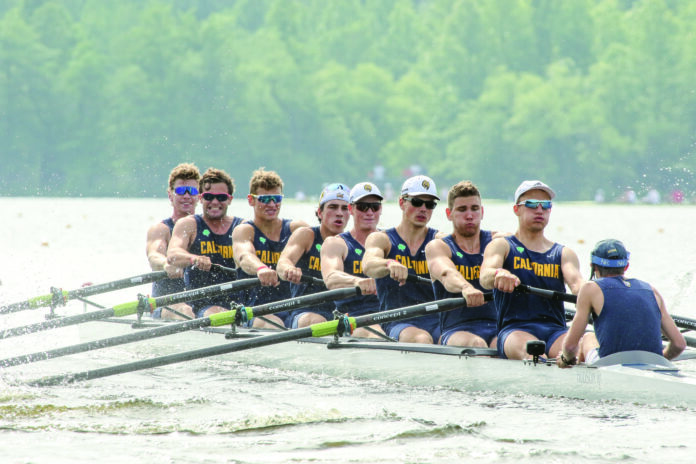
And then there’s the strength—both in numbers and quality—of American youth rowing. We saw it on display at youth nationals earlier this month and were moved by the energy and intensity of our sport’s next generation. Those athletes will soon be filling out collegiate lineups, but they have already made their presence felt.
You’ll find this and more in our blowout championship coverage beginning on page 30. It’s more than coverage, however. It’s a record of achievement and a reminder of why we do what we do—on the erg, on the water, and in the pages of this magazine.
We live for this.
