Home Blog Page 10

Clearing Up Confusion About Sugar

Limiting sugar intake does not harm anyone. Sugar is not an essential nutrient.


I’ve cut out sugar. Gurus on social media say it’s fattening, a waste of calories, and toxic.

I have a sweet tooth. Given the choice of eating more dinner or having dessert, I’ll always choose dessert!

Is Coke healthier if made with cane sugar instead of high-fructose corn syrup?

If you’re like most of my clients, you’re confused about the role of sugar in your daily sports diet. The anti-sugar “experts” (who speak to the general public, not specifically to athletes) argue that sugar is health-erosive. Sports nutrition researchers claim sugar enhances performance. So for athletes, is sugar friend or foe?

Sugar: Avoid it!

• Limiting sugar intake does not harm anyone. Sugar is not an essential nutrient. Our bodies can make sugar (glucose) by breaking down muscle and fat tissue or by converting the fat and protein we eat into glucose.

• The average American consumes about 17 teaspoons of added sugar a day (60 pounds a year). That’s a lot of empty calories. Populations with a high intake of added sugars tend to have health issues. By reducing added sugar to less than 10 percent of total calories, they can reduce tooth decay and the risk of weight gain, obesity, and associated health issues.

• Dietary sugar can drive up blood sugar. The risk of diabetes increases by 38 percent in those who routinely consume the sugar equivalent of a can of soda a day.

• Drinking Coca-Cola made with cane sugar is no better for you than Coca-Cola made with high-fructose corn syrup.

Cane sugar (also called sucrose) is comprised of 50 percent glucose, 50 percent fructose. High-fructose corn syrup is 45 percent glucose, 55 percent fructose. Both are metabolized similarly. Although President Trump says all-natural cane sugar “is just better,” science does not support that belief. Both contribute to health problems. Drinking Coke made with cane sugar will not make America healthier.

• With very high sugar consumption (sports drinks, gels, soda, candy), one could become nutrient-depleted. Empty- calorie sugar offers no nutritional value yet displaces nourishing food, which can lead to a lackluster sports diet.

Sugar and rowers: Moderation!

• Sugar consumption increased from less than 10 pounds per person a year in the late 1800s to about 100 pounds per person a year by 1945. It remained relatively flat until 1980. Yet our health improved between 1880 and 1980. We can’t blame just sugar for health problems. Lack of exercise, high stress, and poverty are also health-erosive.

• Sugar (a “carb”) is in breast milk, dairy food, fruit, vegetables, honey, potatoes, corn, quinoa, and all grains. People around the globe have consumed these foods for years. So why now are sugar and “carbs” deemed responsible for creating human obesity and diseases?

• Such fear-mongering terms as unhealthy, poisonous, and toxic are simply unscientific. People who lack knowledge of physiology fail to understand that sugar is not inherently fattening, nor is one particular food inherently healthy or unhealthy. An apple is a healthy food; a diet of all apples is very unhealthy.

• Our present state of poor health is not because we consume sugar and our diets are unhealthy. Rather, we are physically inactive. Too little exercise reduces our ability to metabolize sugar optimally. That, along with environmental factors, endocrine disrupters, stress, etc., explain the fundamental causes of obesity and metabolic disease.

• In terms of diabetes prevention, you should be concerned about blood sugar, not dietary sugar. A rise in blood sugar that occurs after eating is not pathological—unless unfit muscles and the liver fail to take up the sugar. It’s not what you eat, but what your body does with what you eat.

With inactivity, the body becomes less able to transport sugar out of blood and into muscle. This erodes metabolic health. Also with inactivity, a person can easily overeat because energy intake gets dissociated from energy expenditure.

Remember: The bodies of athletes are metabolically very different from the bodies of the sedentary. You want to stay active to preserve your ability to enjoy some sweets without hurting your health.

• Sugar cravings happen when the body needs fuel. If you eat before you run out of fuel, you will tame your sweet tooth. Have a second lunch when you are droopy and low on energy in the afternoon instead of devouring sweets in the evening. That said, a desire for sweets can also be a genetic preference.

Concluding comments

Lack of physical activity is a bigger threat to health than sugar. For people who are overfat and underfit, a diet low in sugar and starch is likely a wise idea. But for athletic people like rowers (who are at lower risk for heart disease, diabetes, and obesity), sugar and carbs are not toxic; they are an important fuel for enhancing athletic performance.

The one-size diet does not fit all. No one is suggesting that athletes should eat more sugar. Instead, rowers can embrace a sports diet that includes an appropriate balance of sugars and starches (carbohydrates) in each meal.  Strive for a healthy eating pattern that offers 85 percent to 90 percent quality foods and 10 percent to 15 percent fun foods, such as apple pie instead of an apple.

If you are fearful sugar will harm your health, keep in mind that fear-mongering relies on cherry-picked research that can prove what the “expert” wants to prove. Fear-mongering “experts” have created distrust of the food industry and have shaped opinions that support raw foods, super foods, whole foods, organic foods, and clean eating.  Confusion reigns!

My suggestions:

—Enjoy a variety of foods to get a variety of nutrients.

—Limit added sugar to less than 10 percent of your total calories (about 250 sugar calories per day for an active woman; 300 sugar calories for an active man).

—If you currently limit your sugar intake to a weekly “cheat day,” try this experiment: Enjoy a small sweet daily as a part of lunch or afternoon snack. This can curb your urge to binge on sweets in an unhealthy way on a cheat day. Sugar binges are what give sugar a bad name.

Nancy Clark, M.S., R.D., C.S.S.D., counsels both fitness exercisers and competitive athletes in the Boston area (Newton; 617-795-1875). Her best-selling Sports Nutrition Guidebook is a popular resource, as is her online workshop. For more information, visit NancyClarkRD.com

The Art of Making Mistakes

It’s inevitable: throughout your career, you’ll make mistakes, big and small. PHOTO: Lisa Worthy.


It’s inevitable: Maybe you hit a buoy, have a brush with a bridge, or you call the sprint far too early. Throughout your coxing career, you’ll make mistakes, big and small.

I spoke to Matilda Horn, assistant coach with the Cambridge University women, former Great Britain senior-team and Olympic coxswain and worlds silver medalist, and co-founder of The Winning Cox, about making—and recovering from—mistakes. 

In our conversation, I confessed to Matilda that I forgot my CoxBox for my first away race. Her reply?

“I forgot my CoxBox going to the final of the world championships.”

From your first day shoving off the dock to an Olympic final, coxswains of all levels will make mistakes. What differentiates the best coxswains is how you respond and recover.

So, something bad has happened. What next?

First, if it’s been a collision or a safety issue, get yourself and your crew into a good spot.

“Go into pilot mode and get yourself out of the situation really, really well,” Horn said. “You can give yourself permission to have a minute. If it’s in a race scenario, you might need to just get through it. Then you can give yourself a minute and go: ‘Right, so I’ve messed up, and that’s OK. What have I learned from it?’”

It’s easier said than done, but it’s important to be accountable. There’s nothing wrong with a quick apology and admitting that you have made an error.

“I think the biggest thing is owning your mistakes,” Horn said. “Because you’re scared or you’re worried about what people might think, the temptation is to hide. As a cox you’re supposed to have this bravado, so the temptation is to say this wasn’t my fault, or this wasn’t me, or whatever reason you can come up with to save face.”

Owning up to the mistake honestly and without groveling helps you earn credibility with your rowers and your coach. As a coxswain, you want to show that you can handle responsibility without getting defensive or making excuses.

That being said, your rowers need ownership but they still need a strong leader. Don’t let the mistake shake you to the core. Too many times, I’ve seen a coxswain make a serious error in practice and then spend the rest of the practice in stunned silence. Make sure that you rebound.

“You’re not owning the mistake to the point that it crushes you or changes who you are,” Horn said. “You don’t want it to be the thing that people can turn around and use against you. So you have to react in a way that goes: I know I made a mistake, and this is how I’m going to respond. So that’s the bit where you earn respect and people say, fair enough, and give you the time to recover from that mistake.”

Once you’re off the water and away from a team environment, you can give yourself a little more time. If you need to get more emotional or do some processing, out of the boat and after the session is a good time. Call someone unrelated to the situation, explain, and have a good cry if you need to.

“Be really mad about it, be really sad about it, and then go to your safe space and let all the emotions out,” Horn said. (And if you’ve really damaged something, she added, “that’s what insurance is for.”)

After you’ve done a bit of emotional recovery, you’re going to need to get back on the water and do it again.

“It’s OK to be sad or scared about something,” Horn said. “But it’s like if you fall off your bike, the best way to get over it is to get back on it. It sounds cliché, but then you can go: OK, how am I going to be able to do this again? What do I need to feel safe again?”

If you need a bit of extra support from your coach or teammates—more help with steering, another practice at backing into the stakeboat, more communication from a stroke or bow seat about what’s happening around them—don’t hesitate to ask for help. The point, Horn said, is that you (or you and your coach) can come up with a solution that helps you feel safer on the water. Then you can begin building up your confidence.

Mistakes happen to us all as long as we are in boats.

“Say you’re sorry, but also make sure [your rowers] know that you’re in control of what you take away from that mistake; they don’t get to determine that for you. They don’t get to own your mistake, but you do,” Horn said.

Be responsible, articulate what you’ve learned, and make a plan to avoid that error in the future. And when something happens, don’t let it shake you to your core. Hop back in the stern and show your rowers just how responsible and resilient you can be. 

Hannah Woodruff is an assistant coach and recruiting coordinator for the Radcliffe heavyweight team. She began rowing at Phillips Exeter Academy, was a coxswain at Wellesley College, and has coached college, high-school, and club crews for over 10 years.

Coaches are educators and leaders, not customer-service representatives.

Coaches are educators and leaders, not customer-service representatives. When that line blurs, authority erodes, hours expand, and burnout accelerates. PHOTO: Intersport-images.com.


By CJ Bown

The recent SafeSport survey that revealed the reasons for coach attrition didn’t tell me anything new. It simply put data behind conversations many coaches have been having with me for years.

Rowing coaches aren’t burning out and leaving the sport because they don’t care. Coaches are burning out and leaving because the job has expanded far beyond coaching. For many coaches, the job now involves managing parents, and most do so without training, structure, or support.

In rowing, pressure rarely shows up on the sideline. In fact, there really isn’t a sideline where it can manifest. Rowing doesn’t look like most youth sports. There aren’t parents yelling at officials or shouting instructions from the stands. There’s no obvious flashpoint.

The pressure on coaches builds elsewhere. In emails. In texts.

In conversations that begin politely and slowly turn into second-guessing of training plans, development timelines, and race-day lineups.

Why did they do that at practice? Why are they seat racing again? Why isn’t my athlete in the top boat?

None of these questions is unreasonable on its own. But with 50 plus athletes on the team, these conversations compound, creating an environment where coaches feel constantly evaluated and quietly undermined. That’s exactly the kind of tension and distrust the SafeSport survey describes.

Rowing is a long-term lifelong sport competing with a short-term “give me results now” culture.

Many families come to rowing with expectations shaped by other sports, where advancement feels faster and outcomes are better understood.  Rowing isn’t on SportsCenter and it’s not “mainstream,” so when rowing doesn’t deliver immediate validation, frustration builds. The coach becomes the most obvious place for that frustration to land.

The SafeSport data make clear that this dynamic is a major driver of coach burnout. In rowing, it’s compounded by the reality that many junior programs rely heavily on dues and fundraising. That creates an imbalance where coaches can feel exposed when pressure escalates and expectations collide with the cost and leverage of paid dues.

Rowing already runs on a thin coaching pipeline. There are few full-time roles, limited paths for advancement, and let’s be honest, not much money. Despite growing youth participation and demand, the sport relies on a small number of highly committed coaches carrying an oversized load for modest to no pay.

The incentives to coach in rowing aren’t strong. Hours are long and unpredictable. Early mornings, late nights, and weekends on the road. Compensation is limited and plateaus quickly.

Add constant parental pressure on top of that, and the question becomes obvious: Why would a good coach choose to do this long term?

When a coach leaves, the impact is immediate. I know; I get this call once a week. Rowing knowledge walks out the door. Teams scramble to find a novice coach so development doesn’t stall. Continuity with the varsity team breaks.

In most cases, programs don’t fail loudly, they shrink quietly, scale back, or fade out over a few seasons.

It’s a structural, foundational problem baked into how the sport operates. And it’s why the SafeSport findings aren’t surprising. Now, those of us in rowing have to work together to build and support the response.

Parent management isn’t just an important skill. It’s a core part of the job.

I’ve worked in the sport a long time and spent countless hours around both the coaches and the parent boards that support junior rowing teams. To me, the most important takeaway from the SafeSport survey is the need for better education, training, and support specific to managing parents.

My recommendations:

Coaches must be prepared for the full scope of the role.

This is on the coaches as much as it is on the parent boards. Coaching education does a solid job covering technique, training, and safety. But it doesn’t do a great job of teaching communication, expectation setting, and conflict navigation—areas that consume the most time and emotional energy.

Expectations must be set early and consistently.

Most conflicts don’t appear mid-season. They grow out of assumptions that were never addressed up front. Clear, consistent parent education can reduce a significant amount of friction before it reaches the coach, which matters when coaches are already working long hours for modest pay.

Support must be structural, not just verbal.

Saying “we support our coaches” doesn’t mean anything if, when pressure rises, coaches are left to handle it alone. While I understand that parent volunteers on the board are busy, too, when coaches are questioned, real support and real backing matter even more.

Coaches are educators and leaders, not customer-service representatives. When that line blurs, authority erodes, hours expand, and burnout accelerates. In a sport where coaches aren’t paid well to begin with, that tradeoff stops making sense very quickly.

Schools and boards must create a coach-support policy that relieves coaches of parent-conflict management. It needs to protect coaching authority through clearly defined escalation and communication protocols.

Honesty about development matters, too.

It’s hard for parents to hear that a son or daughter might not be the star athlete they want them to be. Not every athlete rows varsity. Not every athlete is recruited. When those realities aren’t stated bluntly, parental frustration and disappointment can build.

Those feelings then land on coaches, who are already doing the best they can to support the team. Programs should state realistic development and recruiting expectations for families before the season begins so coaches don’t have to manage cases of disappointment individually.

Combine the above recommendations and we can position coaches for real success—but only if we act and make actual changes.

The SafeSport survey doesn’t solve a mystery; it confirms something coaches already know. Unmanaged parent pressure is a major reason they leave. The fix isn’t complicated but it requires intent and follow-through. Do these things and you reduce the pressure that drives good coaches out of rowing.

The rowing community doesn’t need to panic but we do need to recognize that protecting coaches is as important as protecting athletes. It’s a responsibility we can’t keep ignoring.

C.J. Bown began his coaching career at Marquette University. He is vice president of sales at Pocock Racing Shells and president of sales and marketing at Finish Line Shell Repair.

On the Thames, Anything Can Happen

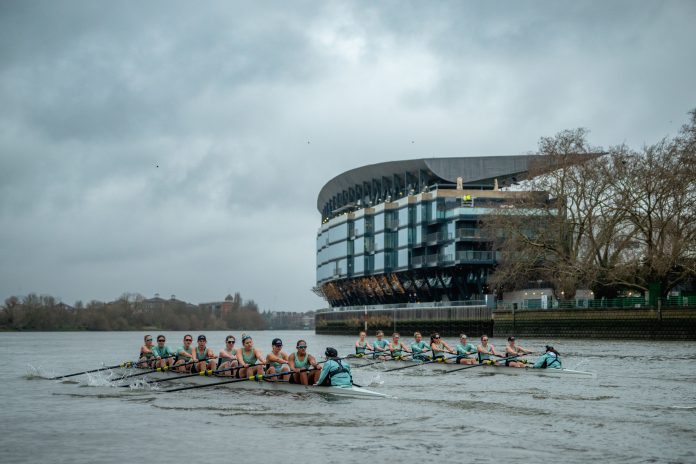
The Cambridge men remain strong favorites, and the Dark Blue women still have the favorites tag. But the Cambridge women are closing the gap. PHOTO Courtesy The Boat Race.


By Martin Cross

On the last day of January, the putative Oxford men’s Blue boat was barreling down the Thames championship course at full pelt. They were matched against an eight from London Rowing Club. The waters off The Boat Race start at Putney had been full of all sorts of boats, forced off the non-tidal stretches of the Thames because of the impossibly fast stream conditions (the UK and rain…).

Right on the corner of the Fulham bend, the London crew—at that point nearly a length down on Oxford—had to hold their boat up hard as they threatened to ram a flotilla of sailing boats. Collision was averted, the race restarted, and both London and Oxford went on to share the honors in a well-matched encounter.

Anything can happen in The Boat Race, and this was a reminder of that.

Yes, The Boat Race fixture season is upon us—that time of year when the Oxbridge squads take on the finest domestic and international opposition on the famous championship course.

The next day, the Tideway was again packed, as Oxford’s women dominated their fixture against London Rowing Club. But the most interesting contest on the first of February was the four races between eight–yes, eight–Oxford Brookes eights. The university club that has frankly dominated student rowing in the UK was back!

Last year was an unhappy one for the Brookes Boat Club. Controversies and bad publicity over the methodology of its coaches had forced the club to withdraw from the 2025 fixture season, when the Brookes rowers were supposed to pit themselves against the Blue boats. The run of bad luck continued at Henley, where the club failed to win a trophy for the first time in a long while.

But 2026 has seen a rejuvenated Brookes return to the tidal Thames with new men’s and women’s chief coaches ready to take on the Blue boats.

Ali Brown, a fresh-faced, incredibly enthusiastic coach, stepped out of the prestigious Leander Club setup to take on what he called “a dream job.” Despite last year’s controversy, Brown has no shortage of athletes. He has entered nine Brookes crews for the Head of the River Race on the 28th of March.

But before then, Brown is salivating over the prospect of racing both Oxford and Cambridge Blue boats, the former on the seventh of March and the latter just a couple of weeks earlier on the 21st of February.

Traditionally, the Brookes stable of athletes includes rowers who have graduated but still compete for their alma mater. Brown has made the brave decision, however, to race against the Blue boats with just undergraduates. The Brookes match racing on the first of February was, in Brown’s words, “to give the new lads a first look at the championship course.”

The Brookes fixtures will be anticipated eagerly, as will the matchup between the men and women of Cambridge and the Dutch national squad. Of course, the two eights from The Netherlands blew away competition from the rest of the world to take two golds at the Shanghai World Rowing Championships last year. Earlier in the season, The Netherlands men’s eight were run close by an exceptional Light Blue crew in the Grand at Henley.

But the two eights that will wear orange for the fixtures on the eighth of March will be athletes from the Dutch development squad. The seniors will have spent several weeks up at altitude and will have come down only on the fifth of March. That’s deemed too soon for them to race Cambridge on the Thames.

Meanwhile, the rumor mill has been working overtime on the likely relative speeds of both men’s and women’s Boat Race crews. Cambridge’s reserve boat was said to have beaten the men of Thames Rowing Club on the Tideway. Given that Thames and London are a similar speed, and factoring in the result of London vs. Oxford, that means that Cambridge’s first boat (at this stage) is faster than Oxford’s best crew.

The Cambridge women shared the honors against a very strong Thames R.C. eight, though apparently they were bettered by a Leander crew that came up to the Light Blues Ely course, in the east of the UK, as the speed of the river at Leander’s Henley base is too fast.

What does all this mean? Well, the Cambridge men remain strong favorites, and the Dark Blue women still have the favorites tag. But the Cambridge women are closing the gap.

Moreover, the Light Blues have a significant performance advantage in that they can continue to row on their Ely stretch of water, which is unaffected by the stream and floods. Oxford, however, can’t row out of their Thames-based boathouse until the rain stops and the waters on the Wallingford stretch subside. So the Dark Blues have to find water elsewhere. That means significant traveling time and, frankly, a bit of a logistic nightmare.

Chris Dodd, 1942-2026

2005 FISA World Cup, Dorney Lake, Eton, ENGLAND, 27.05.05. [Friday ] Chris Dodd. .Photo Peter Spurrier. .email images@intersport-images...[Mandatory Credit Peter Spurrier/ Intersport Images] , Rowing Courses, Dorney Lake, Eton. ENGLAND


Chris Dodd, the greatest rowing journalist of all time, died on Jan. 25 in Great Britain. He was 83.

Dodd, who covered rowing for The Guardian, reported on more major regattas better than anyone else and wrote several books on the sport, including most recently (with Hugh Mathewson), More Power, the story of Olympic rowing coach Jürgen Gröbler.

“Nobody in the field—past or present–has come up to Chris’s standards,” said Martin Cross in The Guardian. “A quietly spoken private man, he was head and shoulders above the rest of his journalistic colleagues, of whom I was one.”

Dodd loved rowing and served the sport not only by telling its stories but also by being a friend and supporter of those who aspired to do the same. He shared his intellect, experience, and sharp wit generously.

A side-eye glance paired with a few words under his breath in the press box could be both the truest and funniest words a fellow journalist might hear in a season of covering rowing. He may or may not have coined the term blazerati for the blue blazer-wearing officials and bureaucrats of elite rowing, but none wielded it more deftly.

Christopher John Dodd was born in Bristol, UK in 1942 and became The Guardian’s rowing correspondent in 1970. He was the founding editor of Regatta magazine, the defunct publication of Great Britain’s Amateur Rowing Association—now British Rowing—and also wrote The Story of World Rowing. He was a driving force behind the founding of The River and Rowing Museum in Henley-on-Thames, which opened in 1998 and closed last year due to financial struggles.

In 2022, British Rowing awarded Dodd its Medal of Honor for his outstanding service to the sport.

“I am somewhat astonished as well as flattered to hear that I am to be awarded British Rowing’s Medal of Honor,” Dodd said at the time. “Flattered because it boosts my ego; astonished because I have sometimes given British Rowing, once the Amateur Rowing Association, a hard time in print.”

He supported and encouraged Rowing News and other new rowing media with his words while also representing the old guard of rowing journalists, including his late friends Peter Spurrier, Mike Rosewell, and Geoffrey Page, with whom he founded the British Association of Rowing Journalists (BARJ).

It was the natural formalization of the band of correspondents who more often than not gathered for drinks at the end of the workday and usually a meal at the end of the regatta, which could be as much fun as the event.

BARJ pushed back against press offices for regattas and rowing associations transitioning from media liaisons to public relations and marketing organs. His career spanned the arc of journalism from when basement printing presses dimmed the lights of The Guardian building to the dim lights of digital-only outlets that have superseded many actual publications.

“Chris was the quiet man of the traveling British rowing pack, but there was always something going on–a plan to be hatched or a story to be told,” said Mike Haggerty, Dodd’s longtime friend and rowing correspondent for the Associated Press. “He always knew exactly what he was doing and where he was going, and you were always going to be entertained in his company.”

In the bibliography at the back of More Power, Dodd wrote, “One of the extraordinary things about rowing is the stream of writing dedicated to it.”

He was the greatest source of that stream.

Stanford Opens 2026 Season at #1

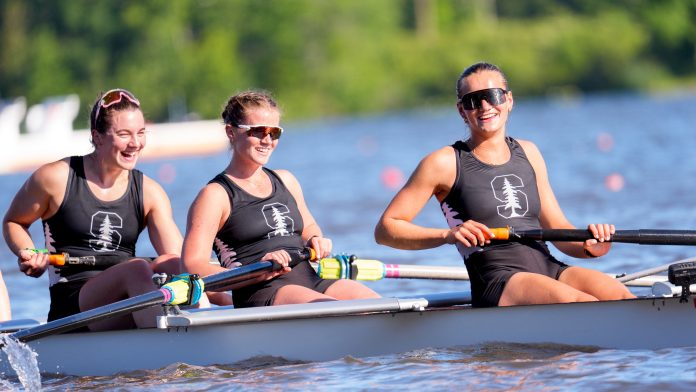
Stanford has won two NCAA titles (2023 and 2025) under head coach Derek Byrnes. PHOTO: Katie Lane.


Defending NCAA Division I national champion Stanford topped the Pocock CRCA preseason poll, earning 22 of 25 first-place votes. Yale, winner of the NCAA I Eight grand final was second, with two votes, and Texas was third, with one.

Stanford head coach Derek Byrnes enters his tenth season as the Farwell Family Director of Women’s Rowing having coached The Cardinal to NCAA titles (2023 and 2025). Stanford added 13 new recruits for the 2025-26 year.

Led by Coach of the Year Will Porter, Yale enters the 2026 spring racing season with nine new recruits from seven different countries, many with international racing experience.

“All these athletes have two things in common,” said Porter  “They are passionate about their education and rowing.”

Texas finished third at last year’s NCAA championship with the youngest squad ever. This year, the Longhorns return eight athletes from the 2025 I Eight, seven from the II Eight, and four from the Four. Canadian Olympic medalist and Yale graduate Maya Meschkuleit joined Texas’ recruiting class of 17.

The Longhorns open the 2026 season the San Diego Crew Classic on March 28-29.

Making History: Youngest Trio of Rowers Cross the Atlantic

Three Flying Fish rowed the Atlantic to raise money for the Teenage Cancer Trust.


By Katie Lane

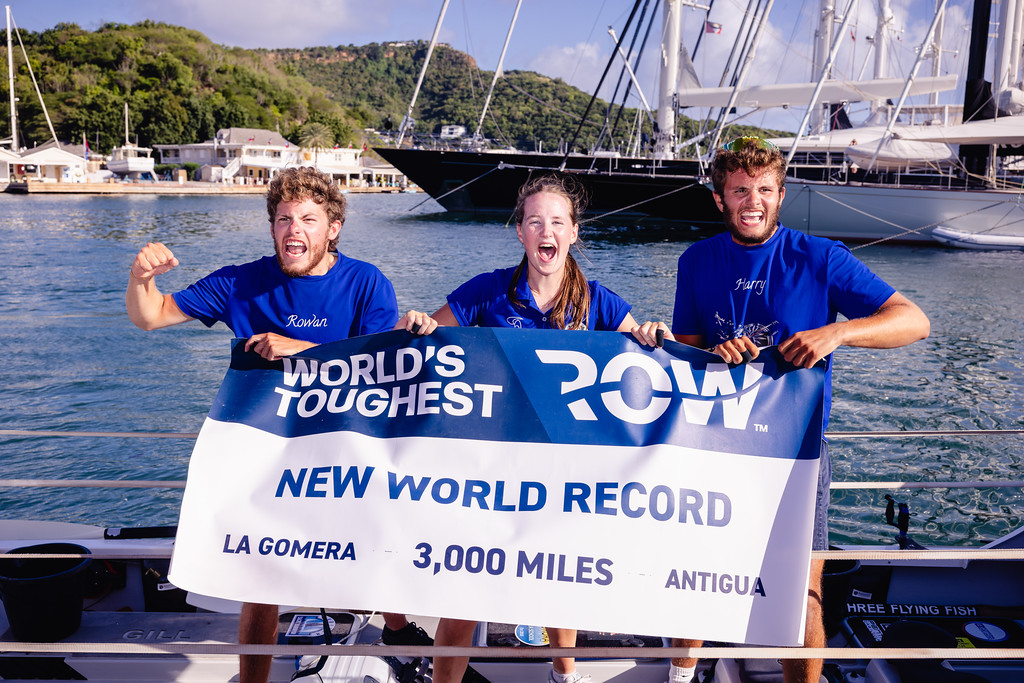
On December 14th, 2025 at 11:38am, Rowan Dally (21), Anna Dunk (19) and Harry Allen (20), otherwise known as the The Three Flying Fish, departed from the Marina at La Gomera in the Canary Islands for the greatest challenge of their individual lives: The World’s Toughest Row. 42 days, 8 hours and 10 minutes later, they are now world record holders as the youngest team to ever row any ocean.

Participating crews in The World’s Toughest Row rowed 3,000 miles across the Atlantic Ocean in one of four categories: solo, pair, trio, or four. The Three Flying Fish were one of 43 boats racing in the World’s Toughest Row – Atlantic 2025.

Inspired by Anna’s father, 2021 World’s Toughest Row Competitor Davie Dunk, The Three Flying Fish begin campaigning for a journey of their own in 2022.

“Our mission is to push the limits of human endurance, resilience and teamwork,” the team states on www.thethreeflyingfish.com. “We are committed to inspiring others by taking on the World’s Toughest Row, whilst breaking a record along the way.”

The Three Flying Fish chose the Teenage Cancer Trust as their community partner, raising awareness and funds, helping offset the costs of specialist nursing care for patients aged 13-24 years old.

“As three young people, we know how lucky we are to be in this situation and be able to do the row. We understand that there are so many children out there who would not be able to do this, due to factors out of their control. We aren’t doing the row because we can, we are doing it because they can’t.”

In the The World’s Toughest Row, each team rows on average 1.5 million strokes during a race. Anna Dunk noted that the physical challenge of rowing across the Atlantic is “so tough, two hours on followed by two hours off, for 45-plus days,” but finds that “the mental side is ten times tougher.”

“Dealing with sleep deprivation, anxiety, and homesickness was the toughest part of the crossing for me,” said Anna Dunk. “The feeling of isolation is immense, and being on a 10 meter boat with two of the same people day in and day out, it’s a recipe for disaster.”

All that’s to say, The Three Flying Fish said being out in nature, spending time with friends, and overall embracing the simplicity of life were what they all looked forward to in the experience. They saw dolphins on Harry’s 20th birthday, flying fish, countless sunrises and sunsets, and even a white-tailed Tropicbird, a bird only found in regions of the Caribbean.

“I only have to eat, sleep and row,” Rowan Dally said. “Not having to send an email, attend a zoom call, or go on social media was a very freeing experience.”

If this journey has taught the Three Flying Fish anything, it’s the importance of teamwork. Whether it’s navigating open waters, securing sponsorships, or managing basic communication, the three learned to rely on each other as they strive towards a common goal.

“More than anything, I hope they come away with a lasting belief in their own capabilities and a deeper understanding of teamwork, perseverance, and humility,” Craig Allen, father of Harry Allen, stated.

“The biggest lesson I’ve learned is that being a team is extremely stressful, especially working in such close proximity to each other,” Harry Allen said. “I learned that I can achieve anything and to never say something is impossible again… rather that I’m possible instead!”

Rowan Dally, Anna Dunk, and Harry Allen.

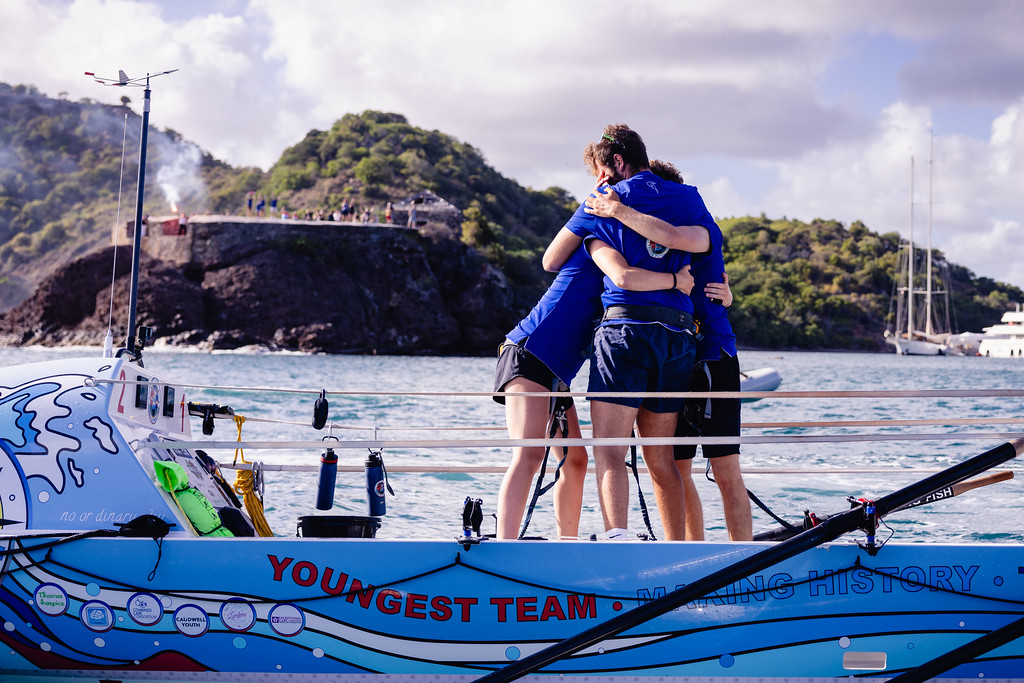
The Three Flying Fish arrived at Nelson’s Dockyard in Antigua on January 20th, 2026, marking the end of their journey across the Atlantic. Officially, the trio finished 20th overall (43 entries), 4th in the trio (six entries), and 3rd in the mixed class (six entries). To date, they have successfully raised over 40,000 pounds ($55,000) for the Teenage Cancer Trust.

When asked how it feels to be a world record holder, Anna, Rowan and Harry all agreed that “it hasn’t sunk in yet.” The trio also said that they would “absolutely do something like this again”.

“I hope that when other people see what we have achieved, it will inspire them to push their own boundaries just like we’ve pushed ours,” said Rowan.

Three Flying Fish are the youngest crew to row any ocean.

Making Erg Training Count

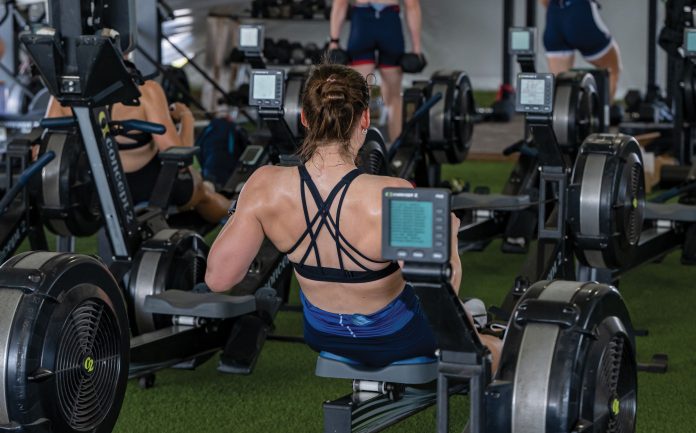
Pay attention to proper technique on the erg to achieve optimal results. PHOTO: Lisa Worthy.

Are you one of those people who feels like time is flying— except when you’re training indoors?

The days when we can’t get out on the water and enjoy the outdoors seem to drag on forever. Yes, we know that indoor training is important and offers benefits that rowing on the water can’t. But we are rowers, and nothing beats the feeling of a team working together and a boat running well.

It’s not hard to motivate myself to go rowing on the water, but it takes considerable effort to pack my bag and go to the gym. I realize how important it is, especially for older athletes, to strength-train regularly, but it’s definitely not a favorite.

From comments I’ve heard, I know that ergometer training is to many rowers what strength-training is to me. Because it’s not exciting, getting it done requires extra motivation.

Everyone agrees that winter rowing on an erg is excellent preparation for rowing on the water, so people put in their time but tend to do it on cruise control. As with any exercise done reluctantly, erg training misses the mark when performed incorrectly.

If you don’t pay attention to proper technique, you won’t achieve optimal results, and positive adaptation, both physiological and psychological, will be limited. Poor technique also can put unnecessary strain on your body and cause injury.

A common technical error: starting the drive by opening your upper body and leaning back while your legs are still straightening. Without the right sequence—legs-upper body-arms—you won’t achieve maximum handle force, you’ll tire quickly, and by weakening your core stability, you may hurt yourself.

If you row this way consistently, thus ingraining the incorrect sequence in muscle memory, once back on the water in the spring, you’ll transfer your bad habits to the boat, which will alter the feel and diminish the power of your stroke.

Other erging no-no’s: gripping the handle incorrectly, lunging, pausing at the catch, not extending your legs fully, bending your knees during the recovery while your upper body is still leaning back, tilting your upper body to one side while exerting uneven pressure on the foot stretcher.

Coaches should correct these technical errors, and rowers shouldn’t ignore them. Watching yourself erg in a mirror will enable you to identify your weaknesses. Even better: a video at race pace. The objective is to become aware of your mistakes so you can fix them.

During long low-intensity training sessions, it’s tempting to go through the motions and assume your technique is fine. But complacency can lead to performance stagnation and even injury. Better to concentrate on improving your erging form so you’ll row better when you get back in the boat.

Volker Nolte, an internationally recognized expert on the biomechanics of rowing, is the author of Rowing Science, Rowing Faster, and Masters Rowing. He’s a retired professor of biomechanics at the University of Western Ontario, where he coached the men’s rowing team to three Canadian national titles.