

On a clear warm morning in late August, 35 women donned fresh purple team kit, picked up newly painted oars, and took to the waters of Oak Hollow Lake in North Carolina for the first practice of the High Point University varsity women’s rowing team.
To continue reading…
This article is exclusively for Rowing News subscribers. For as little as $5 a month, you can get access to the best quality, independent reporting on all the issues that matter to the North American rowing community.
Already a subscriber? Login
For head coach Jessica Deitrick, this day had been a long time coming. A decade, to be precise. Named the head coach for the newly established team in May 2023, Deitrick began her journey to that August morning when she arrived in High Point, N.C., in 2014 to coach the then-club rowing team and serve as the director of club sports.
In her two years with the Panthers club team, she oversaw both the men’s and women’s squads, winning an ACRA national championship and securing a silver medal at Dad Vails in 2015.
The athletic department at that time had added lacrosse and was considering adding another varsity sport. In 2014, Dan Hauser, HPU’s athletic director, approached Deitrick to ask about elevating the club rowing team to varsity status, but she believed the time wasn’t right.
“I don’t think you’re ready for it yet,” Deitrick remembers telling Hauser. “Could it happen down the road? Yes, but I don’t think you have the resources for it quite yet.”
The university was not in a position then to provide the funding necessary to compete on the national level, and Deitrick knew she had her own development to tend to as well.
In 2016, she made the move to Division I rowing, taking on an assistant-coaching role with the Naval Academy women and in 2019 becoming the head women’s coach at Colgate University.
But she never forgot the potential that beckoned in North Carolina.
“I never stopped watching High Point.”

At a time when the future of college athletics is in flux and some universities may reduce financial support for Olympic sports or cut them outright, High Point made the decision to add a varsity women’s rowing team in 2023.
“We want to win in everything,” Hauser, still HPU’s athletic director, declared. “It pains me when—and I’m not disparaging Ohio State—I hear their leadership say recently that they may have tiers of teams. That’s just sad to me.”
The decision to add rowing is very much in keeping with the character and culture of the university, he asserted.
“We have made a ton of decisions with faithful courage, meaning that we aren’t afraid to add rowing. We’re adding a law school. We’re adding a school of dentistry. It takes faithful courage to start programs from scratch.”
That “faithful courage” has paid dividends over the past two decades on the picture-perfect ever-expanding campus.
When Nido Qubein, a successful businessman, motivational speaker, and High Point alum, became president of the university in 2005, HPU was a small, struggling, tuition-dependent liberal-arts college. Since then, HPU has transformed its campus and culture, investing nearly $3 billion in facilities and academic programs, according to the Princeton Review (Rowing News was not able to verify that figure independently). HPU has opened or is in the process of opening five new graduate schools (law, dental medicine, nursing, entrepreneurship, and optometry), and the campus has grown from 91 acres to 530. In addition to rowing, the university added men’s and women’s lacrosse.
Perhaps the only aspect of life at High Point that’s not better now than it was 20 years ago is financial aid. In 2021, about 30 percent of financial need was covered, down from nearly 50 percent in 2005. In 2020, only 11.5 percent of HPU’s first-year students were recipients of federal Pell grants, awarded to students with exceptional financial need, and of 1,658 institutions ranked by Education Reform Now, a non-partisan K-16 education think tank and advocacy organization, High Point came in at 1,629.
Nevertheless, enrollment has grown from fewer than 2,000 students to 6,000, while the operating budget has swelled from $40 million 20 years ago to $350 million this year.
Hauser credits Qubein for the dramatic change in fortune.
“President Qubein came from the business world, not the academic world, and his knowledge of business has been very powerful in helping this university make sound business decisions.”
High Point’s rank in the Princeton Review’s survey of the best-run colleges in America: No. 1.

The dramatic growth and a concomitant focus on an upscale experience are evident in every aspect of campus life. Classical music is piped into outdoor spaces, and snacks and coffee are available for free at gazebos as students hurry to class. Dorms offer a nail salon and barber shop. Fine-dining campus restaurants, included in meal plans, require reservations, business attire, and proper etiquette and are designed to prepare students for future business and networking meals. A concierge advises students and their families about the best amenities both within and beyond the university’s gated walls.
So when time came to add another sport, High Point wanted to make a splash.
“Our leadership team has done a lot of unique things on our campus, and we continue to try to find unique ways we can expand and brand the university,” Hauser explained. “We looked at rowing as one of those unique ways to continue the growth and exposure of the university.”
After adding women’s and men’s lacrosse in 2011 and 2013, respectively, and achieving success quickly, the HPU athletic department knew what it was looking for in its next sport.
For starters, rowing enables the university to differentiate itself from peer institutions while appealing to its core demographic (60 percent of students come from Virginia and points north, where rowing is relatively popular). Like lacrosse, rowing has a “heavily Northeast footprint,” Hauser said, “which is where our students are coming from.”
High Point is only the third DI rowing program in North Carolina, in addition to Duke and the University of North Carolina. By adding rowing, High Point figured it could “create uniqueness,” Hauser said, “and differentiate High Point University from our peer competitors in the state and in the region.”
The ability to be competitive in the sport nationally was also a significant factor. While there are nearly 300 DI softball programs across the country, there are only about 90 DI women’s rowing teams. For a department seeking success on a larger stage, this smaller pond was appealing. Rather than having to surpass 250 teams, HPU’s rowers need to better only 70 teams to be ranked nationally, Hauser noted.
Logistical matters also made rowing the right choice. Oak Hollow Lake is just 10 minutes from campus and features protected water, a buoyed racecourse, and a vibrant local rowing scene. A boathouse is being built, and HPU has a successful club team already, a promising seedbed for the new varsity squad.
Title IX also played a role, of course. The last sport added, men’s lacrosse, has a roster of 50 to 60 athletes, so the school was looking for a counterbalance. When considering the necessary financial investment, rowing came out on top compared to other sports that require more money for equipment and facilities, even with a full slate of 20 athletic scholarships, which the team will build up to over three years.
For example, the cost of adding rowing was much lower than a “full-out softball stadium that has to match our current baseball stadium, from club suites to lights to video boards and the amenities,” Hauser said. “We couldn’t have an inferior Title IX facility relative to what we already had.
“Our university’s message is ‘choose to be extraordinary,’ so we want to try to be extraordinary in everything we’re choosing to do.”
From the start of her return to High Point, Dietrick felt that extraordinary commitment. There was a press conference to announce her hiring and introduce her to the High Point community, an uncommon amount of fanfare for a rowing coach, even among the flashiest athletic departments. Newly designed team unisuits were on hand, and the website had been updated already to reflect the addition of the newest team.
Most meaningful to Deitrick: Signs around the athletic department that had read “16 teams, One family” had been revised.
“At other places, they’re like, ‘Oh, it’s the rowing coach. Whatever. We don’t even need to do a press conference.’ But here the signs had already been changed to ‘17 teams. One family.’
“I felt appreciated and welcomed into the community.”
Since her hiring, Deitrick has been working to create a team that also will be extraordinary. Her focus is on recruiting athletes who are a good fit for what the team needs now.
“It’s got to be someone really gritty. This is a fight. We’re an underdog and we’re going to be an underdog for a while,” Deitrick tells recruits.
She’s realistic and is looking for diamonds in the rough, knowing that she can develop their rowing skills but that their character is what’s most important.
“It’s not going to be the prettiest of rowing. I can make it prettier, but I can’t teach grit and determination.”
It’s a tough ask of 18-year-olds. The team has no track record, no boathouse (yet), no alumni, and its future success is far from guaranteed. But Deitrick leans into the opportunity to build a legacy. She asks recruits to look 15 years into the future.
“This team is going to be at NCAAs, and they’re going to be in an A or B final. And you can say, ‘I did that. They are there because I laid the groundwork for it.’”
She admits that the current team is unlikely to attain those heights, but the group is excited about erecting the foundation for rowers in the future.
Hauser echoed the sentiment.
“This first class of women rowers who walked in the door in fall of 2024 have courage to believe in the university, to believe that a boathouse is going to get constructed. That’s a testament to their character.”
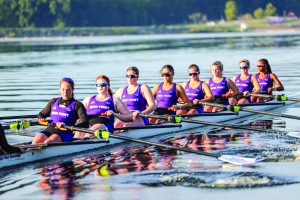
In late September, High Point was training for its first varsity contest, an early-October appearance at the High Point Autumn Rowing Festival, where the crew would vie against Duke, Old Dominion, the Oxford University lightweights, and the Ukrainian national-team eight.
“That High Point University’s first race as the newest university team in the country, or maybe in the world, will be against Oxford, the oldest university, is kind of interesting,” understated Gene Kininmonth, the festival’s director and the head coach of local club Triad United.
Yes, High Point has no past; it has yet to write its history and establish its pedigree. But teams like High Point are the future of collegiate rowing in America.
“We’re thrilled with rowing,” Hauser said. “It’s a wonderful opportunity!” —one other athletic departments should consider.
“I have encouraged other ADs—if you have a body of water and could potentially bring this on, you’re foolish not to look at rowing.”
