

To continue reading…
This article is exclusively for Rowing News subscribers. For as little as $5 a month, you can get access to the best quality, independent reporting on all the issues that matter to the North American rowing community.
By Frank Fitzpatrick
The summer sun bejeweled the surface of Great Hosmer Pond. In the thick woods that enclosed the body of water in scenic Craftsbury, Vt., the cries of warblers and thrush announced a perfect morning.
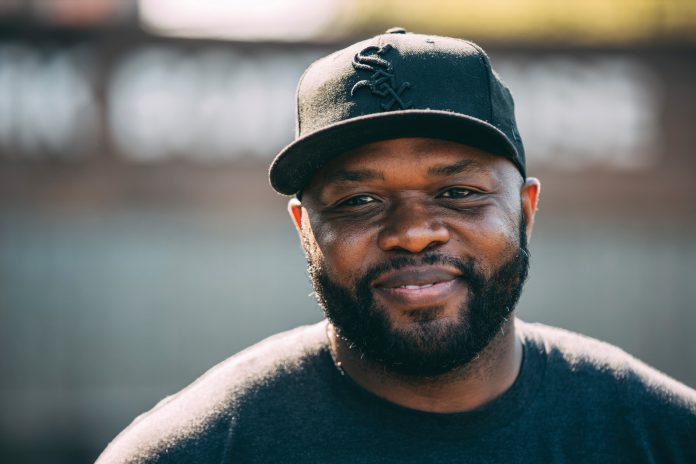
Suddenly, a launch appeared. Atop it–incongruously for this bucolic slice of the nation’s whitest state–sat an African–American man in a White Sox cap. As his craft motored leisurely, he turned his head slowly from shore to shore, absorbing the idyllic surroundings like a painter envisioning his next canvas.
“When I’m out there, I remember what attracted me to rowing all those years ago,” Arshay Cooper said. “The birds were singing. It was so calm. I was like, ‘This is what peace is like.’ I grew up on the West Side of Chicago, and you woke up to all that noise and chaos.
“With sports like football or basketball, there’s that same chaos. But in rowing, you could hear your own thoughts. It was the most tranquil thing I’d ever been a part of.”
It was the promise of pizza that led a reluctant 15-year-old Cooper to rowing, joining what would become the nation’s first all-black public high-school crew. But it was the tranquility that triggered what has been a Road-to-Damascus-sized conversion.
His grudging acceptance of the sport blossomed quickly into a passion and then into his life’s mission. He wrote a memoir on his almost spiritual embrace of rowing, then in 2020 produced a documentary on the same subject. Their success led Cooper in 2021 to launch the A Most Beautiful Thing Inclusion Fund (AMBTIF), whose aim is providing youngsters of color access to a sport viewed historically as exclusionary.
What Cooper has confronted is a sport whose demographics long ago calcified. The logistical and financial demands kept it a White upper-class preserve. Research by USRowing shows that Blacks have accounted for only 1.3 percent to two percent of rowers nationwide. And a 2021 NCAA survey of the participants in women’s rowing programs (men’s rowing is not an NCAA sport) found that only two percent were Black.
“Talent is everywhere,” Cooper said. “But access and opportunity are not.”
While it’s too early to quantify the results of his monumental effort, its positive impacts after just five years are growing more obvious.
So far, by its own calculations, AMBTIF has introduced more than 8,000 youngsters to the sport at its 25 facilities and elsewhere. More than 50 have moved on to row in college, some at places like Harvard, Penn, and UC Berkeley. A few, like Cal’s Ella Wheeler and Hobart’s Conrad Palmer, are vying seriously to become Olympians, perhaps as soon as the 2028 Games in Los Angeles. In July, Wheeler won World Rowing Under 23 Championship gold as a member of the U.S. women’s four.
Cooper speaks at 60 or so schools a year, recruiting and inspiring youngsters. The assistance he offers each is holistic, extending well beyond lessons on rowing technique.
“Arshay will tell you that he’s here for us forever and for everything,” said Julia Veal, a SUNY-Albany rower whom Cooper met at one of Oklahoma’s two rowing clubs. “Whatever it is–school, college plans, a travel situation–he’s there to help. He knows basically everyone in rowing and he’ll find someone to help you make it happen.”
One of AMBTIF’s most successful initiatives takes place each summer in Craftsbury, near the home of one of the organization’s largest sponsors, Concept2. For the last six years, rowers from underserved communities have attended Cooper’s camp at the Craftsbury Outdoor Center.
“I first went to Craftsbury as a camper,” Veal said. “Just being around a bunch of Black athletes was life-changing. Now I’m an intern there and I get to watch the kids experience what I did and see how it changes their lives.”
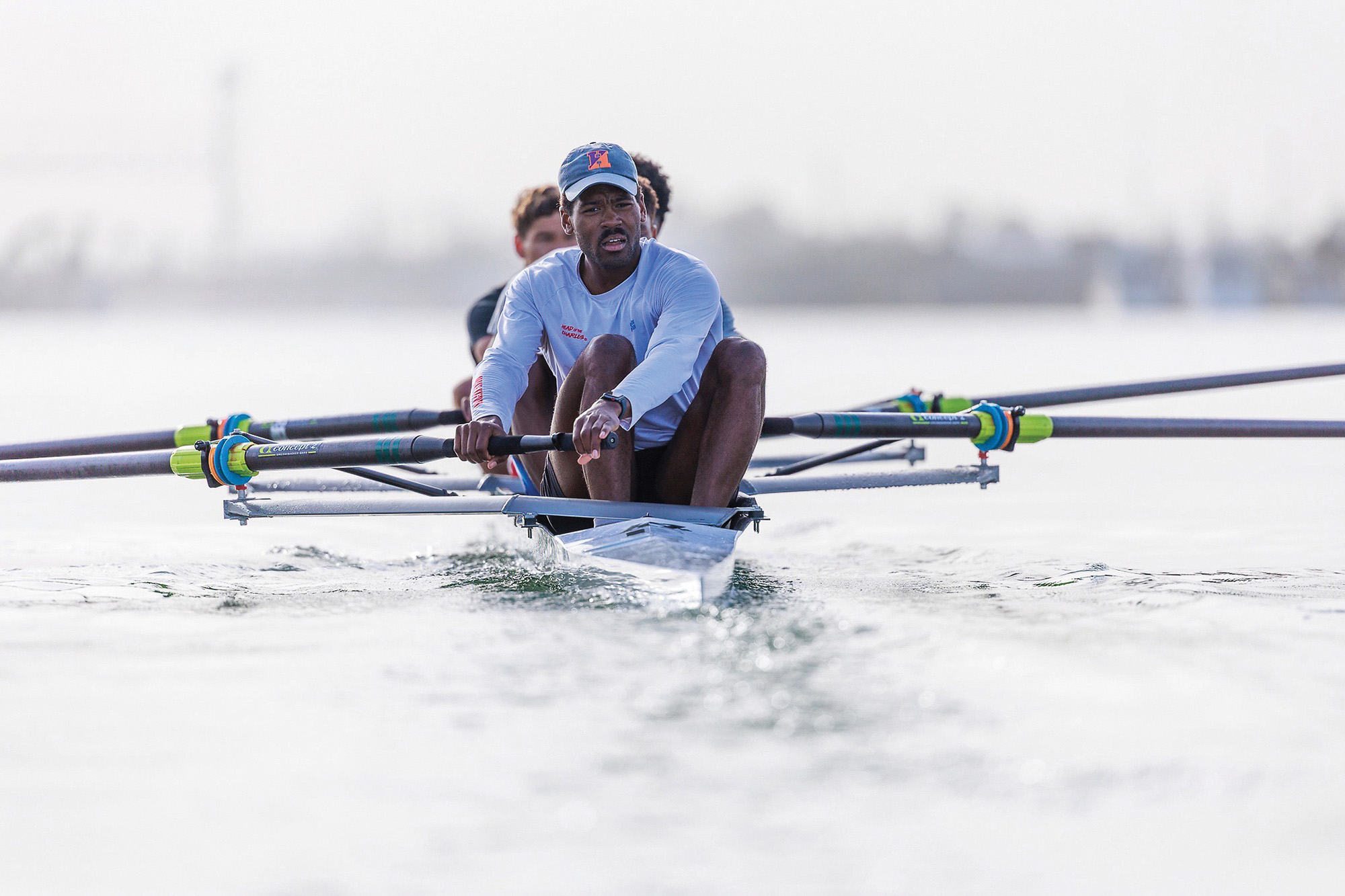
Meanwhile, Cooper connected Conrad Palmer, a promising 6-foot-6 New York City native, to the California Rowing Club in Oakland, where he trained this summer, along with several national team members, under the direction of ex-Olympic coach Mike Teti.
“Conrad is really improving,” Teti said. “He’s a good guy, and I’m hopeful for him. That’s how it works with Arshay. He’ll send us kids. They’ll come out for a week, and we mix them right in with our guys, even Olympians.”
Palmer met Cooper a year after his mother forced him to adopt the sport as a college-application backup to his musical abilities.
“I never even knew anyone who rowed,” Palmer said. “It was an unorthodox sport for New York City, a foreign concept.” So foreign that he hid his participation from classmates.
“A lot of my friends used to call me an ‘Oreo,’” he recalled. “I was the Black guy perceived as White. I didn’t want to feed into that narrative, so I didn’t tell anyone.”
Not long afterward, Cooper visited Palmer’s boathouse. He looked at the long, lean, athletic 10th-grader and told him that if he stuck with it he could become the first Black Olympic oarsman to compete on U.S. soil at the 2028 Games in Los Angeles. (Anita DeFrantz won a bronze medal as member of the U.S. women’s eight at the 1976 Olympic Games in Montreal, becoming the first—and still the only—Black woman to earn an Olympic medal in rowing.)
“Ever since then, Arshay has helped me open doors and get access so I can get closer to making that happen,” Palmer said.
The shining example of Cooper’s dream might be Ella Wheeler. Now in her final year at Cal, Wheeler already has an impressive resume. She won gold at the 2026 World Rowing Under 23 Championships. Earlier, at both the 2022 and 2023 World Rowing Under 19 Championships, Wheeler captured golds in the women’s coxed four.
She met Cooper when she was a student at Northfield Mount Hermon, a boarding school in Gill, Mass., where Cooper is a trustee, with a lot of questions about college.
“When I was getting ready to go to college, I talked to Arshay about various schools,” Wheeler said. “He was able to tell me what he knew about a lot of them and what they would be like for a person of color. Rowing is a very non-diverse sport. But it’s definitely getting better with the help of Arshay. He’s always there making sure that I and the other kids in my circle have everything we need.”
The obstacles AMBTIF is helping communities of color overcome are daunting. The cost of a quality racing shell and a set of oars, for example, can be anywhere from $30,000 to over $100,000. Training equipment like rowing machines and electronics also is costly. Boathouses are often far away and in many areas nonexistent. The best coaches tend to be committed to elite private schools, colleges, and clubs. And many of these youngsters, seldom exposed to pools, lakes, or oceans, have a fear of water.
“A lot of them are like me,” Cooper said. “I didn’t know how to swim. I had no access to water, no access to greenery. But what I saw happen to me and what I still see to this day is what happens to kids who’ve grown up around dirt and concrete when you surround them with water and grass. There’s an environmental wellness, a social wellness, a mental wellness that develops.”
Wellness was hard to come by where Cooper grew up. His West Side neighborhood was afflicted by poverty, gang warfare, drug abuse, gun violence. At one point in the 1990s, one in three teen males there was destined to die before age 18.
“It was a place with a lot of violence, a lot of structural limitations,” Cooper said. “The only sports we had were basketball, baseball, and football. I remember going out for football. I caught my first pass, and the coach yells, ‘Knock ’em dead!’” Everyone tackled me and I wanted to fight. It triggered a lot of trauma because of the neighborhood where I grew up.”
Then one afternoon, Cooper walked into Manley High’s cafeteria and discovered something that would change his life.
“There was this boat in there,” he recalled. “I thought, ‘What the heck is this?’ There was also a TV monitor showing rowing at the Olympic Games. And even though the guys were moving calmly and quickly, I was like, ‘Nah, that’s not a world that I’m used to.’ No one looked like me. I thought, ‘I’m not doing that.’”
A day later, he changed his mind when he discovered the new rowing team’s organizers were offering a free pizza to anyone who signed up.
“So I put my name down,” he said.
Manley’s novice rowers, from different neighborhoods and sometimes different gangs, bonded in what was at first an alien environment. They shared a boathouse at Chicago’s Lincoln Park Lagoon with four all-White crews from private schools.
“We saw them performing and that helped bring out our own competitiveness,” Cooper said.
AMBTIF has raised millions of dollars and in-kind contributions from private donors—from companies like Concept2, Hudson Boat Works, and Rowkraft; from organizations like the George Pocock Rowing Foundation and the Concrete Foundation (created by Dick Dreissigacker and Judy Geer, founders of Concept2, and the official 501(c)(3) fiscal sponsor for AMBTIF). In turn, it provides grants, scholarships, and equipment to schools, clubs, and individuals.
“I want every boathouse to reflect the full diversity of its city,” Cooper said. “Our sport has always recruited great people, but we pulled them from one group of people. There’s talent in every ethnic group. My vision is not to change the sport but to change access to the sport. I still go to places where kids have never heard of rowing.
“But in the end,” he said, “Arshay cannot diversify the sport of rowing; Rowing has to diversify the sport of rowing.”
FRANK FITZPATRICK, a longtime sportswriter for The Philadelphia Inquirer, was a finalist for the 2001 Pulitzer Prize. He covered nine Olympics, including the 2004
Games in Athens when the U.S. men’s eight ended a 40-year drought by winning a gold medal.
