


To continue reading…
This article is exclusively for Rowing News subscribers. For as little as $5 a month, you can get access to the best quality, independent reporting on all the issues that matter to the North American rowing community.
The Mountain Pacific Sports Federation (MPSF) named Michael Callahan Coach of the Year in 2026, but one Ivy League coach still says, “He’s underrated.”
That’s high praise from a member of a fiercely competitive coaching corps that can be less gracious, especially when talking off the record. It’s also probably true.
Callahan’s 2026 University of Washington men’s heavyweight varsity was remarkably successful. That’s why he and his rowers are the 2026 Rowing News Coach and Crew of the Year.
They were undefeated and repeated as IRA national champions. After an historically fast 2025 season, they were even better this year, knocking off the defending Olympic champion British eight and beating the University of California, Berkeley, its archrival, three times.
Callahan, now in his 25th year coaching and The Blake W. Nordstrom Head Coach for Washington Men’s Rowing at the University of Washington—the only place he’s ever coached, after graduating from there in 1996—saw 14 of his former charges race at this summer’s World Rowing Championship, winning 10 medals. That’s the big-boy senior worlds, where crews qualify for the Olympics, not the developmental under-23 worlds (where 10 UW oarsmen also competed).
Coaching peers, including Wyatt Allen, 2025 Intercollegiate Rowing Coaches Association Coach of the Year, say that what sets Callahan apart is his ability to build and run a program comprehensively.
“The sustained success that he’s generated there is a definite tribute to his ability not only to coach but also to build a program holistically, to think about things from every angle, and oftentimes be two steps ahead of the rest,” said Allen, who interned at Washington early in his career and is now the head coach at rival Dartmouth.
“It was a total crash course in collegiate coaching. I couldn’t believe the level of training and execution that went on there, the attention to detail and program building. He thinks about every detail and sets a high, clear standard for everyone involved in their program.”
To see Callahan at the Conibear Shellhouse is to see a man truly in his element. He logs long days, often working late after his rowers have left.
“If you don’t like what you do day to day,” Callahan said, “you probably should do something different.”
Former U.S. Olympic coach Mike Teti, who coached rival Cal from 2008 to 2018, said of Callahan, Allen, and the rest of the top IRA coaches, “I’m glad I don’t have to coach against these guys now.”
The essence of Callahan’s success is his consistent ability to create the fastest eight in our sport while also developing many of the best individual athletes in our sport. He grows both great forests and trees.
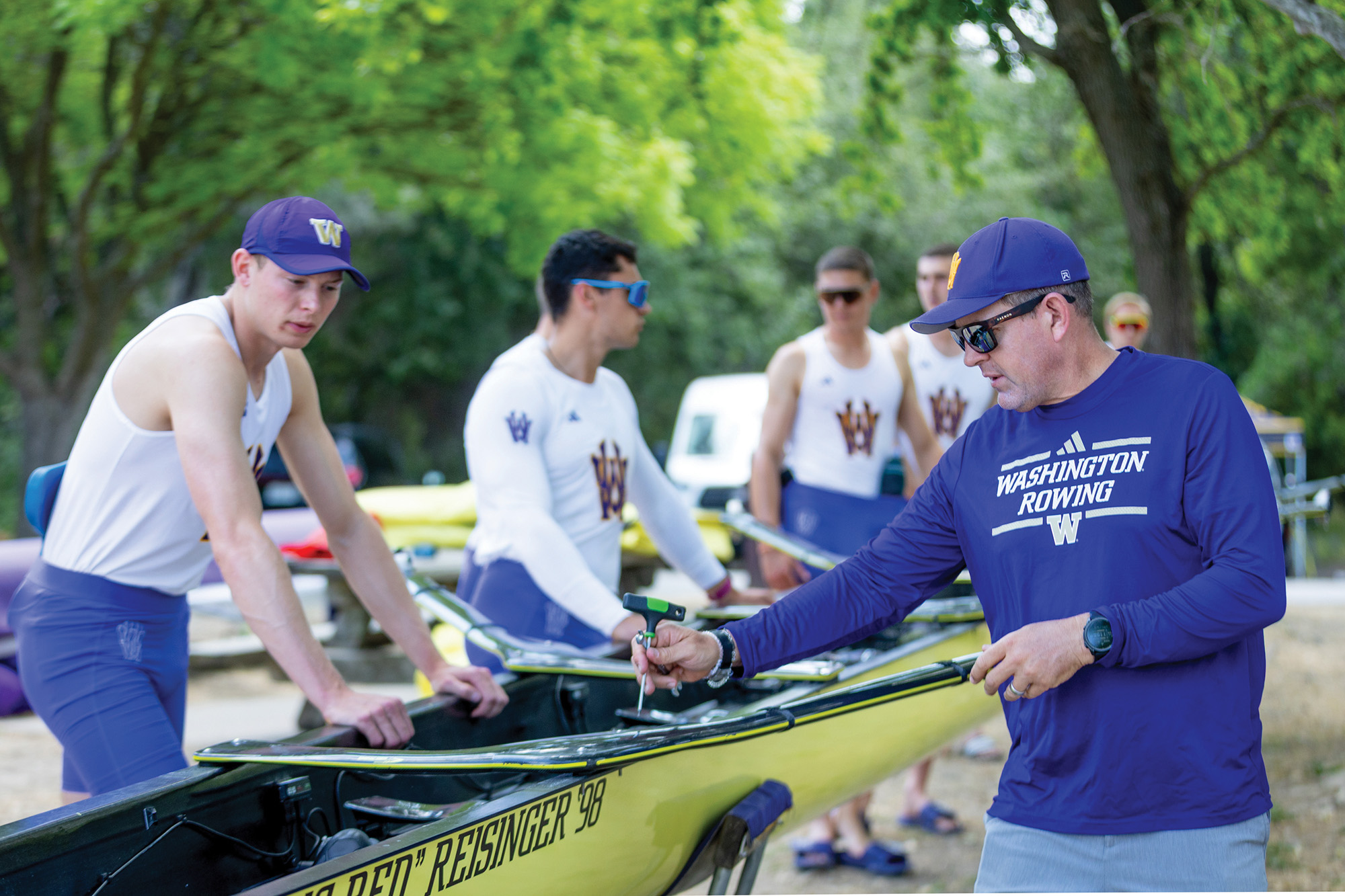
“I try to get people to conform to a group,” Callahan said. “Here’s something bigger than you. ‘The strength of the pack is the wolf, and the strength of the wolf is the pack.’ It’s a bit of a cliché, but you’re doing both at the same time—getting people to conform to a greater group and also figuring out how to maximize each guy.
“I’ve made mistakes, too. We’ve gotten too individual, and it splits the group up.”
The mistakes are few. Callahan was named Pac-12 Coach of the Year an unprecedented 12 times before the league folded, and he has led Washington to 10 IRA national championships.
“Our program is pretty much the same year in, year out, but there are always adjustments. We may row more singles or straight fours or pairs or maybe more RP3 or C2 [ergometer workouts]. We have all these tools at our disposal.”
The 2026 Rowing News Crew of the Year began scripting its legendary year before the real racing season began in March. The Huskies had the fastest collegiate eight and the championship four at the 2025 Head of the Charles in the fall, and two weeks later at Seattle’s Head of the Lake they won all their races.
They launched the 2026 season by winning their third-straight Benderson Cup at Sarasota’s Nathan Benderson Park against some of the perennially fastest programs: Harvard, Brown, Stanford, Northeastern, and Yale, with six of the field at the time ranked in the top 10.
That first—and stiff—competition of the year came at the end of a spring-training trip, which offered the added benefit of preparing for six-lane league- and national-championship racing at season’s end.
“We use it to develop the team,” said Callahan of racing in Sarasota, “to get on lane lines on a real FISA Olympic-level course, which is very valuable for our coxswains.”
A lover of rowing history and the sport’s venerable pedigree (rowing is the original intercollegiate sport), Callahan embraces our sport’s traditions. He coaches from a restored classic wooden launch, often wearing a leather-sleeved letterman’s jacket, and brings several crews—not just the first varsity—to experience Henley Royal Regatta.
He’s no techno-phobe, though. Perhaps no program uses new telemetry technology as much as Callahan’s. He creates his own programs for interpreting data from the Peach system and sends coxswains home with their own copies of software and laptops to learn and create their own. Each seat in a Washington eight might be rigged differently, depending on what Callahan and his staff determine is best for each oarsman.
Callahan has worked with Harvard and Stanford to reestablish dual-crew contests for traditional rowing cups at Nathan Benderson Park, a fair and reliable course in early spring when rivers elsewhere churn with spring runoff. The Huskies won both the Bolles Cup (against Harvard) and the Paup Cup (against Stanford) on a Friday before tying Harvard on points the next day for the Benderson Cup and ultimately winning the tie-breaking varsity eight final by 1.5 seconds.
“I’ve known Michael Callahan since the mid-90s, having the opportunity to coach him in various national-team boats,” said Chris Clark, recently retired Wisconsin coach. “While I knew him as a competitor, I had no inkling of the incredible coaching career to come.
“As well as that has gone for him and UW, it’s Michael’s respect, dedication, and promotion of the entire sport that has blown me away. He understands absolutely how unique and special rowing is and helps spread the gospel relentlessly.”
Washington swept Oregon State in April, two weeks before The Dual at Redwood Shores in northern California against Cal for the Schoch Cup. The importance of that rivalry, which was portrayed dramatically in The Boys In The Boat, can’t be overstated.
“Our histories are tied together,” Callahan said. “We’ve been pushing each other for over a hundred years.”
The Schoch Cup is named after Delos “Dutch” Schoch, UW ’36, an alternate on “The Boys” crew and the father of Fred Schoch, the Washington oarsman who led the Head of the Charles for over 30 years and grew it into the world’s largest regatta.
“I met Mike when he worked for me briefly as an intern, long before he found his path into coaching,” Schoch said. “Mike had a relentless work ethic then, and his Washington crews are imbued with that same trait today. He has also evolved and matured as a coach, which is so important in today’s dynamic environment.”
Part of that evolution has been to embrace fundraising, as college athletic departments cut budgets for seemingly everything that isn’t football, basketball, or directly related (such as women’s rowing, which, unlike men’s rowing, is an NCAA sport and thus counts toward Title IX balancing acts.)
“It’s the most important part of my job,” said Scott Frandsen, head coach of men’s rowing at Cal, of securing funding for his rival program.
Recently, Callahan concluded a successful $10-million campaign that, while not increasing the size of his program (for the first time, the athletic department has instituted roster limits—part of the balancing act), will keep the lights on at the most successful men’s program of the past two years.
Washington circles the date of The Dual every year, making it, along with the IRA national championship, one of the two peak regattas of the season.
“The quality of intercollegiate racing is really high now,” Callahan explained. “It takes a big toll on the student-athletes. We are teaching them to try to race at their best ability each weekend but we definitely have to circle a few days on the calendar when we really want to have our best, our maximum performance.”
First contested in 1903, The Dual this year featured an incredibly fast Cal program that put 17 oarsmen on 10 different national teams at this summer’s World Rowing Championships. Last year, white-cap conditions in its semifinal had denied the Golden Bears’ varsity an anticipated rubber match in the grand final of the 2025 IRA National Championship. Cal won the 2025 Mountain Pacific Sports Federation (MPSF) league replacement for the Pac-12 championship after Washington had won The Dual. This year would be Cal’s chance to settle unfinished business.
The varsity race was a thriller, with Washington holding off Cal by half a length at the line. UW also won the second varsity race, but Cal prevailed in the third and fourth varsities as well as the freshman race. (Washington and Cal still race freshman crews and develop walk-ons into national teamers.)
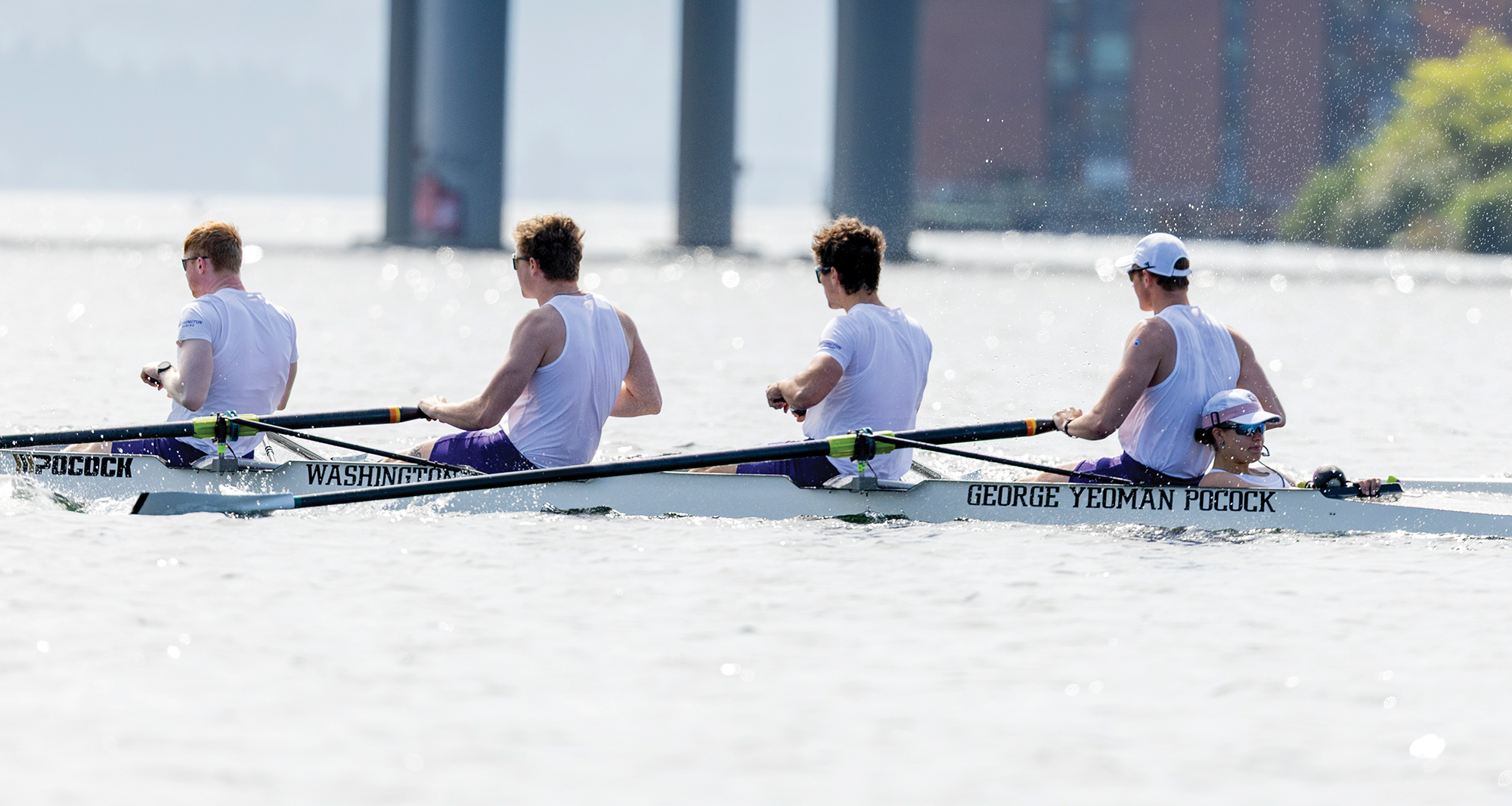
Then, in May, at the Windermere Cup, a Seattle regatta started in 1987 by Windermere Real Estate founder John Jacobi to celebrate opening day of the boating season, Washington hosted Great Britain’s men’s eight, defending Olympic champions with six oarsmen from the previous year’s crew on board.
The Husky varsity, with two British oarsmen, trailed Northeastern off of the start, then took the lead, and managed to hold off GB, aided by a pair of UW alumni, by a whisker.
“Maybe our best race of the year was actually the Windermere Cup,” Callahan said. “There’s nothing to lose. We’re racing a national team, and then Northeastern was there, and we knew they were quite strong, too. It was a race where the pressure was off, so we could race completely unhindered and just see what we could do.”
All that remained for Washington’s extraordinary year was a defense of its IRA national championship. The racing on Sacramento’s Lake Natoma didn’t disappoint, and in the grand final Cal earned accolades for its relentless attack. It wasn’t alone, as Princeton, and then Harvard pushed the pace, followed by Dartmouth and Stanford, to a point that tested Washington not just in the final but through the entire regatta.
Entering undefeated and as defending champions and victors over the British national team, Washington faced tremendous pressure.
“I’m sure everyone wanted to take us down,” Callahan said, “and people threw an amazing final together. Going through the thousand, you have four boats across. And then 500 meters to go, it probably could go a lot of different directions.”
In the final 500 meters, Cal summoned a valiant effort and again challenged Washington. And again it was the Huskies first across the line—as it was in every race this undefeated season, a season during which they won their 22nd national championship and captured the James Ten Eyck Trophy for team points for the 20th time.
“It’s just one of those magic crews,” Callahan said. “They believed in each other and, under a lot of stress and pressure and challenge from other teams, they responded. They’re outstanding champions.
“I told them on the bus as I rode home with them, ‘The saddest thing about this whole thing is I won’t be able to see you guys row again.’”
CHIP DAVIS is the founder and publisher of Rowing News. An oarsman from birth, he rowed on championship crews at St. Paul’s School and Dartmouth College, where he captained the lightweights. Now he sculls in Vermont when the weather is suitable and ergs the other half of the year.
