

To continue reading…
This article is exclusively for Rowing News subscribers. For as little as $5 a month, you can get access to the best quality, independent reporting on all the issues that matter to the North American rowing community.
Already a subscriber? Login
By Terry Galvin
Darrel Davidson is lucky his heart stopped at the finish of a race at the Sarasota Invitational Regatta at Nathan Benderson Park – if it had to happen anywhere.
He suddenly pitched forward, unconscious and not breathing Feb. 23 after the eight in which he was rowing crossed the finish line at the Sarasota, Fla., rowing venue. His chances of survival were terribly low, but safety procedures in place for all events at NBP helped make it possible.
Statistics show that only 10 percent to 14 percent of people who receive CPR outside of a hospital setting survive. But because of the park’s precautions and a few lucky breaks, Davidson lived to turn 72 during 18 days of treatment and rehabilitation at Sarasota’s Lakewood Ranch Medical Center.
As the chief medical officer at NBP, Dr. Joanne Fava, put it: “The stars were aligned” for Davidson, who suffered the most serious incident to occur during an NBP event since it began holding regattas in 2009.
But the stars had to be there first, and NBP has a few of them. His survival was largely due to the park’s staff and its efforts to keep the venue safe for the tens of thousands of athletes who participate in events there yearly. Fava has been instrumental in those efforts since 2010, first as deputy to Dr. Valli Gambina, then as chief starting in 2019.
The park, owned by Sarasota County and operated by the nonprofit Nathan Benderson Park Conservancy, holds hundreds of events a year, many of them on the 2,000-meter, fully buoyed racecourse that has made it the top rowing venue in North America and one of the best in the world. Rowers competing in regattas there range from middle school students to athletes in their 80s.
About 30 events the park hosts each year attract more than 3,000 people each, Fava said.
The largest annual event is the USRowing Youth Nationals, a four-day competition held at NBP since 2019, except the Covid year of 2020. That event brings in more than 4,000 youth rowers, plus 1,000 coaches and 5,000 spectators, for a total of around 10,000 people, according to USRowing.
Youth Nationals is held at the end of the school year, which is also the hottest time of the year, so the emergency medical staff is on high alert for heat-related medical issues, Fava said. The park plans shade structures and hydration areas this year.
Standard NBP emergency precautions
“My focus at NBP has always been on keeping our athletes safe both on and off the water,” said Fava, who has created medical plans and been part of medical support teams for sports events internationally, including Olympics qualifiers, in a variety of sports. Fava’s position as a member of the Nathan Benderson Park Conservancy board shows how seriously the park’s leadership takes her role.
She said she employs best practices based on a national governing body’s requirements and tailors the number of medical staff and the amount and type of equipment to the size and conditions of each event.
Standard safety precautions Fava and NBP staff take for events include:
- Paramedics and EMTs are posted in two medical tents, one near the launch-and-recovery docks and one near the finish line.
- Basic Life Support and Advanced Life Support equipment and medications are on hand.
- Five automated external defibrillators (AEDs) are placed throughout the venue.
- A volunteer position, called Hawkeye, is stationed on the sixth floor of the Nathan Benderson Family Finish Tower to keep watch over the entire lake, especially the return channel, and equipped with a radio to call in any issues they see.
- A designated medical launch boat patrols the finish area to help extract from the water or a rowing shell any athletes in distress and bring them to medical staff stationed nearby on the shore.
- A medical dock near the finish is dedicated to receiving any athletes brought ashore.
- Emergency golf-cart lanes are marked on Regatta Island during events.
Having EMS on site and Lakewood Ranch Medical Center 10 miles away helps ensure the best continuum of care for people suffering medical emergencies at the park, Fava said.
The Safety Squadron
In another effort to ensure the well-being of athletes at the park, its staff realized about five years ago that the volunteers who drive motor launches for officials and to respond to on-the-water emergencies needed training to do their jobs well. Before, as at many rowing venues, just about anyone who volunteered and said they could do the job would be handed the keys to the boats.
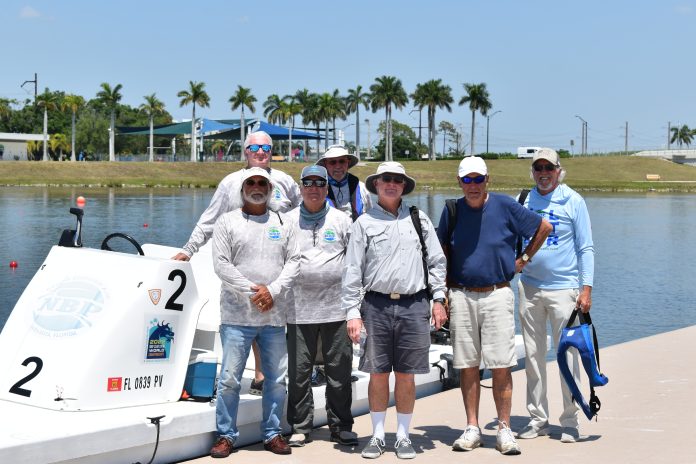
NBP formed a Safety Squadron to check out and train launch drivers. Although it continues to have to work to recruit and train enough volunteer drivers, it has succeeded in forming a corps of people with boating experience who are trained in the specific skills necessary at the venue’s events.
The group, led by Mason Johnson, NBP programs and aquatic manager, emphasizes past boating experience in selecting people to train. Prospective drivers must go out on the water with experienced trainers before they’re added to a list of people approved to operate the boats.
Trainers stress safe boat handling and the need for teamwork with event officials, whether at rowing events or at the venue’s growing number of dragon boat and other paddling events, plus triathlons and open-water swimming competitions.
Johnson, NBP volunteer coordinator Renee Chacon and a Squadron volunteer send emails to members before every event with information about the competition, from the big picture to details such as traffic patterns and the amount of time between races.
“It is a gift to have such well-trained boat drivers,” said Debbie Grossman, who has worked at many regattas at NBP and elsewhere in her 36 years as a USRowing referee. “In the unfortunate event of an emergency, the referees can feel confident that the NBP launch drivers will know what to do.”
What went right for Davidson
Davidson’s heart attack happened as he sprinted to the finish in a hotly contested race. It was the third race of the day for the Vero Beach, Fla., resident, who said he was accustomed to rowing three times a week.
Several factors added up to make Davidson’s survival possible. Because his feet were tied in the boat’s shoes, he didn’t fall completely out of the boat when he suddenly lost consciousness and pitched forward, half out of the boat. With the help of other rowers in the eight, one of the park’s Safety Squadron launch drivers was able to get him out of the boat and to shore quickly. One of the rowers in Davidson’s boat was Dr. Rodrigo N. Banegas, a Palm Beach orthopedic surgeon, who began chest compressions on the short ride to shore, where emergency medical staff were waiting.
The emergency medicine specialists continued chest compressions and used an AED, oxygen, medications and other equipment and supplies. They later received Phoenix awards from the Sarasota County Fire Department for their successful efforts.
The Lakewood Ranch Medical Center ER was ready to receive Davidson before the ambulance had even made the trip of less than 10 minutes from the park.
At the medical center, highly rated for its ability to care for heart-attack victims, Davidson’s heart continued to need restarting. The head of the hospital’s cardio catheter lab was working that Sunday afternoon, and he and his team were able to quickly correct the blockages that had stopped Davidson’s heart.
Reached by phone on April 16, only a month and a half after his heart attack, Davidson was at Costco shopping with his family. He sounded impatient with the pace of his recovery.
“Compared with any other illness and sicknesses I’ve had, this is the slowest recovery,” he said. He added that he still gets tired quickly and has lost 20 pounds, including so much muscle mass that “I look like a shriveled-up weenie.”
The retired carpenter, who sounded like someone who’d always taken pride in his strength and fitness, said he has been rowing for less than two years and had suffered a previous heart attack.
He said he felt pain in his back in January 2023 after getting home from a bicycle ride.
He said it turned out to be a cardiac event. Doctors found two blockages but said they weren’t serious enough to require stents. Since then, he’s exercised frequently and began rowing but did not continue checkups with cardiologists because they wanted to put him on a statin to lower his cholesterol levels and a blood thinner. He felt fine, he said, continuing to row regularly.
At a master’s regatta in May 2024, he had his first experience with rowing in a race, which was something of a revelation.
“At race pace, when you are going all-out for 1,000 meters, it’s a whole different level of effort,” he noted.
He said his heart attack at the Sarasota Invitational might have been due to the cumulative effect of doing three races in one day. “If I’d done only two ….”
Terry Galvin is a longtime volunteer at Nathan Benderson Park and a member of its Safety Squadron.
