

Newton’s first law dictates that the rower-boat-oar system can be propelled only by external forces. All forces within the system—be it on the footstretcher, the handle, the seat, or the oarlock—cannot change the movement of the overall system unless force acts on the blades.
To continue reading…
This article is exclusively for Rowing News subscribers. For as little as $5 a month, you can get access to the best quality, independent reporting on all the issues that matter to the North American rowing community.
Already a subscriber? Login
From a stationary position in the middle of a windless lake, you can demonstrate the most beautiful rowing technique and generate huge forces on the footstretcher, handle, seat, and oarlock and the boat will not move as long as the blades do not touch the water. In other words, the all-important propulsive force—the resistance of the water—acts only on the blades, which is why they’re so important.
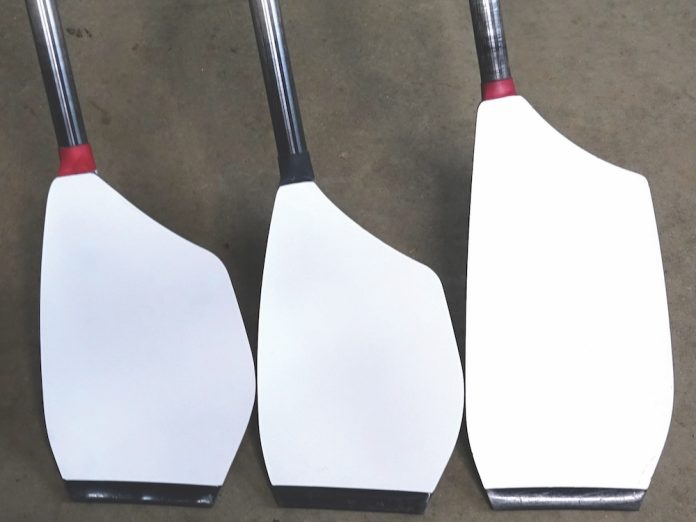
Blades have changed radically in recent years. So many blades are on the market that it’s hard to keep track of what’s out there and what’s best to use for all the different rowers in a club. Oar blades differ not only in shape, curvature, and edges at the top and front ends but also in face area.
Rowing blades used to be narrow and long before they became wide and short. Then they changed from a symmetrical, tulip-like shape to an asymmetric, more rectangular design as surface area increased. All things being equal, an increase in surface area leads to a linear increase in the force generated by the movement of the blade against the water. Simply put, the greater the surface area, the greater the force, which is what we want to achieve. Hence the advent of the Macon Blade, the Big Blade, the Slick Blade, and the FatBlade.
In designing the new generation of oars, other factors also were considered. For example, oars were made shorter to ensure that the end of the blade closest to the shaft does not move against the water, creating drag instead of propulsion.
Each new blade design has its theoretical advantages, but rowers must adapt their technique to get the best out of it, and for many athletes each new shape can present more challenges than potential improvements. It takes more effort and skill to get larger blades in and out of the water, especially with stroke rates that seem to be reaching new highs in racing, let alone in tricky wind and wave conditions.
In addition, larger blade areas, and the associated higher forces, require shorter outboard lengths, which present another technical challenge, namely balance. More complex rowing and rigging bring a whole new dimension to decision-making. Despite the well-documented advantages of FatBlades, most rowing programs have stuck with Smoothie and Slick-size blades.
We have reached the limit, it seems, in increasing surface area. The COMP and APEX-R designs, in shortening the blade length, actually reduce blade area and the force such blades can generate. This is the first time in many years that a new design has gone in this direction, which runs counter to achieving greater water force. Oar manufacturers are trying to compensate for the loss of blade area by increasing efficiency through a leading-edge design that improves hydrodynamic flow and curvatures of the blade surface that make rowing more comfortable.
As faithful readers know, I’m a big fan of increasing the blade area and simultaneously shortening the outboard. When the new COMP blades came onto the market, they seemed at first glance to contradict this idea. Testing showed that the larger surface area of the FatBlades remained an advantage, but the improved efficiency and comfort of the COMP design were intriguing. How would a blade with the new features and a larger surface area perform? This could be achieved only by increasing the width of the blade, since the length, determined by the permanent connection to the shaft, was fixed.
The obvious next step was to ask Concept2 to build such a blade, which I called COMPx because of its large width and surface area. This blade, with the necessary shorter outboard, worked as expected in terms of increased blade force, at least at low stroke rates. The limits—or rather my technical limits—became apparent at high stroke rates, such as a full-out start. I wasn’t able to square the extra-wide blade fast enough to get it into the water cleanly, and the result was some strokes that were very erratic. I guess I need to improve my technical skills if I want to keep up with these cutting-edge developments.
The bottom line is that with modern materials and know-how it’s possible to build blades that push the limits of the size of their surface area. But it’s another matter altogether to keep such blades rowable. It’s not just about pushing through engineering limits; we also need to devise new rowing techniques to make the most of these technological breakthroughs.
