

To continue reading…
This article is exclusively for Rowing News subscribers. For as little as $5 a month, you can get access to the best quality, independent reporting on all the issues that matter to the North American rowing community.
Already a subscriber? Login
By Mike Jensen
A million meters on the erg?
In one summer?
That sounds like a goal too far, a torture too cruel. Just break it down, though. And add an incentive. Take that ergometer for a 10,000-meter ride every day, for 100 days, don’t miss a day, and you’ll get your million.
That’s what Temple men’s rowing coach Brendan Cunningham did the summer before his junior year at the school where he now coaches. The challenge was presented to him by an older brother who had preceded him in the sport.
Brendan’s father had just died that spring. Brendan was drifting a bit. Gavin White, Temple’s legendary coach, saw that, and also saw potential. He was thinking about giving Cunningham some scholarship money. Brendan’s brother Luke presented Brendan the challenge: Go a million meters on the rowing machine that summer, and Luke would get him a PlayStation.
“When he came back to school, his roommates had a PlayStation,” Luke said.
“It was a great deal for my roommates,” Brendan said.
Better yet, Brendan had a spot in Temple’s first varsity eight, plus some scholarship money.
He hadn’t been averse to the work required by the sport. His high-school coach, Dave Krmpotich, had won a silver medal at the 1988 Olympics and would bring his own pre-Olympic workouts to the boys for their winter workouts. If that seemed insane to them, they took pride in the insanity.
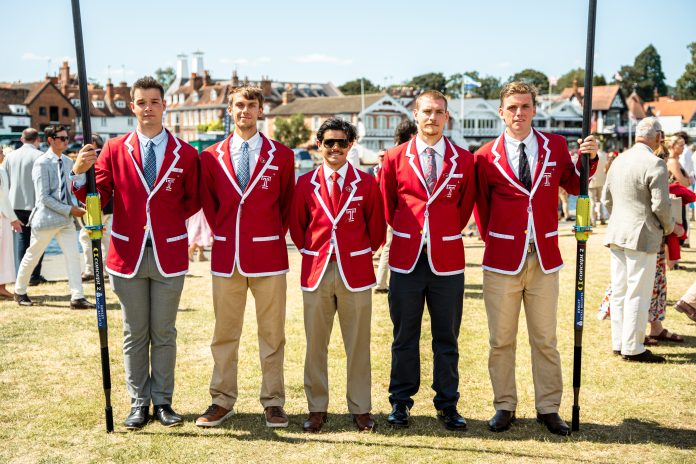
So Cunningham, entering his second season as Temple’s coach last fall, knew the value of setting distant goals. In 2024, one of his rowers, Ryan Yates, had texted Cunningham and asked him what it would take for them to go to Henley the next year, to row in the Henley Royal Regatta.
The coach texted back, “Win Dad Vails.”
That used to be a regular thing—Temple’s men dominating the varsity eight in the big local race of the year. Walk in what they call the Great Room, the lobby of the East Park Canoe House, just below the Strawberry Mansion Bridge along the east bank of the Schuylkill River, there’s a banner noting Temple’s Dad Vail Varsity Eight Championships. Every year from 1983 to ’87, missing in ’88, then every year from 1989 to 2001. Another miss in 2002, then titles in 2003 and ’04.
Then there was a drought.
Brendan was there early in the drought, and experienced the reason for it.
“We were in the boathouse for the first fall. Then that winter, Gavin was like, ‘We’ve been evicted,’”Cunningham said.
Evicted? The building had been condemned. The rowers had noticed—but had not really cared—how their cramped space was, in fact, falling apart.
“I remember being up there, you’re doing ergs, you couldn’t see the walls; there would just be dust,” Cunningham said.
For the rest of his time (and quite a few years thereafter), Temple would row out of tents in the parking lot.
“There’s no porta-potties, so you make do,” Brendan said of the years under the tent. “You don’t know any better. Gav always found a way to make it feel like a great experience.”
But years in the tent, and then their dock falling into the river so they had to walk the boats farther down river to launch them—it all took its toll. Recruiting grew more difficult.
Eventually, new administrators took over at Temple, all out-of-towners, and looked at the books. They decided some sports had to be cut. They looked at everything like they were outside business consultants and they decided rowing would be one of the sports to be axed.
I was writing for The Philadelphia Inquirer at the time and I got in Gavin White’s car right after he was told rowing was done. White was in shock, just short of a rage, but he also told me the sport couldn’t keep going the way it was being neglected.
The outcry, however, was such that the sport was saved; that’s how it works sometimes. No one pays attention until it’s going to be gone. A benefactor, Gerry Lenfest, wrote a big check to restore the boathouse, which is how the years 2018 and 2021 were added to that Dad Vail banner in the lobby.
But what about 2025? Could they get to Henley?
Cunningham’s own journey began by watching two older brothers rowing on the Schuylkill for Monsignor Bonner High. Dan had been the first to row, and the first to spot a path to college, St. Joseph’s in his case, where he was eventually a captain. The commitment began in the morning.
“You need at least nine people to show up at 5 o’clock in the morning for practice that’s 30 minutes from the high school,” Dan Cunningham said of rowing for Monsignor Bonner, located in Upper Darby, just outside Philadelphia. “We never had anybody miss in four years.”
Next was Luke. First, Luke thought he was a basketball player, and that’s what he began playing at Bonner. In the summer, some of the best games were at the public courts in Narberth, a suburban borough near the city. Luke didn’t pay much attention to the competition. He just knew how to be a wiseass, even guarding the best guy on the other team. That guy’s dad played in the NBA? Luke trash-talked his man by saying he heard the dad wasn’t that great.
The other kid apparently took that a bit personally. Kobe Bryant didn’t just block Luke’s shot. He caught it and threw the ball over the fence into the adjacent playground.
It was the last straw for Luke. Then and there, he decided that maybe his brother’s sport might be a better fit. Sure enough, he proceeded from Bonner to become an all-Ivy rower at Brown. (His wiseass ways have served him well, too, as a standup comedian; a staff writer at The Tonight Show, writing jokes for Jimmy Fallon; and lead writer for the VMA Awards and the ESPYs.)
As important as Brendan’s brothers were his coaches. One of the Bonner coaches, Mike Cipollone, was the father of 2004 gold medal-winning Olympic coxswain Pete Cipollone. In addition to head coach Krmpotich, there was the coach’s brother, Jim, who was always there helping out. The brothers grew up rowing in Duluth, Minn.
“I think he lived over in East Falls,” Brendan said of Jim Krmpotich’s taking charge of winter workouts, including on snowy days. “We were always like, Is school canceled? But practice would never be canceled, because Jim Krump would be able to drive his little Honda Civic to Bonner, and that meant you had to figure it out. If your parents couldn’t drive, you had to walk through the snow. You had to get there. That was the template you had to work off.”
Running the hills over at Cobbs Creek golf course was part of the winter workout, just a little warmup. The course was a couple of miles from the school.
“You’d run over, run the hills, like 10 up-and-downs, then you’d run back, and that was before school,” Cunningham said.
Dave Krmpotich would be out there with them.
“I never saw him wear gloves, ever in my life,” Brendan Cunningham said. “If it was really cold, he’d put socks on his hands. He was just tough as nails. He’d do the warmup runs with us, and beat us. He would do workouts on the erg, and beat us. It was a thing to try to beat Krump. You would hear stories. I think he ran the loop (around the Schuylkill River) one time, got hit by a car, finished the workout, and then went to the hospital.”
“Dave Krump, he never chased you to be at practice,” Luke Cunningham said. “He never pursued you to be on the team. If you’re here, I’m going to work you. How much work can you deal with before failure?”
Since Dan was the first Cunningham to row, Luke went down to the river to watch. He remembers their dad talking about how the rowing races used to be a big gambling enterprise. “Before the NFL, there used to be 100,000 people at the river.”
Luke thought the whole sport seemed kind of glamorous. He envied his brother.
“I very quickly figured out he was out of the house at 4:40 in the morning,” Luke said.
Brendan thinks about it still, ninth-graders being sent out to a busy river in the pre-dawn—crazy! But he turned out to be the lifer. By the time he was done rowing at Temple, Cunningham decided he’d try to emulate Krmpotich and Gavin White’s booming voice from the launch and get into coaching himself. His first stop was at Washington College in Maryland for two years as a graduate assistant.
“I worked for the guy who wrote The Nuts and Bolts Guide to Rigging,” Cunningham said. “Mike Davenport. I knew how to rig and de-rig a boat. I knew to make sure the nuts and bolts were tight. But I didn’t know much about how the pin could move in, the pin could move out, how to change the gearing, how to change the loading. It was just interesting to know if you have two people of different sizes, you can rig differently to get maximum boat speed.”
Next stop was another volunteer gig—at Yale.
“I want to see what it’s like at the top level,” Cunningham said, recalling his pitch.
“Great,” he was told. “We can’t pay you.”
Steve Gladstone, Yale’s head coach at the time, is on every short list of the top American coaches in the history of the sport, in addition to being so respected that he was named athletic director at Cal while coaching in Berkeley.
At Yale, Brendan wasn’t treated as a mere volunteer; he was considered part of the team, and Gladstone understood he was there to learn everything. One gathering, Brendan was told to go sit with the board of directors of the rowing program, to take in their conversation, since he’d be dealing with the money someday if he stayed in the sport.
Gladstone was way ahead of the curve in figuring out that there were ways to measure a recruit objectively, once all ergs produced uniform times. He’d demand a recruit produce a time in competition so it could be believed, but that competition could be anywhere in the world.
After his apprenticeship at Yale, Cunningham was hired as a full-time assistant at Penn, then moved to Drexel, where Paul Savell’s program had become dominant at Dad Vail. A big takeaway from Savell: Talk to these kids, all the time. They’re college students; they want to hear from you.
“You could not have produced a better pedigree of coaches to produce Brendan,” said Luke Cunningham, who’d been an assistant coach himself at Columbia and UCLA while pursuing his full-time career in comedy.
Just inside the Temple rowing office is a cheap version of a WWF wrestling belt. Whichever Temple rower has a big day on the erg, he gets to wear the belt. Luke’s idea. Just to keep things fun while they’re doing the work.
Do they wear the belt proudly?
“Uh, they put it on,” Brendan said.
“He has ways to motivate each rower individually,” Yates, now graduated from Temple, said of Cunningham. “He tries to figure out how each person is motivated, and uses that to motivate them.”
The first varsity eight had more incentive. They’d caught wind of a documentary being made about Philadelphia collegiate rowing. They’d heard the filmmakers were hanging around Drexel and La Salle, which had finished 1-2 the year before, with Temple third, less than a tenth of a second behind La Salle.
“We were upset about the film,” Ryan Yates said of the documentary, It’s a Philly Thing.
What’s more of a Philly thing than a grudge fueling your own work? They compared themselves to the Eagles a lot, said coxswain Grace Crosby, combining an underdog mentality (“especially compared to the elite kids on Boathouse Row”) with a belief they were ready to win the big races.
The spring season proved their readiness, with Temple finishing on top of La Salle and Drexel just before the Dad Vails, which were over in South Jersey on the Cooper River again.
“We knew we had to come out swinging and keep going,” said Kevin Harvell, in the five-seat in last year’s varsity eight. “We had a powerful jump.”
Get the bow in front, stay in front, right to plan. They were in front for the first half of the race, but La Salle wasn’t rattled. They were coming fast.
“We were neck and neck for a long time,” Yates said. “To the very end.”
After the race, Yates said, it was a heart-racing two minutes.
They could see folks in Temple colors celebrating on the banks of the Cooper, but that’s not confirmation. Crosby, the coxswain, wanted to tell them they’d won, but she had stayed focused on her own boat until after the line. She didn’t want to say anything to her rowers until she knew for sure.
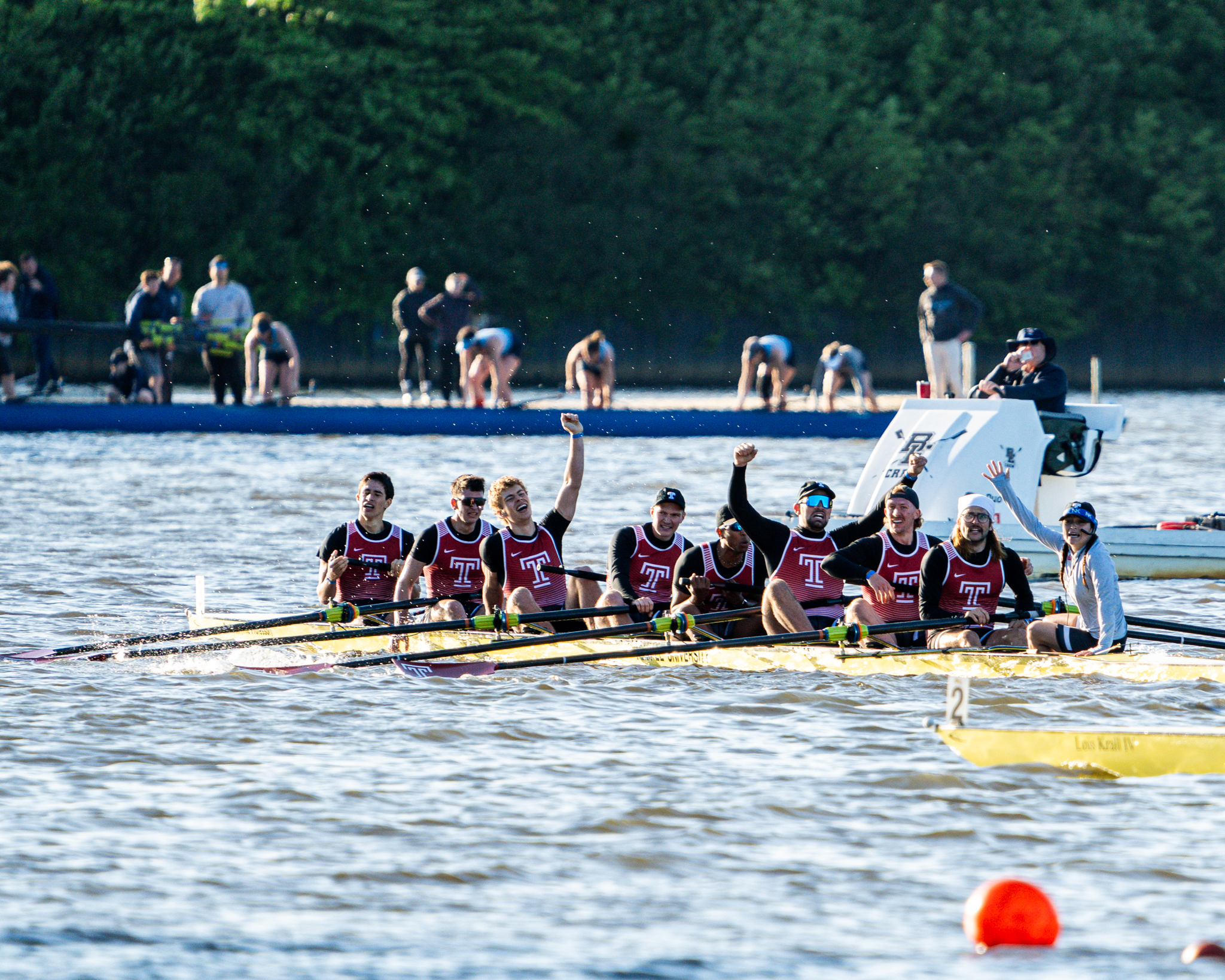
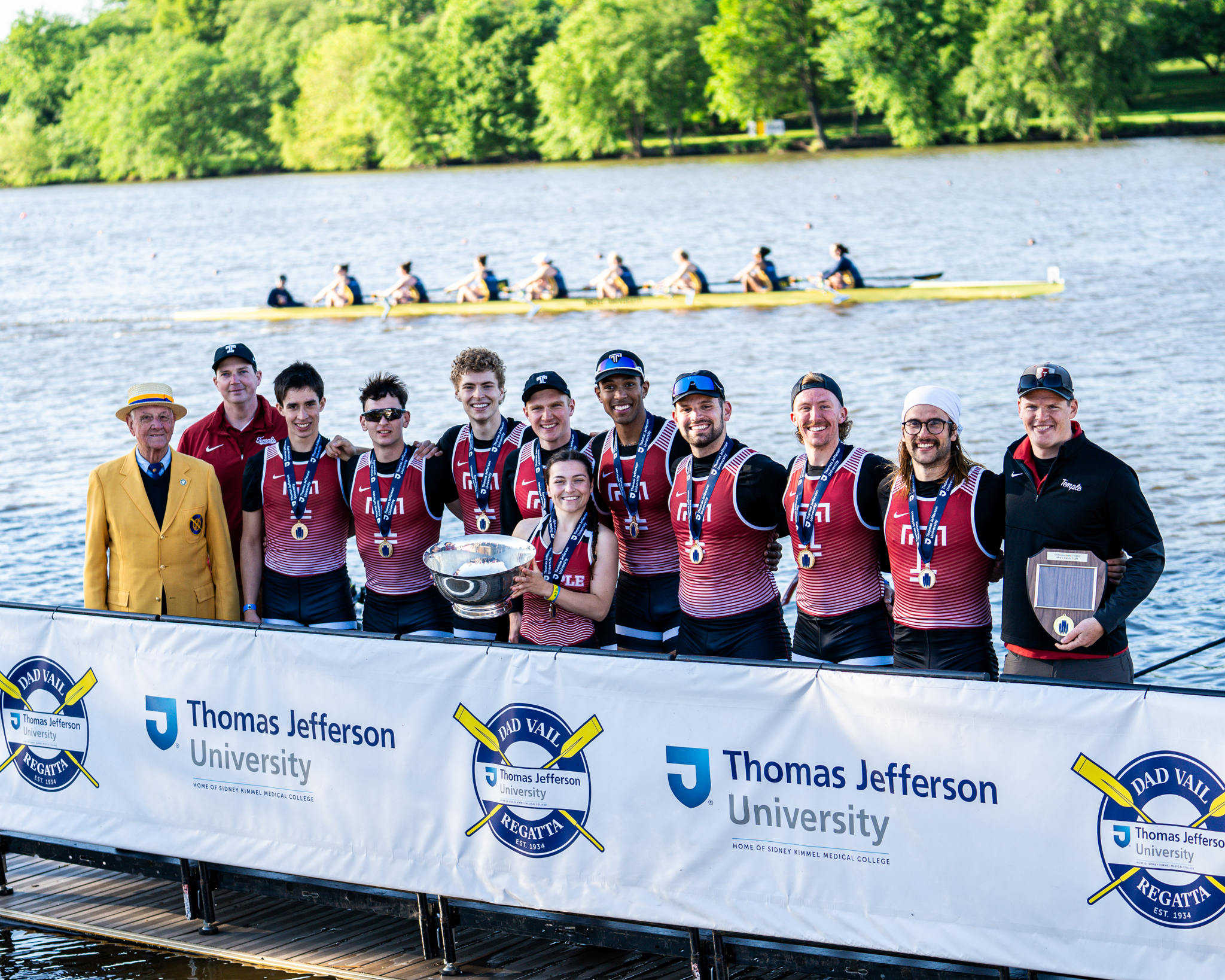
She called over to Cunningham. He confirmed it was official. Temple finished in 5:37.711, with La Salle clocked at 5:38.073.
At the dock, celebration in full swing, Temple’s coach saw Yates and brought up their exchange of a year earlier. They hadn’t spoken about it since the texts.
“You know what this means?” Cunningham said.
“Henley,” Yates said.
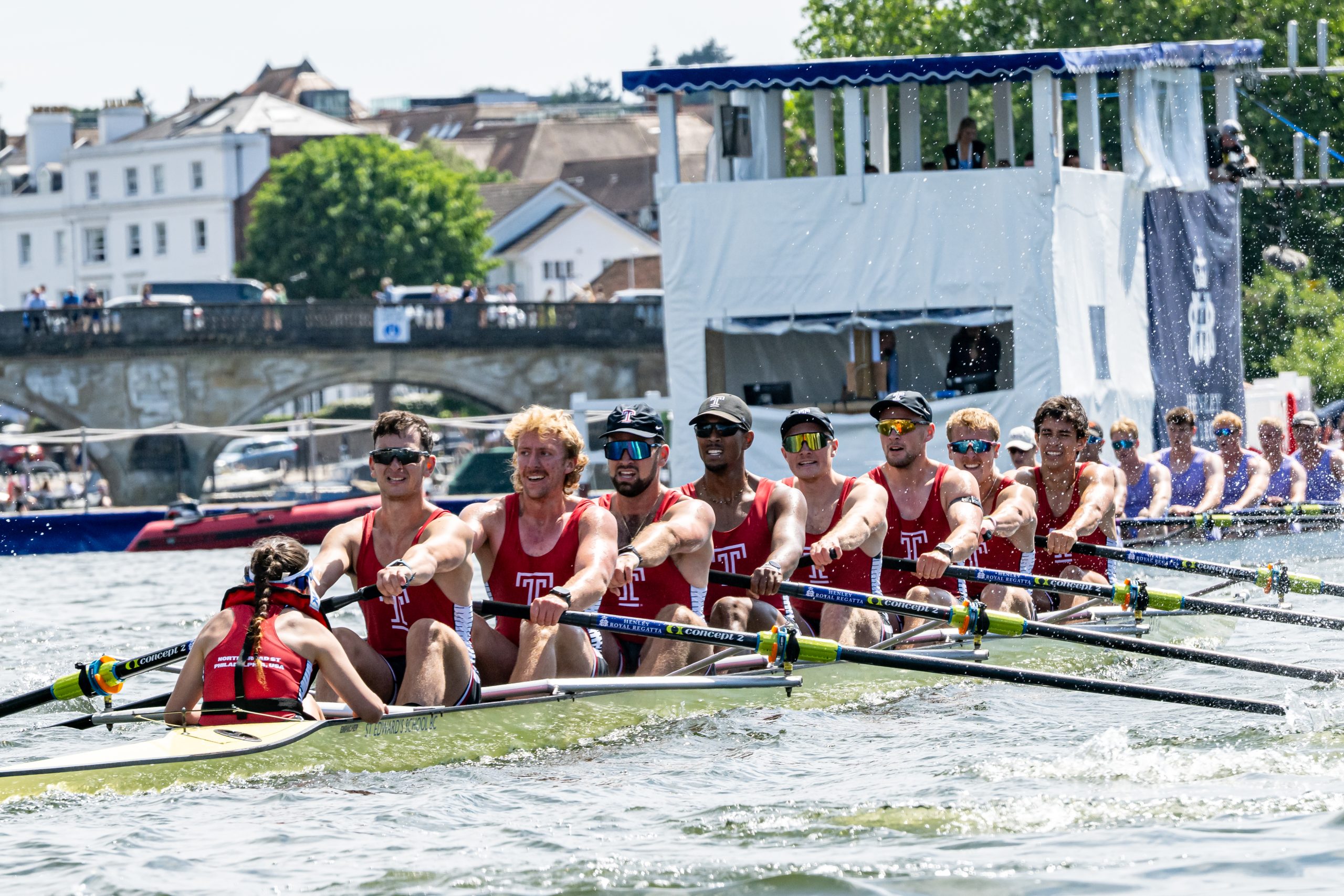
The coach nodded. For this program that had survived a boathouse eviction and the threat of being terminated permanently, and this coach who had jump-started his own path with a million meters on the erg, the 2025 season was not over.
It would end on the River Thames.
Mike Jensen wrote for The Philadelphia Inquirer for 35 years and was named Pennsylvania Sportswriter of the Year in 2023. He covered rowing on the Schuylkill River and at the Beijing Olympics and wrote the weekly Merion Mercy Academy crew newsletter for seven years while two of his daughters were champion rowers at the school. His book, Philly Hoops: How Philadelphia Transformed Basketball, will be published in late 2026.
