

To continue reading…
This article is exclusively for Rowing News subscribers. For as little as $5 a month, you can get access to the best quality, independent reporting on all the issues that matter to the North American rowing community.
Already a subscriber? Login
The pay of head rowing coaches varies widely—from less than $50,000 to over $300,000–surveys by the sport’s two coaches associations show.
Division I NCAA women’s head coaches make more (median pay: $107,499) than IRA heavyweight men’s head coaches (average $85,000 to $99,000).
Power 4 conference (Big 10, Big 12, ACC, and SEC) women’s head coaches were paid even higher salaries, with median compensation of $137,499. Median pay for NCAA Division II head coaches was $54,999, and higher for NCAA Division III head coaches at $72,499.
“We do these surveys as a service to our members and the sport in general,” said Chris Clark, co-president and co-founder of the Intercollegiate Rowing Coaches Association, for men’s coaches. “Without them, it’s an opaque market—to the disadvantage of the coaches.”
The survey by the Collegiate Rowing Coaches Association, for women’s coaches, received 73 responses, with 62 disclosing salary data. The IRCA survey collected responses from 55 institutions, representing 95 percent of the association’s membership, with 46 completing the full survey. Many coaches’ salaries and contracts are public information, available online and through information requests and reporting services.
“Things being more public is only good, for the coaches,” said Texas head coach and CRCA board member Dave O’Neill, “even if it’s uncomfortable.”
Most of the coaches contacted about the salary surveys were unwilling to comment on the record—a reflection of the sensitive nature of the subject as well as the tendency of rowing coaches to avoid controversy. Many head rowing coaches consider their positions dream jobs unlikely to be improved by change, although many complain about the low wages.
Each survey broke down pay by position—head coach, associate head or first assistant coach, and third assistant—and conference. Benefits like health insurance, retirement plans, and leave were common among all leagues and both surveys. Club memberships and cars were among the benefits listed in coaches’ contracts, as were additional job responsibilities, such as meeting with local businesses and running summer camps.
The CRCA survey did not address funding sources, while the IRCA survey noted a variety of ways coaches get paid, commonly through booster, alumni, and charitable family foundations.
Last year, the eventual national champions lost their regular-season contest against their bitter rivals but won the season finale against another program when the rivals failed to advance to the final. That storyline earned Ohio State’s head football coach, Ryan Day, over $10 million in compensation from his Big 10 school.
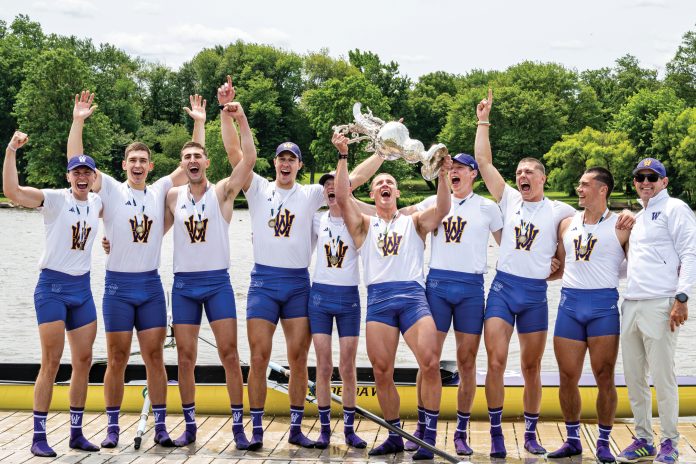
The same storyline earned Washington men’s rowing head coach, Michael Callahan, less than three percent of that—about $330,000 total salary, mostly earned through performance bonuses—making him the highest-paid men’s college rowing coach in America.
(Ryan Day’s total makes him only the fifth-highest-paid college football coach. Top of the heap: Georgia’s Kirby Smart, at over $13 million).
At the 2024 Olympic Games, 17 Huskies competed, winning 11 total medals. Callahan coached the U.S. men’s Olympic eight, winners of the bronze medal—with four Huskies on board. As this issue went to press, 22 Huskies headed to Shanghai to compete in the 2025 World Rowing Championships, with the largest number of them there to compete for the United States.
Callahan and Washington’s head women’s coach Yaz Farooq were paid roughly the same amount the year before, according to Washington state data, which likely makes Farooq the top-paid women’s coach.
Private institutions, like NCAA DI team champion Stanford and DI varsity eight winner Yale, do not report salaries and contracts publicly.
The pay disparity gets even worse among assistant coaches. Ohio State’s football staff has seven members making over a million dollars each, and the 11th-highest paid staffer—linebackers coach James Laurinaitis, who took home $350,000—still earns more than the top rowing coaches. The average assistant coach, according to the IRCA salary survey, makes about $50,000.
Comparing rowing to college football, with its billions of dollars in TV revenue, is apples to watermelons at best, of course. Comparing rowing to track & field, with its large rosters of student-athletes racing in an Olympic sport, is more apt.
There again, however, colleges underpay rowing coaches compared to their peers. For example, Ohio State paid women’s rowing head coach Emily Gackowski $160,000 and track & field/cross-country head coach Rosalind Joseph $212,180—over $50,000 more—despite the fact that rowing typically serves a bigger roster.
Rowing, along with every other sport that is not football or basketball, faces an uncertain funding future as the NCAA falls apart in the wake of the Supreme Court’s NCAA antitrust decision and settlement, which allows college athletes to be paid directly, players to profit from their name, image, and likeness (NIL), and massive increases in TV broadcast payments to football conferences.
Football programs today spend as much as they receive for broadcast rights (and sometimes more), The Atlantic reported recently. Result: The vast increase in revenue has not produced balanced budgets or surpluses to support non-revenue sports.
Among college Olympic sports, a further division between those that charge admission (volleyball, softball) and those that don’t (rowing) has led some universities to set up NIL opportunities for “ticketed” sports and not for others.
Much attention has been paid to the rise of international recruits in both men’s and women’s varsity rowing programs (funded by a school’s athletic department as opposed to club programs, which are funded by student activity fees and dues). A commonly expressed concern has been whether the displacement of domestic athletes by internationals has hurt the development of U.S. Olympic rowers. The salary surveys, however, finger a more likely culprit: the demise of novice and freshman programs and their coaching positions.
The top assistant rowing coach used to be the freshman or novice caoch. Not so anymore. Instead, those positions have been replaced almost totally by recruiting coordinators.
Practically no walk-on opportunities exist in the top IRA and NCAA Division I programs—sources of the entire 2024 U.S. Olympic squad (with the exception of three-time Olympian Meghan Musnicki, who began rowing at Division III St. Lawrence University).
Some of the most successful U.S. Olympic rowers ever, such as Susan Francia, who, like Musnicki, is a two-time Olympic rowing gold medalist, learned to row in college. Today, that opportunity barely exists in Division I rowing, the surveys show. One coach said he would be laughed out of his athletic administration offices for even suggesting the reinstatement of a novice coaching position. There is no real pathway to the Olympics in U.S. rowing besides Division I varsity programs, currently.
Following the money is a good way to understand how a situation came to be. The CRCA and IRCA surveys help head coaches receive better pay for the valuable work they do, but more TV money hasn’t led to more opportunities for student-athletes—the ostensible purpose of college sports.
