Home Blog Page 6

Chris Dodd, 1942-2026

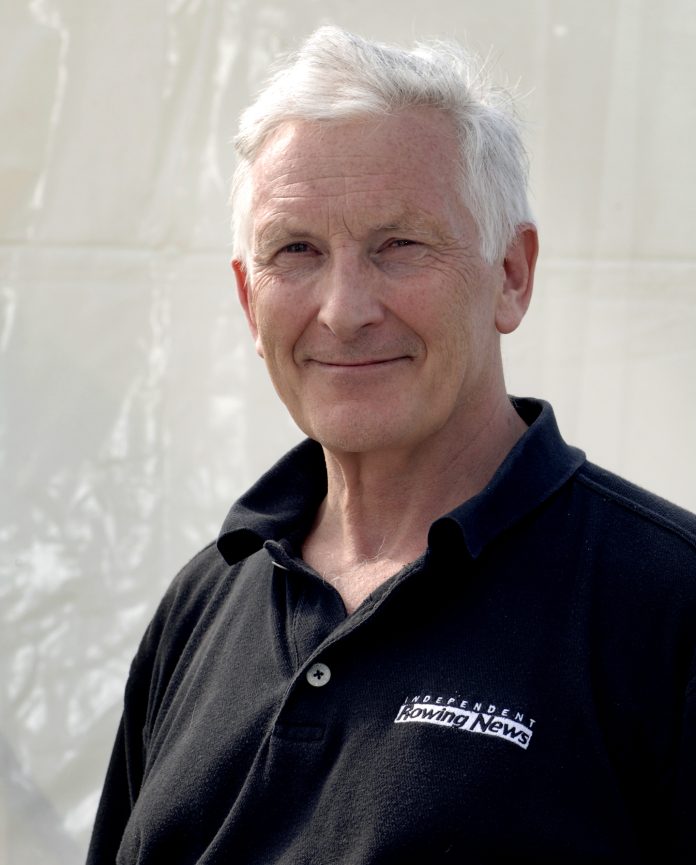
2005 FISA World Cup, Dorney Lake, Eton, ENGLAND, 27.05.05. [Friday ] Chris Dodd. .Photo Peter Spurrier. .email images@intersport-images...[Mandatory Credit Peter Spurrier/ Intersport Images] , Rowing Courses, Dorney Lake, Eton. ENGLAND


Chris Dodd, the greatest rowing journalist of all time, died on Jan. 25 in Great Britain. He was 83.

Dodd, who covered rowing for The Guardian, reported on more major regattas better than anyone else and wrote several books on the sport, including most recently (with Hugh Mathewson), More Power, the story of Olympic rowing coach Jürgen Gröbler.

“Nobody in the field—past or present–has come up to Chris’s standards,” said Martin Cross in The Guardian. “A quietly spoken private man, he was head and shoulders above the rest of his journalistic colleagues, of whom I was one.”

Dodd loved rowing and served the sport not only by telling its stories but also by being a friend and supporter of those who aspired to do the same. He shared his intellect, experience, and sharp wit generously.

A side-eye glance paired with a few words under his breath in the press box could be both the truest and funniest words a fellow journalist might hear in a season of covering rowing. He may or may not have coined the term blazerati for the blue blazer-wearing officials and bureaucrats of elite rowing, but none wielded it more deftly.

Christopher John Dodd was born in Bristol, UK in 1942 and became The Guardian’s rowing correspondent in 1970. He was the founding editor of Regatta magazine, the defunct publication of Great Britain’s Amateur Rowing Association—now British Rowing—and also wrote The Story of World Rowing. He was a driving force behind the founding of The River and Rowing Museum in Henley-on-Thames, which opened in 1998 and closed last year due to financial struggles.

In 2022, British Rowing awarded Dodd its Medal of Honor for his outstanding service to the sport.

“I am somewhat astonished as well as flattered to hear that I am to be awarded British Rowing’s Medal of Honor,” Dodd said at the time. “Flattered because it boosts my ego; astonished because I have sometimes given British Rowing, once the Amateur Rowing Association, a hard time in print.”

He supported and encouraged Rowing News and other new rowing media with his words while also representing the old guard of rowing journalists, including his late friends Peter Spurrier, Mike Rosewell, and Geoffrey Page, with whom he founded the British Association of Rowing Journalists (BARJ).

It was the natural formalization of the band of correspondents who more often than not gathered for drinks at the end of the workday and usually a meal at the end of the regatta, which could be as much fun as the event.

BARJ pushed back against press offices for regattas and rowing associations transitioning from media liaisons to public relations and marketing organs. His career spanned the arc of journalism from when basement printing presses dimmed the lights of The Guardian building to the dim lights of digital-only outlets that have superseded many actual publications.

“Chris was the quiet man of the traveling British rowing pack, but there was always something going on–a plan to be hatched or a story to be told,” said Mike Haggerty, Dodd’s longtime friend and rowing correspondent for the Associated Press. “He always knew exactly what he was doing and where he was going, and you were always going to be entertained in his company.”

In the bibliography at the back of More Power, Dodd wrote, “One of the extraordinary things about rowing is the stream of writing dedicated to it.”

He was the greatest source of that stream.
Stanford Opens 2026 Season at #1

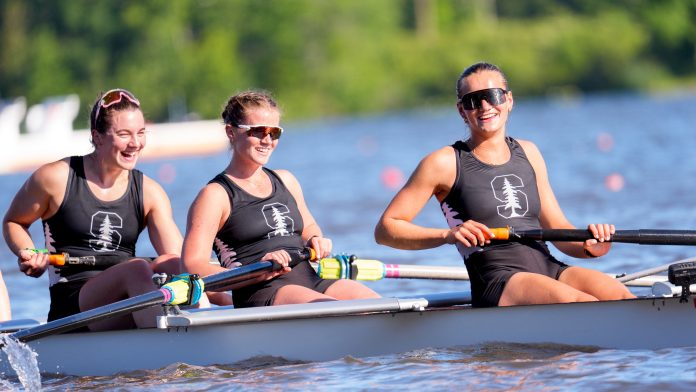
Stanford has won two NCAA titles (2023 and 2025) under head coach Derek Byrnes. PHOTO: Katie Lane.


Defending NCAA Division I national champion Stanford topped the Pocock CRCA preseason poll, earning 22 of 25 first-place votes. Yale, winner of the NCAA I Eight grand final was second, with two votes, and Texas was third, with one.

Stanford head coach Derek Byrnes enters his tenth season as the Farwell Family Director of Women’s Rowing having coached The Cardinal to NCAA titles (2023 and 2025). Stanford added 13 new recruits for the 2025-26 year.

Led by Coach of the Year Will Porter, Yale enters the 2026 spring racing season with nine new recruits from seven different countries, many with international racing experience.

“All these athletes have two things in common,” said Porter  “They are passionate about their education and rowing.”

Texas finished third at last year’s NCAA championship with the youngest squad ever. This year, the Longhorns return eight athletes from the 2025 I Eight, seven from the II Eight, and four from the Four. Canadian Olympic medalist and Yale graduate Maya Meschkuleit joined Texas’ recruiting class of 17.

The Longhorns open the 2026 season the San Diego Crew Classic on March 28-29.

Making History: Youngest Trio of Rowers Cross the Atlantic

Three Flying Fish rowed the Atlantic to raise money for the Teenage Cancer Trust.


By Katie Lane

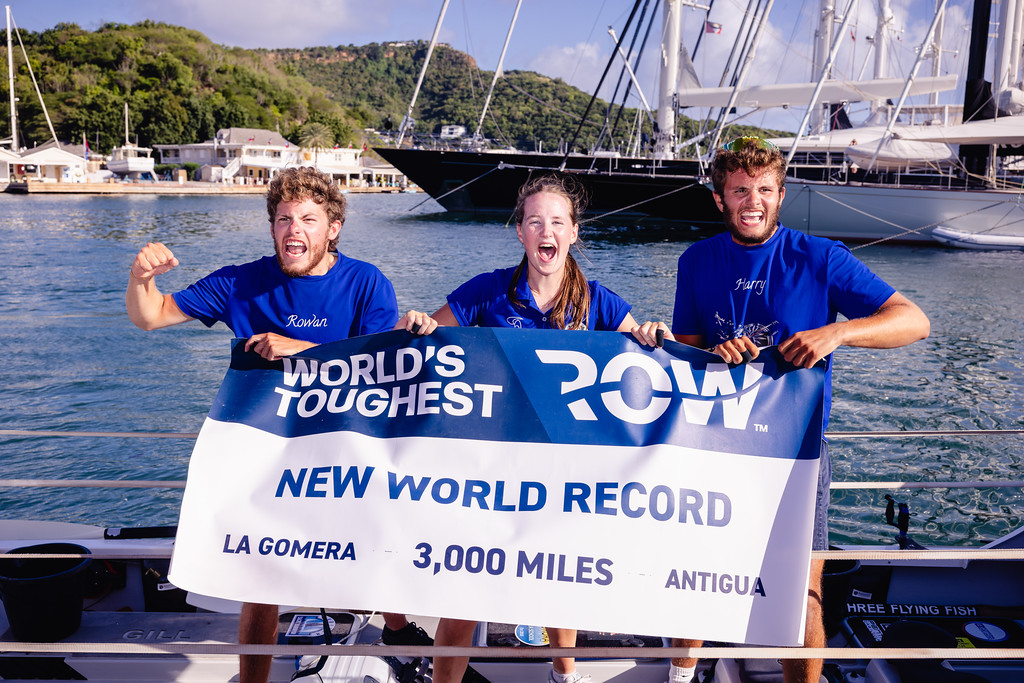
On December 14th, 2025 at 11:38am, Rowan Dally (21), Anna Dunk (19) and Harry Allen (20), otherwise known as the The Three Flying Fish, departed from the Marina at La Gomera in the Canary Islands for the greatest challenge of their individual lives: The World’s Toughest Row. 42 days, 8 hours and 10 minutes later, they are now world record holders as the youngest team to ever row any ocean.

Participating crews in The World’s Toughest Row rowed 3,000 miles across the Atlantic Ocean in one of four categories: solo, pair, trio, or four. The Three Flying Fish were one of 43 boats racing in the World’s Toughest Row – Atlantic 2025.

Inspired by Anna’s father, 2021 World’s Toughest Row Competitor Davie Dunk, The Three Flying Fish begin campaigning for a journey of their own in 2022.

“Our mission is to push the limits of human endurance, resilience and teamwork,” the team states on www.thethreeflyingfish.com. “We are committed to inspiring others by taking on the World’s Toughest Row, whilst breaking a record along the way.”

The Three Flying Fish chose the Teenage Cancer Trust as their community partner, raising awareness and funds, helping offset the costs of specialist nursing care for patients aged 13-24 years old.

“As three young people, we know how lucky we are to be in this situation and be able to do the row. We understand that there are so many children out there who would not be able to do this, due to factors out of their control. We aren’t doing the row because we can, we are doing it because they can’t.”

In the The World’s Toughest Row, each team rows on average 1.5 million strokes during a race. Anna Dunk noted that the physical challenge of rowing across the Atlantic is “so tough, two hours on followed by two hours off, for 45-plus days,” but finds that “the mental side is ten times tougher.”

“Dealing with sleep deprivation, anxiety, and homesickness was the toughest part of the crossing for me,” said Anna Dunk. “The feeling of isolation is immense, and being on a 10 meter boat with two of the same people day in and day out, it’s a recipe for disaster.”

All that’s to say, The Three Flying Fish said being out in nature, spending time with friends, and overall embracing the simplicity of life were what they all looked forward to in the experience. They saw dolphins on Harry’s 20th birthday, flying fish, countless sunrises and sunsets, and even a white-tailed Tropicbird, a bird only found in regions of the Caribbean.

“I only have to eat, sleep and row,” Rowan Dally said. “Not having to send an email, attend a zoom call, or go on social media was a very freeing experience.”

If this journey has taught the Three Flying Fish anything, it’s the importance of teamwork. Whether it’s navigating open waters, securing sponsorships, or managing basic communication, the three learned to rely on each other as they strive towards a common goal.

“More than anything, I hope they come away with a lasting belief in their own capabilities and a deeper understanding of teamwork, perseverance, and humility,” Craig Allen, father of Harry Allen, stated.

“The biggest lesson I’ve learned is that being a team is extremely stressful, especially working in such close proximity to each other,” Harry Allen said. “I learned that I can achieve anything and to never say something is impossible again… rather that I’m possible instead!”

Rowan Dally, Anna Dunk, and Harry Allen.

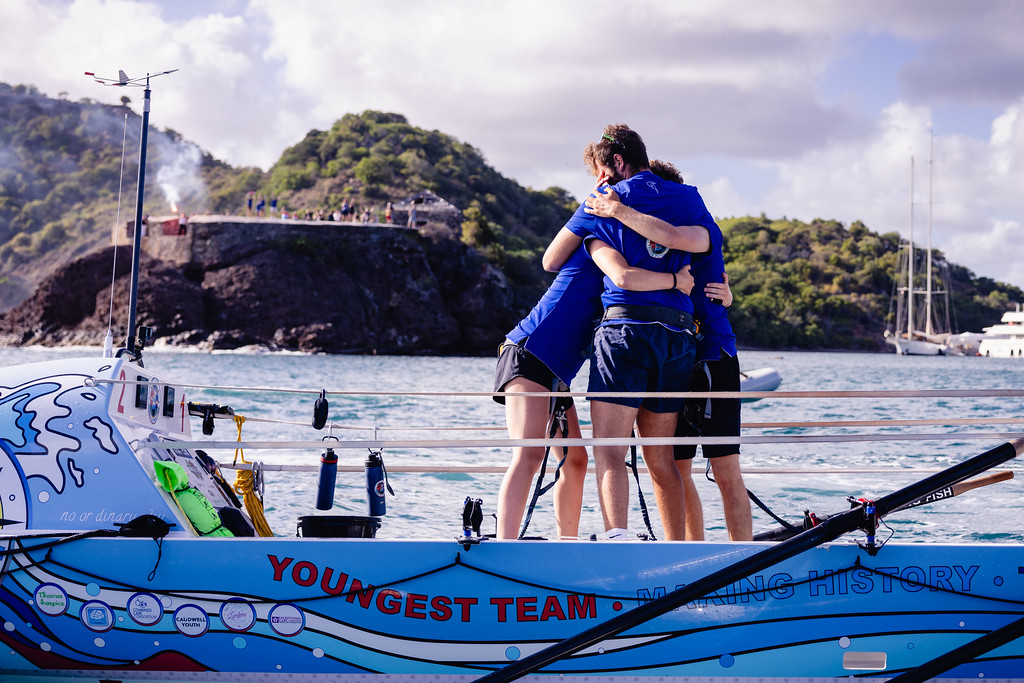
The Three Flying Fish arrived at Nelson’s Dockyard in Antigua on January 20th, 2026, marking the end of their journey across the Atlantic. Officially, the trio finished 20th overall (43 entries), 4th in the trio (six entries), and 3rd in the mixed class (six entries). To date, they have successfully raised over 40,000 pounds ($55,000) for the Teenage Cancer Trust.

When asked how it feels to be a world record holder, Anna, Rowan and Harry all agreed that “it hasn’t sunk in yet.” The trio also said that they would “absolutely do something like this again”.

“I hope that when other people see what we have achieved, it will inspire them to push their own boundaries just like we’ve pushed ours,” said Rowan.

Three Flying Fish are the youngest crew to row any ocean.

Making Erg Training Count

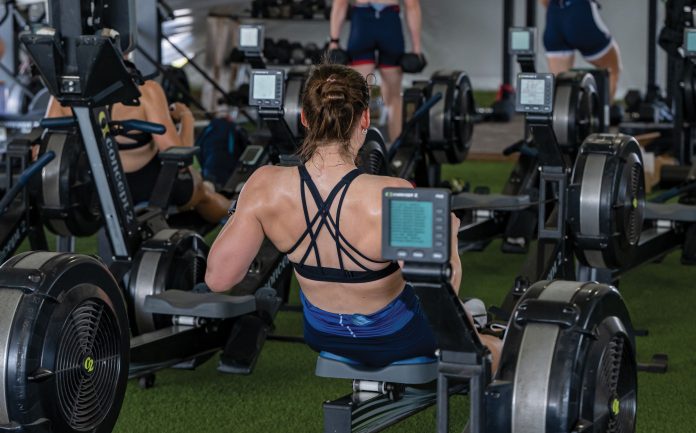
Pay attention to proper technique on the erg to achieve optimal results. PHOTO: Lisa Worthy.

Are you one of those people who feels like time is flying— except when you’re training indoors?

The days when we can’t get out on the water and enjoy the outdoors seem to drag on forever. Yes, we know that indoor training is important and offers benefits that rowing on the water can’t. But we are rowers, and nothing beats the feeling of a team working together and a boat running well.

It’s not hard to motivate myself to go rowing on the water, but it takes considerable effort to pack my bag and go to the gym. I realize how important it is, especially for older athletes, to strength-train regularly, but it’s definitely not a favorite.

From comments I’ve heard, I know that ergometer training is to many rowers what strength-training is to me. Because it’s not exciting, getting it done requires extra motivation.

Everyone agrees that winter rowing on an erg is excellent preparation for rowing on the water, so people put in their time but tend to do it on cruise control. As with any exercise done reluctantly, erg training misses the mark when performed incorrectly.

If you don’t pay attention to proper technique, you won’t achieve optimal results, and positive adaptation, both physiological and psychological, will be limited. Poor technique also can put unnecessary strain on your body and cause injury.

A common technical error: starting the drive by opening your upper body and leaning back while your legs are still straightening. Without the right sequence—legs-upper body-arms—you won’t achieve maximum handle force, you’ll tire quickly, and by weakening your core stability, you may hurt yourself.

If you row this way consistently, thus ingraining the incorrect sequence in muscle memory, once back on the water in the spring, you’ll transfer your bad habits to the boat, which will alter the feel and diminish the power of your stroke.

Other erging no-no’s: gripping the handle incorrectly, lunging, pausing at the catch, not extending your legs fully, bending your knees during the recovery while your upper body is still leaning back, tilting your upper body to one side while exerting uneven pressure on the foot stretcher.

Coaches should correct these technical errors, and rowers shouldn’t ignore them. Watching yourself erg in a mirror will enable you to identify your weaknesses. Even better: a video at race pace. The objective is to become aware of your mistakes so you can fix them.

During long low-intensity training sessions, it’s tempting to go through the motions and assume your technique is fine. But complacency can lead to performance stagnation and even injury. Better to concentrate on improving your erging form so you’ll row better when you get back in the boat.

Volker Nolte, an internationally recognized expert on the biomechanics of rowing, is the author of Rowing Science, Rowing Faster, and Masters Rowing. He’s a retired professor of biomechanics at the University of Western Ontario, where he coached the men’s rowing team to three Canadian national titles.

The Big Race

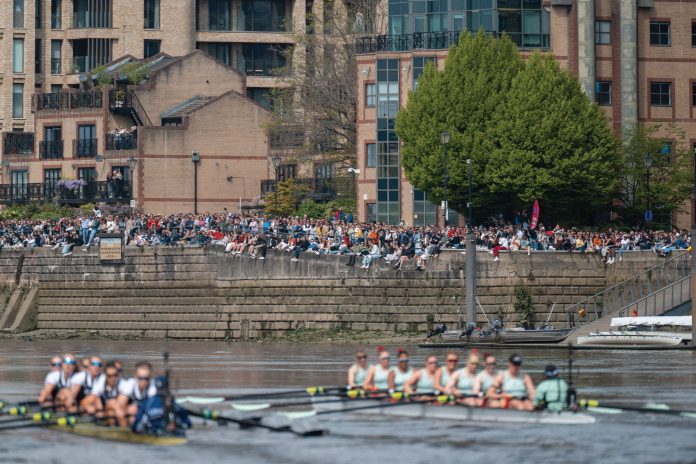
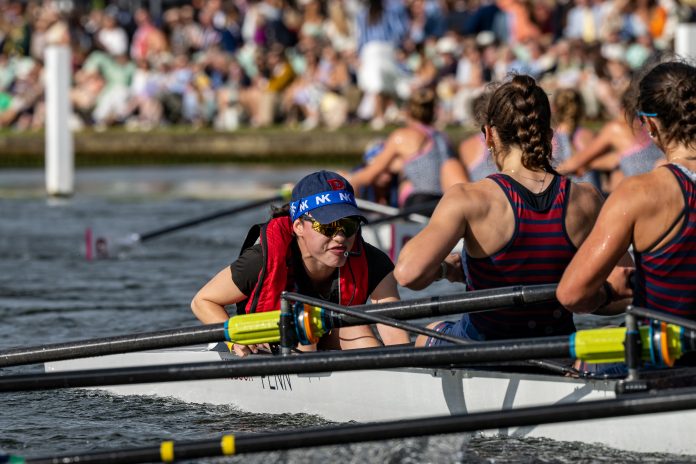
The Boat Race draws huge crowds and millions of viewers. PHOTO: BRCL/ROW360.


The world’s original intercollegiate athletic event, The Boat Race, was first held in 1829, contested by Oxford (the winner) and Cambridge universities. The 2025 Women’s Boat Race broadcast attracted a peak audience of 2.18 million, making it the most watched women’s sporting event of the year in the United Kingdom. This year’s races will be held on April 4.

Back on the Water

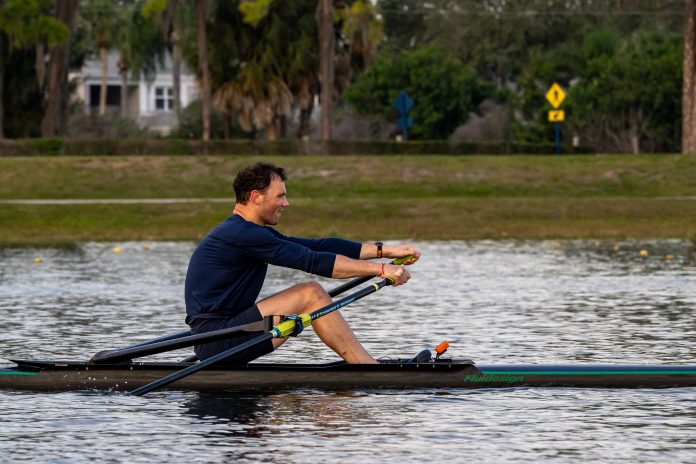
At the start of the 2,000-meter racecourse, Nathan Benderson Park, Sarasota-Bradenton, Florida. PHOTO: Lisa Worthy.


Nathan Benderson Park hosts the American Youth Cup Series I Saturday and Sunday, February 14-15 (with practice on the Friday) and then the Sarasota Invitational on the last weekend of February with middle school races on Friday, juniors on Saturday, and masters on Sunday.

Beefing Up Your Flexors and Extensors

Strengthen your flexors and extensors before getting back on the water. PHOTO: Lisa Worthy.


Now is the time to ready the forearms for the indoor-to-outdoor seasonal shift. Digital flexors and extensors that have not feathered or rolled a blade all winter require some pre-season conditioning.

Sweep rowers need to isolate the functions of their hands to adjust blade position and handle height. Tendon strength develops more gradually than muscle, so proactive attention to the hand and forearm muscles helps ward off potential tendinitis in your wrist and elbow.

Extensor muscles function primarily to move the fingers, wrist, and elbow out of flexion. Flexor muscles are stronger, providing grip and power. Focus on developing extensors before the coxswain commands “hands on” again.

Sample exercises for the elbow includes pushups, dumbbell chest presses, dumbbell triceps kickbacks, and dumbbell overhead triceps presses.

For wrist extensions, place your forearm along an armrest or table with your wrist hanging over the edge and your palm facing down. With a weight in your hand, lift it toward the ceiling. Lower slowly and repeat.

For wrist rolls, attach one end of a rope to a light weight and the other to a dowel about the diameter of an oar. Hold the dowel with your palms facing down and roll the weight upward. To increase the difficulty, straighten your arms.

Exercise finger and thumb extension by placing a rubber band around the outside of your thumb and index finger and pulling them away from each other. Repeat with your thumb and other fingers, then all fingers together. To progress, repeat with a thicker band.

Marlene Royle, who won national titles in rowing and sculling, is the author of Tip of the Blade: Notes on Rowing. She has coached at Boston University, the Craftsbury Sculling Center, and the Florida Rowing Center. Her Roylerow Performance Training Programs provides coaching for masters rowers. Email Marlene at roylerow@aol.com or visit www.roylerow.com.

Coxing: A Feast for the Eyes

PHOTO: Lisa Worthy.


So you’ve been working hard all winter, soaking in knowledge, bonding with your rowers, and probably curating some erg-room playlists.

You’ve been with your rowers since day one, making keen technical observations and learning the perfect thing to say halfway through the team’s hardest workout. Now you have to figure out how to apply what you’ve learned when you’re back in the stern (or bow).

I spoke to Izzi Weiss about the transition from land to water in the spring. Izzi coxed at the University of Virginia for four years and won gold and bronze medals with the U.S. Under 23 team. Weiss runs Inside Turn, a coxswain consultancy that helps coxswains at every stage of their career take the next step.

First, don’t underestimate the importance of the emotional connection you’ve created with your rowers over the past few months of training. If you’ve paid attention to your rowers and approached practices with intention, you can reap the rewards on the water.

“You get to establish strong bonds on land and have more time to help rowers with what they’re working on,” Weiss said. “You can build a rapport that’s different from being in the boat.”

Sure, you may not be on the erg with your rowers (or maybe you are!), but if you’ve been engaged in your land sessions and invested in your rowers’ development, then you’ve demonstrated that you’re with them every stroke.

Now, you have an opportunity to strengthen those bonds on the water.

“There’s a sense that you’ve really showed up for them, and now they can show up for you and work together in a different way,” Weiss said. “You’ve been there for them in really hard situations, and they trust you and rely on you.”

From a practical standpoint, because you’ve seen how your rowers react to hard training, you’re better attuned to when they might need extra encouragement or input.

The move from winter training back onto the water is an opportunity to help your rowers technically as they get back into a boat. For a coxswain, winter training is a feast for the eyes; you can see so much more standing in the erg room than sitting in the stern. You can see where rowers begin a session and how their technique changes from fatigue or stress. 

“Obviously, in the fall and spring, you work with people on their bladework, but in the winter you can see how their bodies are moving when they’re rowing in a way you can’t in the boat,” Weiss said.

On the water, “you can see [their bodies] only if they’re in the boat next to you, and in that case you can’t help them in that moment.”

Use the winter to connect what you’re seeing the bodies of your rowers do with what you see their blades do on the water.

“Try to understand people’s body position and technical growth areas beyond the handle and the oar,” Weiss said. “If you know that so-and-so drops her chest into the catch, then, when her blade is moving away from the water, you can put together what’s happening. If you remember how she ergs, that gives you a lot more context on what could be happening on the water that’s causing poor bladework.”

This enables you to give better feedback when looking at blades. Pointing out the problem is far less effective for fostering improvement than offering a solution. Observing stroke after stroke on land can give you the confidence to present solutions to struggling rowers once you’re back on the water.

“The most important carryover to me is that you get on the water and you know more about your rowers than when you finished the fall,” Weiss said.

If you walk into the boat bay in the spring with renewed excitement and a better understanding of your teammates, it should pay dividends on the water immediately. 

Hannah Woodruff is an assistant coach and recruiting coordinator for the Radcliffe heavyweight team. She began rowing at Phillips Exeter Academy, was a coxswain at Wellesley College, and has coached college, high-school, and club crews for over 10 years.