Home Blog Page 54

Is the Romanian Olympic Rowing Team playing Games with their entries?

Photo by Lisa Worthy.

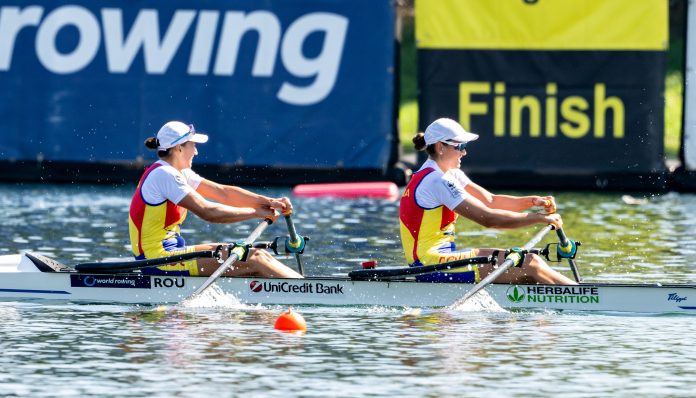
Romania is the only country besides the U.S. to have qualified 12 (of a possible 14) boats for the Olympic regatta, but unlike the U.S. crews, which have been named and entered, the Romanians seem to be engaging in some gamesmanship with their Olympic rowing line-ups.

Romania’s national team has a reputation among Olympic coaches for saying they’ll race at certain regattas or particular events, and then doing something different. By not entering athletes that double-up, the national team retains the credentials, and then can change up to 50 percent of a crew.

Here at the Paris Olympics, they’ve switched an athlete in both their men’s and women’s pairs and half the crew of their men’s and women’s fours, between the official entries of July 12 and the entries shown on the day of the draw, two days before racing begins on Saturday, July 27.

The level of concern raised to the point of it leading the agenda of the team managers meeting. The international governing body, World Rowing, has posted its rules for athlete replacement, along with the more stringent Olympic rules for “Late Athlete Replacement” on its website, with a comparison chart. World Rowing knows its Rules of Racing are lenient on the matter, and an official said off the record that they need to be updated. But those rules have been for situations involving injury, not gamesmanship.

“In the end, it doesn’t matter,” says Josy Verdonkschot, the U.S. Olympic rowing chief coach. “We’ll be fast and see if anybody is faster.”

Feature: The Training Conundrum

Photo by Lisa Worthy.

Are we training enough? Are we training too much?  What is everyone else doing?

All rowing coaches have asked themselves these questions at some point during their careers, perhaps as often as every day. Yet coaches remain siloed and silent for the most part, reluctant to discuss training practices with peers or ask them about theirs. As I talked to coaches for this feature, time and again I heard this refrain:

“I don’t know what other teams are doing,” Scott Frandsen, head men’s coach at Cal, told me.

“I don’t really know what other people are doing,” echoed Dave O’Neill, head coach of the NCAA-champion Texas women.

Aleksandar Radovic, head coach of the RowAmerica Rye back-to-back Youth National champion boys, took it a step further.

“We really don’t care what others are doing.”

So, if they’re not talking to each other, how are coaches making training decisions?

Personal experience, trial and error, a little science, and a dash of artistry.

Coaches begin coaching usually where they left off as athletes, continuing to pursue positive approaches or attempting to correct perceived wrongs. Which is exactly what Frandsen has done since taking over as head coach of the Cal men in 2019.

“It’s been a combination of all the different coaches and approaches I’ve had, picking the good things I liked and avoiding the bad.”

Frandsen is fortunate. The stable of coaches he’s been able to imitate and emulate is impressive: Tony Carr in high school; Craig Amerkhanian and Steve Gladstone at Cal; Sean Bowden at Oxford; Mike Spracklen and Terry Paul of the Canadian Olympic team. When Frandsen returned to Berkeley, he served as an assistant to U.S. Olympic coach Mike Teti before taking the reins himself.

Not all coaches have such a pedigreed background or choose to pull from it.

O’Neill, with 23 years of experience as a collegiate head coach, says “chefs can follow the same recipe, but it’s always going to taste different.”

He keeps abreast of training trends in other realms of athletic endeavor and tries to adapt them to rowing. At the beginning of the 2022-23 academic year, fresh off back-to-back NCAA championships, O’Neill was looking for ways to maximize aerobic capacity while limiting the physical and mental stresses of training at an elite level.

Accordingly, the Longhorns committed to exercise physiologist Steven Seiler’s 80/20 training method—80 percent low intensity, 20 percent high.

“Let’s put in as many minutes of aerobic training as we can,” O’Neill declared as he abolished all ranked and even recorded erg workouts.

By February, however, it became evident that it didn’t feel the way it had in previous years, the mental load was no lighter, and the team lacked power. They went on to finish a relatively disappointing fourth at NCAAs.

In a dramatic departure from that, O’Neill this year was influenced by Jakob Ingebrigtsen, the Norwegian runner and current world-record holder for the indoor 1,500 and 2,000 meters who does “a ton of stuff at threshold.”

Ingebrigtsen’s so-called “Norwegian Method,” which calls for lactate-guided meters and double-threshold training days, is challenging many long-held beliefs in elite endurance training.

Threshold training involves training at a pace where your body transitions from aerobic metabolism (getting fuel by burning carbohydrates and fats in the presence of oxygen) to anaerobic metabolism (getting fuel from stored sugars and producing lactic acid faster than it can be metabolized). This can be determined by measuring either oxygen consumption or lactate levels in the blood. A simpler way is the “talk test”—when during training you go from being able to speak full sentences to only short phrases and words.

This year, the Longhorns rowed many more meters at threshold. They raced. By his own admission, O’Neill integrated training philosophies into the larger context of Texas Rowing, “piecing together how the training fits into the team culture and how the training needs to have an effect on technique, even on how we want to race. We got back to looking at it from a holistic standpoint rather than just a training plan standpoint.”

Some coaches profess a combination of personal experience and training education, such as Radovic, who keeps up to date by attending coaching conferences and learning from the World Rowing website, in addition to building on his own athletic experience.

Radovic grew up in Serbia, where he competed on multiple junior, under-23, and senior national teams in the mid-2000s. Their training was adapted from the East German system, comprised almost exclusively of long, low steady state.

“Just row as much as you can,” he explained.

When Radovic came to the U.S. for college and rowed at Drexel University in Philadelphia, the training was “pretty much the total opposite,” with hard racing pieces almost every day.

In time, he saw the benefits and drawbacks of both approaches and combined them in a training plan suitable for high-school athletes. RowAmerica Rye trains once a day, six days a week, with Sundays always off.

“Some days we do steady state, some days we do pieces. One day a week is at threshold. One day a week is, depending on the season, either power strokes or higher-cadence speed work, and that’s about it.”

Many coaches, when asked to describe their approach to training, answered in terms that are similarly simplistic. Liz Trond, head coach of the Youth National champion Connecticut Boat Club women, summarized their training as “easy, hard, easy, hard, easy or hard, easy, easy, hard, easy, easy, hard.”

“Honestly, that’s the basics,” she quipped.

Such a description belies the sophisticated effort these coaches put into developing and, most important, adjusting a comprehensive training plan. Something that came up time and again in my conversations was the importance of reflecting honestly on past training and being open to feedback from trusted athletes.

“I like to read the room with our top guys,” Trond  elaborated. “Are they still joking? Are they still coming to practice light and loose or are they dragging a little bit?”

This informs her adjustments to training–when to push the intensity or load, when to back off.

Similarly, Frandsen turns to trusted athletes to guide his training decisions.

“It’s about having the humility to talk to the guys that you trust,” he explained. “At the end of the day, you need to be able to take all that in and convey it in a way that shows this is what you believe, and this is what we’re doing, and everyone’s got to buy in.”

He learned the lesson the hard way in his first years as head coach at Cal, when the team did more of everything.

“We did more volume. We did more strength and conditioning. We did way more hard ergs.”

It was, by Frandsen’s own estimation, too much. By March, the team was exhausted. So he took a different approach, spoke with “a few guys that you trust, learn a little bit, self-reflect a little bit, and then we made some really good changes.”

A trend that emerged in conversations with coaches at both the junior and collegiate level is a move away from high-volume training.

“More volume is not the answer,” said Emily Gackowski, the newly named head coach of the Ohio State women. “We’ve reached the max that you can push volume-wise, with the rib injuries and mental hurdles that come with just doing more. There has to be something else.”

O’Neill agrees that there’s more to a successful training plan than simply training more.

“It’s not just about putting in minutes and volume,” he said. “People have to be happy about what they’re doing and happy where they are; otherwise, they’re not going to perform.”

Which is why, after experimenting with the higher-volume, lower-intensity 80/20 approach in ’22-23, the Longhorns this year focused on threshold-intensity work at prescribed paces and preparation at race speed. When they did put in the necessary aerobic work, it was largely through easy minutes on the bike.

O’Neill agrees with Swedish speed skater Nils van der Poel, who never skated slower than race speed in training.

“You can’t do speed-skating slowly,” O’Neill said. So why row slowly?

A few years ago, moderating hard effort might have been dismissed as soft, but it’s hard to argue with the success of Texas and others taking this approach. Frandsen thought a lot about this after he took over at Cal. When developing the team’s training, he wondered, “How do you stretch the amount of progress you can make while limiting the stress and the injuries and the detriments of working too hard?

“How do you make as much progress as possible from September to February while teaching young people how to be tough and have those moments of adversity? They need those hard ergs, but how many do they really need to learn those lessons?”

That’s why, in 2022, as soon as he knew Cal had a fit and fast varsity eight, Frandsen did less training, not more. He credits his assistant coaches, Sam Baum and Brandan Shald, with encouraging this moderation in an attempt to keep the athletes healthy.

“We’ve got the speed,” Frandsen said, recalling his thinking. “Is doing those extra two hard workouts a week going to make everybody a little bit tougher? Maybe.”

But the potential drop-off in speed if just one guy got injured was a significant hazard.

“Just keep them healthy,” emphasized the coaches.

That crew did indeed stay healthy and went on to win the IRA national championship. The following year, depth was no longer a concern as the Golden Bears swept the IRAs, winning all four heavyweight men’s events.

The adoption of moderate training in a happy environment is not unique to college training and is even more important for junior rowers, who are still early in their athletic development.

“I don’t know what two by 90 minutes does for anybody, other than just taking a lot of boring strokes,” declared Trond. Like Frandsen, she questions how often athletes really need to go all out in order to perform their best on race day.

“How many times can you ask someone to go to that place?” she wondered.

Last fall, her youth women’s four hadn’t gone all out once before their race at the Head of the Charles. Trond’s charge to them before the race: “This is it. One moment, one time, you have to go as hard as you possibly can.”

The crew won the event by 14 seconds.

Many of the coaches I spoke to have been at this for many years and have the benefit of experience, the opportunity and security to experiment and to learn from trial and error. Until now, new coaches, especially new head coaches, have defaulted to adapting their own experiences to their current circumstances. As exercise science and the resources of college and junior athletics advance, however, new coaches have previously unavailable resources at their fingertips.

Gackowski took the helm of the Buckeye program in early July. When questioned shortly after about how she would be developing her team’s training program, she answered confidently, referencing a combination of programmatic history and on-campus resources. Gackowski has the last 10 years of training data, so, she explained, “I know how this team got to win a championship. I know how this team won eight Big 10 championships in a row, and that’s really helpful in starting to build my own training plan.”

Context matters, though, and Gackowski knows she can’t simply replicate the training that was done in the past. She intends to build a relationship with Ohio State’s sports science department to check what she knows along with the historical data on hand and to stay abreast of the latest trends in training. She will seek also to collaborate with the athletic training and strength and conditioning pros, since she and her staff, like most rowing coaches, lack degrees in kinesiology and sports science.

“I’m really trying to build relationships with all three of those parties to ensure that the training I want to do is scientifically what’s going to be moving the team in the right direction,” said Gackowski, one of a growing number of coaches, especially younger ones, who are looking outside of their own experiences and even beyond rowing to inform their approach to training.

The practical limitations of training a team, which can sometimes be as large as 50 or even 100 athletes, cannot be overlooked. RowAmerica Rye is home to 100 varsity boys and girls combined, along with another 50 novices, putting space at a premium in the boathouse.

When training on land, the four teams engage in an elaborate rotation among ergs, weights, bikes, and running throughout their two-hour practices, meaning time is limited in any one modality. One day a week in the winter, the boys are on the ergs for the full session while the girls lift the whole time. The next day, the teams swap.

Connecticut Boat Club also deals with training  constraints.

“We have a finite block of time,” Trond said. “We have two and a half hours, which really means an hour and 45 minutes” with different arrival times, traffic on 95, time to change clothes, and have a quick meeting.

Logistical limitations are caused by the water as well. Radovic’s athletes row on Milton Harbor, which is tidal and has only 3,700 meters of protected water. Hence, opportunities for long uninterrupted strokes are in short supply.

These common limitations—shared facilities, less-than- ideal waterways—mean that coaches must tailor their training philosophies to the realities of their rowing environs.

Obviously, there’s more than one way to train a winning crew, which is why successful coaches and teams train in a wide variety of styles and why even the winningest crews adapt and change their approach over time.

O’Neill believes coaches occupy a continuum. On one end, “there’s the scientist coach, where it’s all about the training plan and millimeters of lactate and watts per kilo and the force curves and the Peach System and everything is down to the numbers.”

On the other end, “there’s the artist coach, where it’s about the feel, the flow, the beauty of rowing, the power of the human spirit, team culture.”

Though he remains curious about exercise science and willing to experiment with different training methods, O’Neill places himself firmly in the artistic camp.

Sensing when to push athletes, when to back off, and when to change things, whether innate or hard won, is crucial to a coach’s ability to train a crew effectively. Scientists have some answers for how to build a training plan, but some things are more metaphysical. That’s when art takes over.

As O’Neill revamped his team’s training in response to a disappointing ‘22-23 campaign, he returned to some time-honored classic workouts.

“We needed to do some workouts that might not make sense from an exercise science standpoint, but from a team culture, trust, confidence standpoint, we needed to do some things that are memorable.”

That’s what led the Longhorns to DKR–Texas Memorial Stadium on a Friday night in March after a long week of training. Under the lights, the rowers attacked repeats of the football-stadium steps with abandon, O’Neill urging them on.

It might not have made sense physiologically, but good coaches know that sometimes teams just need to suffer together to be able to stand atop the podium in June.


Promising Para Rowing Prospects in Paris

The U.S. Para mixed four finished second to Great Britain at the 2023 World Rowing Championships. Photo by Lisa Worthy.

The U.S. Paralympic four carried a seven-year silver medal streak through the Tokyo Games in 2021, broken by a fifth-place finish at the 2022 World Rowing Championships, and resumed at last year’s Worlds. It’s a streak they’d like to break again—by finally beating the British crew.

Great Britain’s Para fours are undefeated over 13 years, including the last three Paralympic gold medals. The GB lineup has changed over the years, while the results have not.

“The Brits are together for a long period. They come fully prepared,” said USRowing’s chief of high performance, Josy Verdonkschot.

The U.S. PR3 mixed four of Gemma Wollenschlaeger, Skylar Dahl, Alex Flynn, Benjamin Washburne, and Emelie Eldracher, along with the the U.S. PR3 mixed double of Todd Vogt and Saige Harper, head to the Paris Paralympic Games as strong medal contenders.

“Getting one medal would be the minimum,” said Verdonkschot of expectations in the lead-up to Paris. “If they equal the result of last year [two silvers at Worlds], it would be great.”

Coaching the U.S. Para double is Andrea Thies, a two-time Olympic athlete.

“The truth is when you go to the high-performance level, knowing what it feels like to be at the 1,000-meter mark, I know I can bring that into this. These Paralympic athletes don’t behave any differently. You don’t know what your capacities are until you actually come to the limit. They have a lot of potential. This is just the beginning.”

“Last year felt good,” said Alex Flynn, now in his second year in the four. “This year feels better.”

Para athletes face the same challenges as other athletes racing on the water—and overcome others getting there.

“We have different mobility levels and strength levels,” said Skylar Dahl, a member of the mixed four (two male and two female rowers). “So the rigging comes into play not just individually but throughout the whole boat.”

“Being in the boat—that exercise improves the quality of my life,” said Todd Vogt, stroke of the double, who has Parkinson’s. “When I get done rowing, my body feels really good for several hours afterward. The days I don’t row, my tremor will be a little exacerbated, and I might not move as well as I do otherwise.”

Vogt, who is married and lives in Portland, Ore., is training in Boston as he prepares for the Paralympic regatta, Aug. 30 to Sept. 1.

“It does put a financial strain on our relationship, and I don’t get to see my wife.”

Vogt is also adapting to a change in the boat, as Wollenschlaeger and Harper swapped seats from last year’s medal-winning boats.

“We’re a good combination; our skills complement each other,” said Vogt of his new bow-seat partner. “I row with a longer stroke, and Saige is very explosive and dynamic. That works together.”

Also, “she steers way better than I do.”

In June, the four raced at World Rowing Cup III in Poznan, Poland, finishing second, again, to Great Britain, this time by six seconds—the margin had been less than three seconds at last year’s Worlds.

“They were a little bit disappointed about the result in Poznan; I would be as well,” said Verdonkschot. “Obviously, having such young people also means that a lot of them were still rowing in their collegiate programs, so that gives you only a little preparation before the World Cup. Still, it was very good for them, because it’s a reminder how fast it should be.”

“Josy and USRowing have really done a great job with Ellen [Minzner, director of Para High Performance] (interview, page 48) to create a program for us,” said Tom Siddall, coach of the Para four. “He is super helpful in creating the program for us and then giving us the flexibility to run it on a day-to-day basis and make changes as needed.”

As for how the crew will fare in Paris?

“It’s not going to be for lack of effort,” Siddall said. “It’s just, Can we get it right on the day?”

Verndonkschot agrees, noting the young U.S. Para squad is still gaining speed, while the British “will not make another big step, whereas we can.”

“And then it can become tight. And when it’s tight, you just have to remember that you’re American. So you just go for it. Period.”   

UVa and Wisconsin Women’s Rowing Add Assistant Coaches

Photo courtesy of UVa Athletics.

As the summer marches on, more coaches are finding new homes, most recently at UVa and Wisconsin. New head coach of the Cavaliers, Wes Ng, announced the hiring of three assistant coaches, two of whom followed him to Charlottesville from his previous stint at the University of Pennsylvania.  Helen (Tompkins) Samaniego, UVa class of 2010, returns to her alma mater after coaching with Ng at Penn for two years before joining the staff last year at the University of Texas, where she helped the Longhorns win the 2024 NCAA National Championship. Samaniego also rowed for Ng at the 2013 World Championships, explaining, “Wes has shown remarkable compassion and leadership to me at Penn and as my coach at the 2013 World Championships. Working for Wes combined with coaching for my alma mater is a dream come true.”

Josie Konopka, another new UVa assistant, also joins Ng’s staff after having rowed for him, in this case at Penn. Konopka graduated in 2022, after leading the Quakers to their best performance at the Ivy League and NCAA Championships.  “I knew she would be the first person I wanted to build our staff around,” Ng said of Konopka’s hiring. “Josie’s journey from a scholastic recruit to U23 National Team athlete to First Team All-American and two-time team captain at Penn is meteoric. It is one that every collegiate athlete aims for. Her deep understanding of the sport and her ability to teach and inspire from her firsthand experience will be invaluable to our program.

To round out the UVa staff, Taylor Ruden makes the move from Ohio State to Charlottesville after four years with the Buckeyes and a successful career at Indiana.  Ng effused, “Taylor’s ability to inspire and develop student-athletes as a whole person, combined with her strategic programmatic insights, will play a crucial role in driving UVA to our ultimate ambition.”

In Madison, Badgers head coach Vicky Opitz announced two additions to the Wisconsin Women’s Rowing coaching staff. 2024 Olympian and former Wisco walk-on Sophia Vitas will serve as a graduate assistant coach after returning from Paris where she will compete in the U.S. double. Mary Anderson joins the staff as as assistant coach with the lightweight women after spending the last two seasons at Gonzaga, helping the Zags win West Coast Conference Championships in both seasons with the squad.

Steve Gladstone Named Navy Heavyweight Rowing Head Coach

Story and photo courtesy of Navy Athletics.

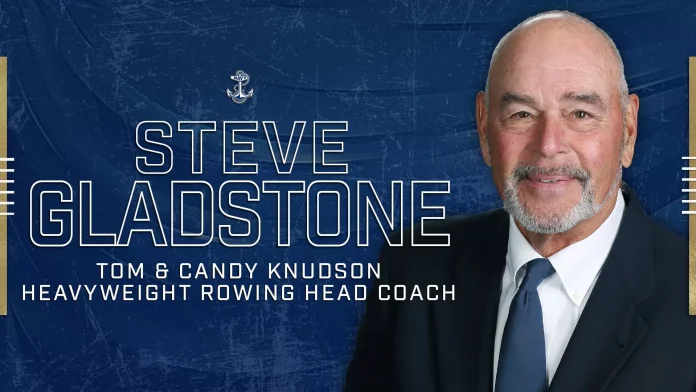
Naval Academy Director of Athletics Chet Gladchuk announced Wednesday the hiring of Steve Gladstone as the Tom and Candy Knudson Heavyweight Rowing Head Coach.

Gladstone has coached more IRA Championship crews than anyone in intercollegiate rowing and is regarded as one of the top crew coaches in the history of the sport.

“Steve Gladstone is the benchmark in all of intercollegiate rowing,” said Gladchuk. “His accomplishments are unsurpassed in the annals of the sport’s history. The positive influence he has had on the lives of thousands of student-athletes over his career is as important to us at the Academy as his competitive achievements. He has been a leader and an educator that clearly understands our mission and has lived Naval Academy values throughout his professional career. Having Steve embrace the opportunity is exciting and sets the stage for many great days ahead in the boathouse and on the Severn.”

“Being appointed the Tom and Candy Knudson Heavyweight Rowing Coach is an honor,” said Gladstone.  “There have been many times in the course of my coaching career I dreamed of coming to the United States Naval Academy. Coaching young men who will be serving their country in leadership positions in the military and beyond is an absolute privilege.”

Gladstone most recently was a head coach at Yale where he led the Bulldogs to unprecedented heights under his leadership.  He was awarded with the 2015 USRowing Medal while being named Ivy League Coach of the Year in 2015, 2016, 2018, 2019 and 2023 and Eastern Association of Rowing Colleges (EARC) Coach of the Year in 2016, 2017 and 2018.

Yale won three-consecutive Intercollegiate Rowing Association (IRA) National Championships (2017, 2018, 2019) for the first time in program history and won seven-straight Sprints titles.

Gladstone’s 14 IRA Championships during his career place him in a tie with Charles “Pop” Courtney of Cornell (1901-15) for the most varsity eight titles in the history of collegiate rowing.

As the head coach of Cal, Gladstone’s crews medaled at the IRA regatta 11 times in his 12 seasons, which was an unprecedented achievement in the long history of the championship.

Over that same period, he directed Cal to eight Pac-10 Championships. His career totals include nine Pac-10 Championships – all at Cal – multiple Eastern Sprints titles (7 at Yale, 4 at Brown), while his 14 IRA gold medals were shared between Cal (6), Brown (5) and Yale (3).

As the director of rowing operations at Brown, Gladstone’s crew triumphed four times at the Eastern Sprints, five times at the IRA regatta and twice at the National Collegiate Rowing Championships.

Gladstone has also served as the U.S. National team coach and was a selector for the 1972 U.S. Olympic team.

Gladstone has served on the Board of Directors of the National Association of Amateur Oarsmen and has also been a member of the Men’s Olympic Rowing Committee. He served as ABC’s analyst for rowing events at the Los Angeles Olympics. He worked in the same capacity for NBC at the Seoul Olympic Games.

Steve Gladstone added the director of athletics role to his duties at Cal, overseeing a department that placed ninth in the Directors’ Cup for overall excellence and won five national team championships.

RowFest Concludes, Crowning Masters National Champions

Photo courtesy of USRowing.

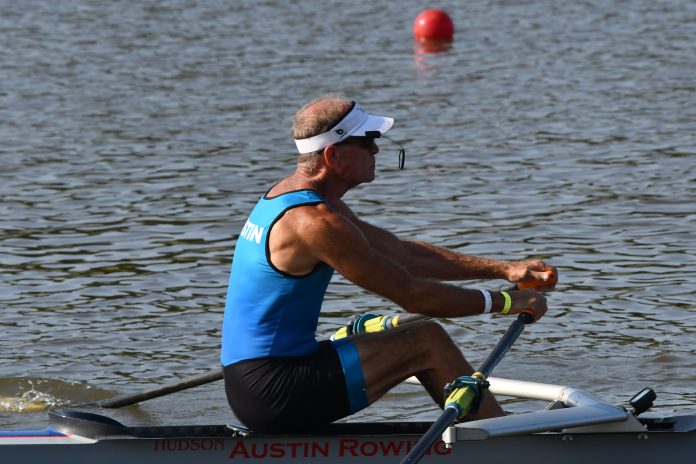
The 2024 RowFest concluded July 21 in Oklahoma City, Oklahoma with the culmination of masters and para events.This segment of the regatta, running from Thursday to Sunday, consisted of 360 races rowed over 1,000m and 500m.

500m sprints ran Friday night, under the lights, with singles and quads competing for $1,000 in prize money along with a bottle of champagne. Next Level Rowing’s Sierra Cydrus won the women’s singles event in dominating fashion, crossing the line over 10 seconds ahead of the field, an impressive feat in a race that was less than two minutes long. In the men’s single, James Barr, racing unaffiliated, claimed the top spot, coming in just over a second and a half ahead of 2012 Olympian Tom Peszek of San Diego Rowing Club. In the women’s and men’s quads, Texas Rowing Center and San Diego Rowing Club won respectively.

Texas Rowing Center entered an astounding 130 masters crews at RowFest and finished the weekend with 25 first place finishes. Chinook Performance Racing, a virtual club that shuns the title “rolodex crew,” entered 80 crews at the event, winning 15 of those events. Austin Rowing Club also traveled with a large contingent, entering 70 masters crews and coming away with medals in 24 events.

Full Results. USRowing Photo Gallery.

From the Editor: Rowing’s Golden Age

Photo by Lisa Worthy.

Sure, the older we get, the faster we were. But even as a card-carrying member of that club, I offer for your consideration the following declaration:

The sport of rowing is in its golden age, the best era in the existence of our sport, dating at least to the 1872 founding of the National Association of Amateur Oarsmen, which combined with the National Women’s Rowing Association in 1982 to give us our United States Rowing Association, currently operating under the brand name USRowing.

As we’ve reported previously, the USRowing Youth National Championship in June broke participation and financial records for the second year in a row. This award-winning event, held on the world-class course at Nathan Benderson Park, was the best it’s ever been in ways that are harder to quantify and measure but plain to see, like a vibrant scene at the venue and the pervasive buzz among youth programs leading up to it.

The Intercollegiate Rowing Association’s 121st anniversary national-championship regatta this year was the biggest ever, as was the American Collegiate Rowing Association’s national championship for college club rowing programs.

Although the NCAA Championships cap participants through a qualifying and bid system, the number of Division I rowing schools will grow as the University of Albany and High Point University launch new women’s varsity rowing programs this fall, followed by the University of Toledo in 2025.

There is, and will continue to be, much handwringing and pearl-clutching about the massive changes occurring in college athletics and how they’ll be paid for. But the coming chaos should present opportunities to strengthen and improve rowing even further.

Some of the best are at it already, such as UCLA and Washington, which are raising multi-million dollar rowing endowments. Others have such endowments already, and still others are cementing their place in the athletic department by providing relatively low-cost athletic experiences for student-athletes with the best academic-progress rates, Olympic representation (41 of Team USA’s 592 Paris athletes are rowers, all of whom went to college), and successful alumni.

Our sport is also its own greatest asset: full-body exercise without concussions or other impact injuries, in which the only way to succeed is to work hard and work together. Moreover, it’s growing beyond the traditional spring racing season. The fall head-racing Big Three—Head of the Charles, Schuylkill, and Hooch—feature their biggest and best fields ever, and Beach Sprint rowing debuts as a full-fledged medal-awarding sport at our home Olympics in LA28.

This is the golden age of rowing in other important ways. The Gay + Lesbian Rowing Federation has promoted inclusion and acceptance in the rowing community successfully for over 20 years. A Rowing News cover story 21 years ago told how rowing was one of the pioneering sports in the Paralympic movement. As USRowing’s director of Para high performance points out in the Rowing News interview, our sport is growing also to include more types of athletes.

From a broader base, rowing is rising to greater heights. 

The ROWING NEWS Interview: Ellen Minzner

Photo by Chris Cardoza.

Ellen Minzner serves as USRowing’s director of Para high performance, a title that describes her work responsibilities but doesn’t begin to tell the story of her career as a champion of actual inclusion, equity, and accomplishment in the sport of rowing.

At Community Rowing, Inc. in Boston, Minzner and her colleagues developed programs that welcomed people with disabilities, underserved youth, and military veterans. Her pioneering work has served as a model for similar programs across the country, and through her current efforts, she’s advancing not only U.S. Para crews but also the sport as a whole.

Minzner is also a two-time world champion athlete who won the lightweight women’s pair at the 1995 and 1996 World Rowing Championships with Christine Smith-Collins.

Rowing News caught up with Minzner at Community Rowing as the U.S. Para PR3 mixed four and mixed double prepared for the Paris Paralympic Games, which will take place Aug. 30 to Sept. 1 at the Vaires-sur-Marne basin in Paris.

Both crews won silver medals at the 2023 World Rowing Championships, and the four carries the U.S. run of Para silvers—all behind Great Britain—into the Paris Games.

Rowing News: It’s been a successful run. What are you most proud of?

The thing I’m most proud of is the growth of the Para and inclusion events at Youth Nationals and Head of the Charles. That took a lot of work. We basically have to build our own pipeline. So most people just see that it has been successful at the top, which is great—I am super proud of all the medals we’ve been able to win—but when a kid at Youth Nationals says, “I just love seeing all the other competitors in this event and getting to talk to everyone and knowing that I’m not the only one because I am the only one at my boat club.”

I am really proud that rowing is something that young people want to come out for in the Paralympic boat classes. I hope that continues to grow.

Rowing News: That’s been part of your success on the elite level, getting more athletes from the colleges than from people who were Para athletes first and then came to rowing? You’re finding the Para among the already rowing?

The way to compete, especially in the PR3 boat class, is you have to come at it with a highly competitive background before you come into Para rowing. It was mainly about realizing that there’s probably way more people with Paralympic eligibility than even I was aware of.

The collegiate coaches were probably not aware that they had the opportunity to put an athlete on the highest stage who may or may not be able to make their top boat. So we spent a couple of years just doing straight-up email campaigns to college rowers and college coaches saying, “Hey, by the way, you may have an athlete on your squad. This is the kind of experience an athlete on your squad with Paralympic eligibility could have if they were to come out for our squad and make a national team.”

That’s how we got a lot of referrals. Many weren’t eligible, but that’s OK because they’re coming to us now as opposed to our having to go and find athletes. We had a very successful selection camp this year. It was a combined camp with the PR3 double and the PR3 four. Even to get invited was tough, because it was a very competitive camp.

What I’m really proud of is that it’s really hard to make these boats, especially in the PR3 boat class. And with some of the young people who come out for Youth Nationals, and our development camp, and Canadian Henley program, we’re getting there also in the fixed-seat boat classes.

We’re trying to provide a way for fixed-seat athletes to find their way to the international level without the infrastructure of a U23 and a U19 world-championship program. That’s something that’s now being discussed. Once we begin identifying younger talent and giving them more opportunity to race, we’ll have more success in the fixed-seat boat classes.

Rowing News: Lightweight rowing is getting cut out of the Olympics because of arguments like “People don’t understand it” and “Those athletes have an opportunity to row in the open class, so they don’t need a special one.” Those same bad arguments could be applied to Para. Do you think that’s a threat?

There is some conversation about changing the Paralympic program. Paralympic rowing is still fairly new—2008 was the first Paralympics for rowing. And we’re still looking at the program. The big change, to move the PR3 double from a world championship to a Paralympic event, was a positive one.

Some events, when they’re not part of the Olympic program, struggle for a subscription in any given year. But we have an eye toward developing the sport overall with World Rowing.

Paralympic rowing is awesome. It’s here to stay. It’s a matter of how we define our sport and our universality.

Rowing News: And what’s holding it back? Equipment?

It’s time we revisit what’s best for the athlete in terms of safety and competitive speed. The level of athletes who are coming out for Paralympic rowing is better and better each year. And the athletes deserve to be in something that is bespoke to them, that works for them.

In Paralympic boat classes for PR1, PR2, there’s essentially one weight range [of boats]. That’s difficult because you have very big athletes whom the boats don’t fit and you have to change the whole structure of how you position the rigger on the hull. You can’t achieve the seat-to-heel height differential you want because the boat is so shallow.

To make that work, you’re putting the athlete higher. Then you’re putting the rigger higher, and soon enough, you’re losing stability. So I’m a fan of taking a look at what’s best for the athlete. There are all kinds of designs and technology that exist right now for almost no cost.

We should be entertaining ideas and talking to the athletes about what’s going to work for them, not only in terms of speed but also in terms of the health of athletes who have high-level impairments having to row the heaviest boat in the sport. It’s a problem.

Why is weight a big factor? Couldn’t we look to something like canoe and kayak, where it’s similar to the open program and you can do whatever you want within certain parameters?  

The one-design approach to PR1 and PR2 isn’t all that helpful because it ends up not working for any individual, really. It takes quite a lot of time and effort on the coaches’ part to do some basic geometry that we would set up in no time in an open boat. It’s time we really look at the equipment.

Rowing News: In Paris, what can fans look forward to out of the USA?

The real excitement is the youth of our team right now. We’ve got our senior guy in Todd [Vogt], but for the most part what these athletes bring is a new look and a new energy. They’ve got some speed, and it’s really up to them what they’re going to do out there.

It’s really exciting—the enthusiasm that we’ve had for Para rowing, the young people who are looking to this crew and saying, “Hey, I could be there in two or three years.”

We’ve got some youthful enthusiasm and we’re going to look to capitalize on that when we get to the racecourse.

Rowing News: Can you beat the Brits?

Of course we can. The question is, Will we?