Nova Southeastern will compete at seven regattas during the 2024-25 season for the Sharks first full season back after the program was cut in 2020 and reinstated in the fall of 2023, as covered by Rowing News. Recently appointed interim head coach Nicholas Iliadis will lead the Sharks after serving as an assistant under the guidance of former head coach Kim Chavers.
“My goal for the year is to bring energy and competitiveness back to this storied program,” said Iliadis. “This team has been through a lot of uncertainty these past few years prior to reinstatement and my hope for the year is to start the process of bringing this team back to the regional and national name that it once was. I hope to push the current athletes to new heights and bring in competitive recruits from all over to elevate the program.”
Last year the Sharks had several opportunities to get back on the water and race, including a fourth-place finish in the women’s DII 4+, a third-place finish in the women’s novice 8+, and a win in the women’s novice 4+ at the Florida Intercollegiate Rowing Association (FIRA) Championships.
The Sharks, along with Barry University, Embry-Riddle Aeronautical University, Rollins College and the University of Tampa, compete in the DII Sunshine State Conference. After taking first at the conference championship in 2024, the Embry-Riddle Eagles advanced to the NCAAs and finished in sixth of six teams. As the team rebuilds, Nova Southeastern looks to return to the NCAAs for the first time since 2014.
The fall slate begins with the Head of the Indian Creek regatta on October 5, at the Ronald W. Shane Center in Miami, Florida followed by the Head of the Canal 54 shortly after on October 9, in Fellsmere.
“This season marks the beginning of a new age for NSU Women’s Rowing,” remarked Iliadis. “After being reinstated as a varsity program the women’s rowing team has continued to grow and both myself and the team are very excited for the upcoming year.”
On March 25, 2025, the spring season will begin in Deland, Florida at the Stetson Showdown. As the year progresses the Sharks will also compete again at the FIRA Championships in March, the Knecht Cup Regatta and Sunshine State Conference Championship in April, and the Dad Vail Regatta in May.
Doctor Rowing received the following letters from two coaches who are students of the sport, both coincidentally named Gregg.
In my column about the micropause, I didn’t mean to imply that the pause is a new thing; it was new to me. Both letters point out, rightly, that it has been around for decades.
I recommend looking at the YouTube videos of Drew Ginn and the Dutch. It’s a good thing to think about.
Dear Doc,
As regards the micropause, I believe it was a Harvard JV oarsman in the 1960s who forced the pause on his rocking and rolling crew to create some discipline. The crew got very fast, and by 1967 all Harvard crews were using what came to be known as the “Stop & Shop” finish.
When Kris Korzeniowski arrived from Poland by way of Canada, he thought Harry Parker was all wrong. Many years later, he apologized and adopted it as well.
Dave O’Neill’s Texas crews have a decided gather. Steve Gladstone’s crews don’t use it, but instead have a strongly defined drop of the hands at the finish, essentially serving the same purpose.
For a few years, I included a history of the pause in an annual lecture to the CRI coaching course. It is not a new British thing.
Gregg Stone Cambridge Boat Club
—
Full disclosure: I have detested the micropause since its beginning. I like your bicycle-chain analogy. I hold up the 1996 Dutch eight as how I want my guys to row, and they row like the bicycle chain, particularly in the YouTube clip: “Holland 8 training.”
I am curious whether you have drawn the same conclusions as I regarding micro (sometimes macro) pause. Basically, I can see it working for elite men who pull in the 5:40s and are quick through the drive and thus have time on the recovery to manage the inevitable rush that comes with it. But for weaker people, I think all it does is create rush, poor steady-state rowing, and holds them back at high rates. I find it can be used as a drill effectively for emphasizing a technical concept, but not something I want to incorporate as part of permanent technique.
The gather concept isn’t new. It dates back decades. In recent years, it was re-popularized by Drew Ginn, in a much-viewed social media post around 2011 titled “Will it make the boat go faster?” Drew explains how they are trying to maximize run. Clearly based on his success, he fully understands and applies the concept and makes the boat go faster. It works for him, most definitely.
Ginn was an elite rower, pulling in the low 5:40s. He could lever through the water pretty quickly with good drive mechanics, which of course he had. If he is rowing at 20 strokes per minute, and can get through the drive in 8/10ths of a second, that leaves him 2.2 seconds to parse out the entire recovery.
A micropause could be incorporated with time left over still to execute a controlled, not-as-rushed recovery. Now, contrast that with a weaker oarsperson who lacks drive mechanics and is also assigned to row at 20, and is more like 7:20 for a 2K erg. They may spend more like 1.5 seconds on the drive, leaving them only 1.5 seconds for the rest of the recovery. Throw in a micropause and they need to rush the rest of the recovery to stay on rate. Throw in some indirect catches and you’re looking at a sloppy mess from the coaches’ launch. So this is a huge difference in ratio, rooted primarily in their physical capacity and ability to apply pressure.
I remember, too, when “fast hands, slow slide” was all the rage in the 1980s. It would minimize time around the back end so the slide could be controlled more.
Seeing the 1996 Dutch crew changed how I conceptualized the stroke, and I eventually landed on what you call the bicycle-chain analogy—smooth, fluid, with no big, sudden movements any place in the cycle.
When coaching this, I refer to moving the handle around the release as “continuous hands.” The handle(s) keep moving steadily, no gather, not super “fast hands,” just continuous. You get the best of both techniques this way, reducing check and promoting boat run through patience.
Gregg Hartsuff Head coach of men’s rowing University of Michigan
In “Better Rowing Through Food Science” by Nancy Clark in the July issue, the section about caffeine states: “Athletes can take caffeine in the form of pills (three to six grams of caffeine per kilogram of body weight; 200 to 400 milligrams for a 150- pound athlete) …”
The reference to three to six grams appears to be an obvious typo; that much caffeine would be dangerous, perhaps fatal. The correct dose would be three to six milligrams per kilogram of body weight, as is reflected in “200 to 400 milligrams for a 150-pound athlete.”
If you check with the author, I’m sure she’ll want this corrected in the interest of accuracy and safety. Nancy Clark is an exceptional resource for your magazine, one of the best sources of scientific information for athletes about nutrition and well-being.
Brown University women’s rowing coaches John and Phoebe Murphy have announced their retirement after the most successful 40 years in collegiate rowing.
“Being part of Brown women’s crew has been a huge part of our lives, but the time has come to retire and give others a chance to lead this incredible team,” said the Murphys in a joint statement.
“We will miss the great racing and all the exceptional people we raced with and against who made our job so exciting. While we will certainly look back, we also look forward to cheering on future teams’ accomplishments. We will miss the boathouse, the Seekonk [River], and most of all, all the Brown students we have had the privilege to coach. We are always rooting for you.”
The Murphys led Brown to every NCAA championship regatta in the 27-year history of the event, winning seven times. Before the inception of NCAA rowing in 1997, Brown women coached by the Murphys won three IRA championships and the first women’s “Triple Crown” of Eastern Sprints, IRA, and the National Collegiate Rowing Championship.
The Murphys coached Brown to nine Ivy League championships and 10 Eastern Sprints varsity-eight wins. In 2022, Brown became the first American crew to win the Island Challenge Cup at Henley Royal Regatta.
Between them, the married couple has been awarded more than 30 different coach-of-the-year honors and is already in the Collegiate Rowing Coaches Association Hall of Fame.
“John and Phoebe Murphy have had a profound impact on our campus and in the world of rowing,” said M. Grace Calhoun, Brown ‘92, the Mencoff Vice President for Athletics and Recreation.
“Their sporting achievements are extraordinary but they pale in comparison to their invaluable role in shaping generations of student-athletes who have graduated to lives of meaning and success. We could not be more grateful for their leadership.”
Calhoun announced that John Murphy will be succeeded as head coach by Tessa Gobbo, a 2013 Brown graduate who captained the women’s crew and has been an assistant coach at Brown for the past three years.
While she was a Brown assistant coach, the Murphyshelped her become the best coach she could be, Gobbo said, including imparting this hallmark axiom: “Keep it simple and don’t talk too much.”
Gobbo, a 2016 Olympic champion in the women’s eight, won two gold and one silver medal at the three World Rowing Championships leading up to the Rio Games. She credits the intense, pumped-up training environment cultivated by the Murphys for lighting her competitive fire.
She also cites John Murphy’s invaluable advice when she attended her first U.S. National Team selection camp: “Be low maintenance.” This year, Gobbo was inducted into the Brown Athletic Hall of Fame.
Friendly and kind, the Murphys cultivated crews that were fiercely competitive and often beat larger rivals with more highly regarded recruits through the intensity with which they typically raced.
While neither secretive nor aloof, they had “a powerful sense of their own mission” as coaches, said Paul Cooke, the coach of Brown’s men’s rowing team for the past 24 years.
Cooke arrived in Providence as a freshman oarsman two years after John Murphy began coaching the Brown women.
Commitment is the word Cooke used to describe the Murphys, recalling that they were “always aware of being competitive.”
“It’s hard to imagine Brown rowing without them,” Cooke said.
John Murphy began his coaching career in 1976 at Cal-Berkeley, where he was responsible for the men’s novice crew. He continued to coach the men’s novice crew in 1977 and 1978.
In 1979-80, Murphy coached the women’s novice crew at the University of Washington, with the first novice eight going undefeated in the Pac-10 and claiming the West Coast Championship.
Murphy returned to Cal-Berkeley as the novice women’s coach in 1980, winning the Pac-10 West Coast Championship in 1981. His 1982 and 1983 crews were silver-medal winners, and his 1984 crew was the undefeated national champion.
John and Phoebe have three children—Jack ‘11, Penelope, and the late Patrick D. Murphy—and they reside in Barrington, R.I.
In addition to the NCAA championships, their IRA and Cincinnati championship results, combined with second- and third-place NCAA finishes, mean that over the past 40 years, more often than not, Brown University, under the coaching of John and Phoebe Murphy, concluded the season on the national- championship podium.
Although they bear the official title of the Brown University Loyalty Chair for Women’s Rowing John Murphy and Gratitude Chair Associate Head Coach Phoebe Murphy, they are known universally, and will be remembered always, as Brown women’s rowing.
“If my associate AD saw only the online broadcast of this [national championship regatta], there’s no way he’d approve the expense of our program,” is what the head coach of a top rowing university told me this spring.
He’s right—and that’s an existential threat to our sport.
My daughter got excited about rowing, finally, not through the hours of rowing videos playing in our house over the years but by watching coverage of Olympic sculling on NBC. We can’t wait another four years to excite the next kid.
Everyone, from executive decision-makers to the next kid to try rowing, experiences more through screens increasingly than in person. It’s why Rowing News makes all of our content available now digitally. It’s expensive to do well, even as technology—and the opportunity to do it poorly—get cheaper.
In 2018, informed by experiences at the 2016 Olympic Games and having seen up close professionals work at the 2017 World Rowing Championships, several Rowing News colleagues and I spent significant time, money, and energy looking into what it would take to bring that level of video storytelling to domestic regattas like the IRA. The short answer: a lot.
About $100,000 per day in 2018 dollars was our conclusion, which tracked with what the best-in-class video presentations of Henley Royal Regatta and the World Rowing Championships cost at the time.
Yes, that’s a lot of money—about $125,000 in today’s dollars—but not out of line with what our community chooses to spend on other expenses commonly found at regattas. Two eights and a four cost that much. The SUVs and luxury cars found in the parking lots approach that cost. The four-year cost of attending the private schools and colleges racing at the regatta are multiples of it. Even some head coaches are finally being paid more than that figure.
If borne by the crews at, say, a 50-school, three-day regatta as an added expense, the cost—$7,500 per school—is not an easy sell. So a financial solution is not so simple.
Still greater complexities and experiences inform the current state of live video coverage of our sport, as Madeline Davis Tully explains in her feature “Rowing on the Small Screen.”
Just because it’s hard to do well (just like rowing) doesn’t mean we shouldn’t make every effort to do it better. And since important decisions will be made by those who experience the world through screen time, we must.
Both the athletic director who decides which sports get cut and the kid looking for her new sport will do so by looking at their screens, and they need to be shown just how great rowing is.
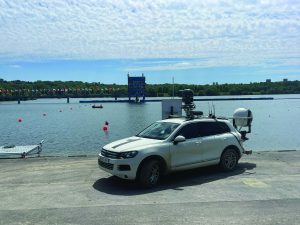
Across the country today, it’s not uncommon to see a media launch or two and a drone trailing college crews down the racecourse.
The Head of the Charles began livestreaming in 2012, and the Henley Royal Regatta made the leap in 2015. Last spring, all Intercollegiate Rowing Association and USRowing-run regattas began livestreaming on Overnght, while numerous colleges compete weekly on ESPN+ and various conference networks.
Not long ago, livestreaming was rare and largely homespun. College dual races, when covered at all, were filmed from a coach’s phone and posted live on Facebook or Instagram in all their grainy, bumpy glory.
Things have improved dramatically, but “rowing is in its infancy as far as livestream goes,” declared Lindsay Shoop, the sports commentator and Olympic gold medalist who called the rowing events at the Paris Olympic Games for NBC.
There’s still a long way to go before all rowing events of consequence are covered, and covered well. Limited budgets, inexperienced announcers, and the indifference of those in power result in broadcasts that fail to convey the excitement of the races and the effort and achievement of the rowers. And in an age when an event hasn’t happened unless it’s available on video or through digital media, this puts our sport at risk.
Getting high-quality rowing broadcasts on the air is not a vanity project or the purview of only the most prestigious events and best-funded teams. It’s everyone’s responsibility to promote high-quality coverage of rowing at every level to grow the sport by making it accessible and enticing.
The first step in providing quality rowing coverage is to commit to doing it. The Stewards of the Henley Royal Regatta had discussed broadcasting the regatta for decades, wondering, as Matthew Pinsent, four-time Olympic champion and Henley Steward, put it: “We can watch the Olympics. We can watch, on occasion, the world championships. Why not Henley?”
The cost, complexity, and technical challenges, however, were daunting. Eventually, the previous chairman of the regatta, Mike Sweeney, decided to explore what was possible and invited production companies to advise the regatta what it would take to do it well.
In 2015, Henley debuted its regatta coverage on YouTube, live and for free around the world. It’s been a resounding success, setting the standard for rowing broadcasts and featuring the first-ever live drone coverage of a sporting event.
In 2018, the athletic department’s production team approached Dave Reischman, head coach of men’s rowing, and proposed providing live coverage of their dual race against Wisconsin. As Reischman recalled, the video team, led by senior producer Kristin Hennessey and engineer Tom White, said, “Coach, we can blow this away. We want to set the standard for how a collegiate dual race is done.”
And that’s precisely what they did. Several factors enabled the crew at Syracuse to back up their assertion. The athletic department, led by athletic director John Wildhack, bought into the importance of covering all sports and doing it well.
“We’re here to develop the whole student athlete— academically and physically—and to provide that support and structure,” said Hennessey, summarizing the department’s philosophy, and that includes all athletes—from big-time sports like football to non-revenue generators like rowing.
In addition to this philosophical buy-in, Syracuse benefits from the expertise and financial support of the ACC Network, which has an in-house unit responsible for live sports coverage. This means that top-tier equipment and the professionals who know how to use it are available to the Orange.
ACC Network livestream coverage of the 2024 Syracuse Goes Trophy
The broadcasts benefit also from the presence of the S.I. Newhouse School of Public Communications, the communications and journalism school at Syracuse, which is ranked consistently among the top in the U.S. and has produced such sports-broadcasting stars as Bob Costas, Marv Albert, and Mike Terico.
Students and staff from Newhouse contribute to the livestream, giving it a professional polish, complete with in-studio commentators, coach interviews, feature packages filmed weeks in advance, and on-screen graphics that explain clearly what’s happening in the race.
Six cameras covered the Wisconsin race (the production crew wanted more but were covering two other events on campus at the same time), and a satellite truck streamed the video feed back to the on-campus studio, where the broadcasters called it.
Production is completed in house, with costs covered by the ACC Network. The athletic department spends about $7,500 on salaries for camera operators and other hourly workers on site creating the broadcast.
The greatest obstacle to creating top-tier rowing coverage is money. For example, Lake Quinsigamond in Worcester, Mass., host to dozens of regattas each spring, does not have a finish-line camera because of budget constraints.
This can and does lead to major errors in regatta coverage, as was the case last spring when the men’s varsity eight final at Eastern Sprints was called definitively, and incorrectly, for Princeton on the livestream when in reality Brown was victorious by a tenth of a second.
The call was made as the camera, positioned on shore well ahead of the finish, lagged behind the racing, making it impossible to get a clear angle of the shells as they crossed the line.
Meager financial support is a complaint heard in boathouses and regatta headquarters across the country. Many athletic departments balk at committing the funds to cover smaller sports.
“Especially with the changes going on in the NCAA,” Hennessey said, “it’s challenging to divert funds, resources, and time to non-revenue-generating sports. And that’s sad.”
Even at the biggest and most well-funded events in the rowing world, the financial commitment required for livestreaming races is huge. That’s what kept the Henley Stewards from exploring broadcast options seriously for decades.
Henley’s membership model enabled the storied regatta to make the leap. Its 7,000 members, all of whom pay an annual subscription, provided the resources to shore up Henley’s infrastructure, including the racecourse, the boat tents and grandstands, and, since 2015, the livestream.
A subscription model is becoming the norm in sports as event organizers seek to offset the costs of broadcasting. Last spring, most IRA and USRowing events were livestreamed behind a paywall on Overnght.
Gary Caldwell, the outgoing IRA commissioner, believes the arrangement will improve coverage. When announcing the extension of their partnership through 2030, Caldwell said of Overnght: “Their dedication to delivering outstanding content and enhancing the viewer experience aligns perfectly with our mission to promote collegiate rowing.”
Henley decided finally to invest in livestreaming because the Stewards were concerned about having the story of the regatta—its heart, drama, and meaning—told by others. Coverage on TV and in print tended to focus on the pomp.
“There’s a dress code, there are lots of hats, there are lots of blazers. It’s a bit of a social scene, and it’s very posh,” Pinsent said. “Coverage used to be rowing in the background and lots of people watching rowing dressed up in the foreground.”
By producing its own coverage, Henley was able to put the focus squarely where they wanted it—on the racing.
“The rowing, the racing, and the athletes are the front of the picture,” said Pinsent of the current broadcast, “and the finery, the color, and the traditions are the backdrop.”
The broadcast has given Henley “an added luster, an added appeal,” Pinsent said.
“And I don’t think there’s an accidental relationship between the number of entries we have and the appeal that we have globally.” (In 2024, a record number of international crews entered the regatta.)
At Syracuse, the quality and content of the broadcasts have attracted the attention of former and future Orange, as well as their supporters.
“People want to feel good about the program, and when they see your guys race and you’re competitive, they appreciate the effort we go to to get it done,” Reischman said.
Result: improved fundraising over the past several years, including a significant donation from an alum in 2019 after the first full ACC Network coverage of a dual race.
Parents of current students have embraced the broadcasts, and families of foreign rowers unable to watch regattas in person appreciate being able to see their children race live in a professional presentation.
Recruits, too, value the exposure, making rowing for Syracuse more attractive. Races witnessed by no more than a couple dozen spectators at Onondaga Lake, including those in the shells, are now broadcast around the globe to people who are rooting for the rowing team and donating money to support it.
The name of the game is eyeballs, and for rowing, the matter is becoming urgent and existential, at both the college and Olympic level.
As a sports journalist for the BBC, Pinsent is aware of trends in the sporting world and warns that rowing “needs to stay as high up the pecking order as we possibly can. Otherwise, we stand a chance of becoming less relevant. And that’s really dangerous.
“We should be in the top 10 of Olympic sports in terms of coverage and buzz and profile and excitement. I’m not convinced we do the best possible job at that. There are loads of new sports coming in, and we need to be taking lessons from them.”
Whether it’s an on-the-water interview with athletes just across the finish line or mic’d up coaches in the boatyard and on the bicycle path, there are many ways to attract and engage more viewers.
“We need people who watch rowing only once every four years to tune in and say, ‘That was so amazing to watch. What a great product. I really felt like I was swept up in it!’” said Pinsent.
“How many people are standing around the water cooler the next day saying, ‘Did you watch that rowing race yesterday?’ That number could always be higher, and we want it to be higher, and we need to guard against that number dropping.”
Camera car at the Olympics
Today, that means covering races professionally, not with inexperienced and volunteer commentators.
“People think it’s easy, and it’s not,” Reischman said. “It’s really tough to announce a race and try to appeal to everybody.”
Experienced commentators like Martin Cross make an event more exciting through enormous preparation and legwork. He speaks with coaches and athletes in the boatyard and on the bike path before the regatta begins. He spends hours researching lineups, collecting past results, and looking for interesting story lines on social media.
When he was invited to cover IRAs last spring, Cross created his own database by looking at lineups from earlier in the season, previous IRA results, and roster stats on each rower. He arrived at the regatta the Tuesday before racing began and walked the boatyard, introducing himself to coaches and crews and getting to know them and their stories.
“It’s a real challenge to pick out one person’s story and to have that one person on the screen and to somehow morph that into telling the story of a race,” Cross said.
Because Cross lacked updated lineups for each crew, he contacted coaches the night before racing. Similarly, Shoop emailed coaches before the Big Ten Invite, asking for information to help her get to know their teams better.
Coaches eager to improve coverage of their events would do well to emulate Syracuse’s Reischman. He and his coaches met with the production crew weeks before the Wisconsin race. They went out on the water to draft a game plan for race day and plot the best camera angles. The day before the races, coaches cut back brush and shrubs on shore to ensure ideal sight lines for the cameras. They made sure the broadcast crew had a quality launch, big enough to fit equipment that could keep up with the races.
“If people see how much you’re willing to do,” Reischman said, “they’re willing to do as much themselves.”
More than anything else, those in the rowing community need to have the vision to see what’s possible.
In his video commentary breaking down the 2023 IRA and NCAA live broadcasts, Texas coach Dave O’Neill challenged regatta organizers, especially at the NCAA, saying, “We can do a better job” than distant drone shots that fail to show individual athletes and their extraordinary exertion. These aerial views, which look like they’re shot from the Goodyear blimp, he said, don’t convey any sense of the precision and intensity as the top collegiate rowers vie to finish first with the national title on the line.
Echoing the question the Stewards asked themselves a decade ago, Reischman wondered, “Henley can do it. Why can’t we do that at the IRA?”
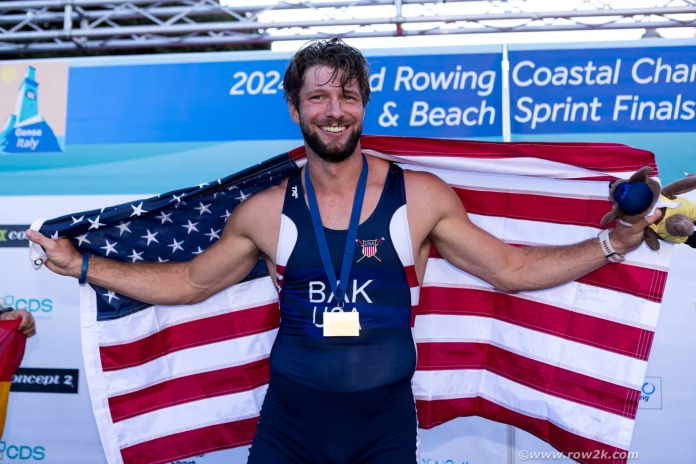
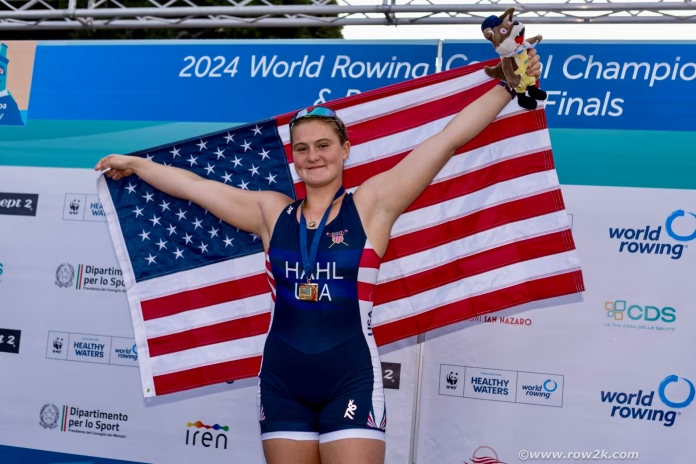
Chris Bak regained the top step of the podium in the men’s solo after illness took him out of the running last year. Annelise Hahl and Annalie Duncomb were able to end their junior’s career on a high note, winning gold in the U19 women’s double sculls. Yesterday, Hahl won gold for the first time in the U19 women’s solo and the PR3 mixed double sculls won silver in the first year of the Para event’s inception. The 2024 World Rowing Beach Sprint Finals concluded with four total medals, three gold and one silver.
Chris Bak got off the beach with a small lead in the knockout round, but the two rowers stayed close down the course, trading blows back and forth. The victory came down to the sprint where Bak was able to pull ahead. In the final heavier waves than previous races rolled in, but Bak handled them like a champion. His opponent, Spain’s Adrian Miramon Quiroga, got caught right off the beach, giving Bak an early lead. The two were neck and neck through the turn, but Bak used the waves to his advantage and pulled away from Spain. Quiroga was able to close on Bak coming into the beach, with both shells arriving on shore at once. Bak proved once again to have the speed on shore, gaining a sizable lead in his sprint to victory.
On returning to the podium this year, Bak said “It feels great, you know. I think you need the losses to be motivated, to get a new goal to strive for. I think it’s important to have those setbacks. If you’re on top all the time, it’s hard. It’s really hard. I love a good comeback story, so this means a lot.”
When asked how he would be celebrating his victory, he replied, “I really want a cheeseburger, to be honest. I love Italy. I love pasta. I love pizza. But I really want a cheeseburger.”
Annelise Hahl and Annalie Duncomb were victorious in the U19 women’s double, returning to the podium to claim gold after a collision last year cost them the competition. In the semifinal, Hahl and Duncomb had a strong start while Peru struggled to get off the beach, allowing the U.S. crew to take an early lead. They worked to capitalize on the lead throughout the race, continually widening the gap.
In the final against Spain, Hahl and Duncomb focused on honoring their final race as junior athletes. They battled with Spain through the midway point with just under a second separating the crews. In the second half of the race, the U.S. attacked their race, building on their margin and gaining speed on the fight back to the beach. They won in a time of 2:38.93, over 12.73 seconds ahead of Spain.
In the knockout round of the Open Women’s Solo, Christine Cavallo had a commanding lead coming into the turn, but veered off course following the turn and was unable to get her footing back. Cavallo finished 5.37 seconds behind Germany’s Julia Tertuente.
Beach Sprints was added to the LA 2028 Olympic program and this style of rowing continues to grow in the U.S. To learn more about this style of rowing, resources are available here.
Dani Hansen made history as the most decorated U.S. Para rower with her silver medal win in the PR3 mixed double sculls at the 2024 World Rowing Beach Sprint Finals in Genoa, Italy. Annelise Hahl won gold in the U19 women’s solo in a dynamic performance, beating Spain’s Lucia Navarro Blasco by 22.34 seconds.
The U.S. PR3 mixed double sculls won silver behind the crew from Great Britain. Hansen and Rought made quick work of the crew from Italy in their semifinal, winning by over ten seconds. Hansen and Rought traded blows with the crew from Great Britain in the final to the halfway mark until Natacha Searson and Colin Wallace were able to walk away.
“My legs are a little tired, and my voice is a little drained from communicating with Dani, but it was a great race,” said Gary Rought. “We were neck and neck with GB right until the turn buoy, lost a little speed coming out of the turn. They pulled away at the end, and I think we gave it all that we could. I mean, we walked away with a silver medal; that’s the best we could ask for.”
Hansen, a two-time Paralympian, has medaled at 11 international rowing events, including silver at the Paralympics and gold at the World Championships. This silver makes her the most decorated U.S. Para rower in history.
“I think my favorite part of doing this entire event has been rowing with Gary,” said two-time Paralympian Dani Hansen. “It’s been fun every time we’ve been in the boat, and to have it be the first ever USA to medal in this event, and the first time this event is happening at Beach Sprints, and to do it with Gary has been the best combo of all time. I’m super happy, and next year, we’re gonna come back even better.”
Hahl was triumphant today, winning gold in the U19 women’s solo. She previously won silver and bronze in coastal rowing. Hahl could finally take the top step today in Italy after a close fight with Latvia in the quarterfinals and China in the semifinals to make it into Final A. Hahl saved her best performance for the final, taking a 12 second lead by the halfway mark and increasing the lead to over 20 seconds by the finish line.
Hahl will compete against Latvia in the knockout round tomorrow in the U19 women’s double sculls with Annalie Duncomb.
Ronan Maher was unable to move past the knock round of 16, losing to Spain’s Ignacio Ramon-Borja Garcia by 10 seconds. Maher had a small lead at the second marker, but bumpy water conditions set in, and Garcia capitalized on the challenging conditions. Spain remained ahead at the buoy turn and continued to widen the gap to the finish line.
Italy knocked the mixed quadruple sculls out of the round of 16. The crew of Malachi Anderson, Cassidy Norton, Sierra Bishop, Justin Stevens and Coral Kasden finished in a time of 2:30.00, 6.47 seconds behind the Italians. The crew fought neck and neck right off the beach, but a strong turn from the Italians helped to secure their win. The U.S. tried but couldn’t make up the distance.
Racing continues at the World Rowing Beach Sprint Finals for the final crews Sunday morning in Genoa, Italy. Results can be found here. Photos from the day are available here.