Home Blog Page 30

Regattas Raise 2025 Entry Fees


USRowing announced last month that regatta entry fees will go up roughly 30 percent, after two years of no increases.

The national governing body attributed the hike to rising costs, including for improved safeguarding practices, additional referee support, and local organizing-committee expenses.

Regattas run by the Intercollegiate Rowing Association will also raise entries fees this year.

“We historically have raised them slightly every year,” said commissioner Laura Kunkemueller. “This year is similar.”

Other regattas run by organizations that have left USRowing will set 2025 entry fees after calculating new insurance costs. One of them, the SIRA regatta, will not be raising fees for 2025, according to organizer Gregory Caleca.

“Our costs this year versus previous, appear to have gone down about 16 percent,” said SIRA president Casey Baker. “SIRA has always wished to provide the best championship regatta experience for our southern members but also for those visiting teams looking to have the same kind of excellence as they prepare for their upcoming championships.”

Annual inflation rates have run between 3.2 and 8.0 percent since 2021, according to the Federal Reserve Bank. What you could buy for $100 back then will cost you $121 now, according to The U.S. Bureau of Labor Statistics’ Consumer Price Index Inflation Calculator.

Entry fees vary widely across regattas. The standard cost for eights in last month’s Sarasota Invitational was $180. Last year, the standard cost for eights at the Head of the Charles was $650, and $2,400 for Directors Challenge eights, a charitable fundraising event.

Far more crews apply to race at the Charles than can be accommodated, even after the racing schedule expanded to three days.
What Really Matters

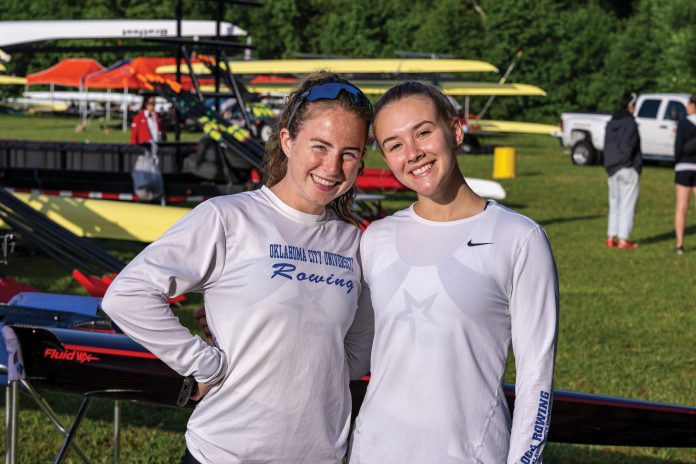
The most critical aspect of choosing a rowing program is its culture. Find a program where you connect with the athletes, coaches, and overall environment. PHOTO: Lisa Worthy.


Rowers often debate whether stroke styles or training methods should influence their choice of a college program. Just as football players select teams based on offensive or defensive strategies, should rowers and coxswains adopt a similar approach?

The answer is both yes and no.

Training philosophies vary widely among rowing programs. Some emphasize high mileage with low intensity, while others prioritize shorter high-intensity sessions. Strength training may be a cornerstone for certain teams but less emphasized in others. Understanding these distinctions can help athletes choose programs that align with their strengths and long-term goals.

Rowing styles also differ, particularly in sweep rowing. Young athletes adapt quickly typically to a university coach’s technical approach, however, and in my experience, it’s rare for a rower’s previous stroke style to limit his or her ability to transition into a new system. College coaches often blend team styles seamlessly during the first few weeks of practice.

While training methods and rowing styles are worth considering, they shouldn’t be the deciding factor. The most critical aspect of choosing a rowing program is its culture.

Find a program where you connect with the athletes, coaches, and overall environment. A negative team culture can dampen not only your rowing experience but also your entire university journey. Conversely, a supportive and positive culture fosters both personal and athletic growth.

At its core, collegiate rowing is about more than just improving speed on the water; it’s about joining a community where you can thrive as a student-athlete. Prioritize finding the right cultural fit, and everything else will fall into place. 

Robbie Tenenbaum coached at the NCAA level for over 30 years and with the U.S. Junior National Team for eight. He now helps rowers and families navigate the university recruiting process.

Kiwis and Hoosiers on Tap for Opening Day

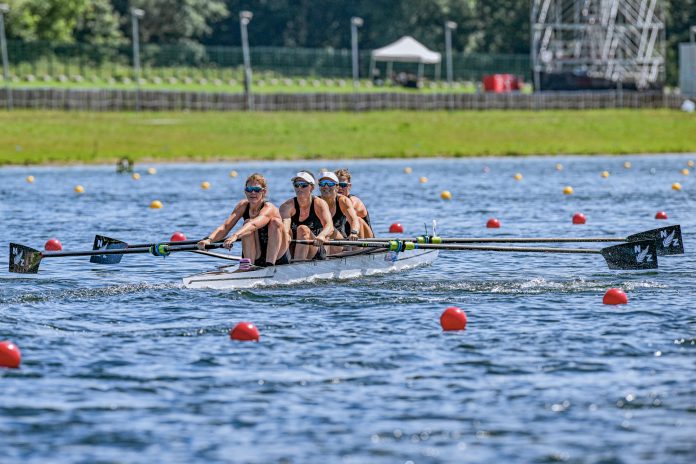
New Zealand's women's four of stroke Kerri Williams, Davina Waddy, Phoebe Spoors, and bow Jackie Gowler won the bronze at the 2024 Paris Olympics. PHOTO: Julia Kowacic.


The University of Washington’s rowing programs and Windermere Real Estate will host men’s and women’s crews from the New Zealand National Team and Indiana University at the 39th annual Windermere Cup and Opening Day Regatta, Saturday, May 3, on Seattle’s Montlake Cut.

“We’ve been looking forward to having New Zealand back at Opening Day for a very long time, and we’re excited to welcome fellow Big Ten team Indiana,” Washington head coach Yasmin Farooq said. “This has the potential to be an epic race for all three teams.

New Zealand will be sending men’s and women’s crews to compete in the Windermere Cup races, while Indiana’s women’s program will compete in the women’s Windermere and Cascade (second varsity eights) Cups.

Washington’s current women’s roster includes four athletes from New Zealand: Olivia Hay, Zola Kemp, Shakira Mirfin, and Madeleine Parker. The Husky men’s roster boasts seven Kiwis: Harry Fitzpatrick, Kieran Joyce, Marley King Smith, Oliver Leach, Will Milne, Ben Shortt, and Logan Ullrich, who won an Olympic silver medal in Paris as a member of the Kiwi four.

On the Friday night before the Opening Day Regatta, all of the Windermere Cup crews will race in the annual Twilight Sprints, a race from the traditional Montlake Cut finish line to the eastern end of the Montlake Cut.

Zagunis Family Donates $500K for Embedded Scientist

USRowing Chief High Performance Officer Josy Verdonkschot at Nathan Benderson Park in Sarasota, Florida. PHOTO: Lisa Worthy.


The Zagunis family has given $500,000 to pay for the embedded scientist called for in USRowing’s high performance plan for the years leading up to the 2028 LA Olympics.

“The Zagunis Family Embedded Scientist will allow the U.S. National Teams to use extensive analytics and data to develop and strengthen our athletes and help us accomplish our goals over the next four years,” USRowing Chief High Performance Officer Josy Verdonkschot said.

“We are incredibly grateful to Robert Zagunis and his family for this gift, which will provide the support our national team athletes and coaches require.”

Verdonkschot, along with U.S. Olympic coaches Casey Galvanek (men’s four) and Michael Callahan (men’s eight) used technology like Peach Innovation’s precision-measurement system as well as data and analysis from Brian deRegt to refine the performance of the two U.S. crews that won medals—gold for the four, bronze for the eight—at the Paris Olympics.

“As I experienced in missing the Olympic finals in ’76 by a bow ball, the margins are slim, and a slight improvement makes a big difference,” said Robert Zagunis, an investment manager who was a member of the U.S. Olympic coxed four at the Montréal Olympics.

USRowing advertised the position with a salary range of $90,000 to $105,000. The online job posting has closed, and Verdonkschot said he hopes to finalize a hire by the end of February or the beginning of March.

ROW LIKE PIGS


32-02_FeaturesXxx

USRowing Records Zero Deaths in 2024

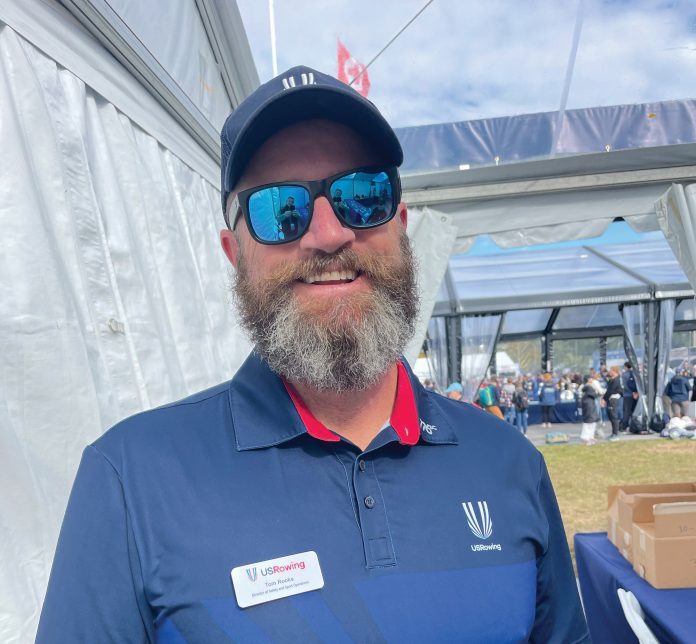
Tom Rooks, USRowing’s Director of Member Safeguarding.


USRowing members achieved zero rowing fatalities in 2024, reported Tom Rooks, USRowing’s Director of Member Safeguarding. The safety accomplishment comes after several years of multiple fatalities. While a direct connection can’t be proved, USRowing’s recent emphasis on safety and safe practices coincides with the first noted year of zero member rowing deaths.

CURRENT ISSUE OF THE MAGAZINE


How Ya Gonna Call? Ghost Racing!

Photo: Lisa Worthy


One of the limitations of race-recording review is that coxswains have such limited opportunities to practice an entire race plan on the water. It’s likely that most of your chances to do so are races and therefore not necessarily the time and place where you’re going to be able to make changes easily.

This is where calling a race off the water—also known as a “ghost race”—can be a useful weapon in your arsenal. To do this, you call a race outside of practice and without a boat in sight. You don’t need to spend hours shouting into a corner somewhere; you can do this quietly—and even in your head, if that’s more comfortable at first.

Run a clock or set a timer to ensure that you’re not getting excited and condensing a 2K race into four minutes. You should know about how long a 2K in neutral conditions takes your crew; thus, you can use time to approximate meter markers and ensure that you’re calling your race plan appropriately. Feel free to use a few written notes at first to give yourself some structure. Call the race a few times, applying different solutions to the weaker parts of your race.

This method can be helpful particularly if you’re struggling to reconcile constructive criticism with your own coxswain voice in a way that feels authentic. This is the perfect place to take risks because the stakes are nil. Get outside your comfort zone and try new things. Borrow some calls from other coxswains and try them on for size. Modify, adjust, and adapt so that you can expand your repertoire of calls.

Cox the imaginary race well. If you make a mistake, practice recovering from it. If you have a race you felt you did well except for one part, you can listen to your own recording and turn down the volume and call over your own race, giving yourself a do-over on the weaker portions.

Calling these ghost races can help you prepare also for all possible outcomes and every eventuality. This is a good way to practice especially calling a race where you’re either up or down off the field by a large margin.

If you compete in dual races primarily, you can practice racing six boats across (can you call the simulated action of the other boats and also manage your own race plan?). You can also test yourself with unexpected circumstances (what do you do if your boat catches a crab, loses the rhythm, or has an ineffective move during close racing?).

Challenge yourself and practice different responses. You won’t get the real-life feedback of your rowers but you can practice your tone, voice, demeanor, and think through some technical focuses that might help your crew. The real benefit of practicing this way is that you’re compelled to think through your race and envision what tools to call on in the moment.

Plenty of race-day anxiety can be driven by the uncertainty of handling unforeseen circumstances. Calling races this way can give you the confidence that you’ve prepared for a multitude of different scenarios and help you be mentally and emotionally flexible.

Ultimately, this should help diminish anxiety, increase the number and type of calls you make, and build the ability to call a great sprint race—any time and any place.

Hannah Woodruff is an assistant coach and recruiting coordinator for the Radcliffe heavyweight team. She began rowing at Phillips Exeter Academy, was a coxswain at Wellesley College, and has coached college, high-school, and club crews for over 10 years.