Home Blog Page 257

Finding Closure

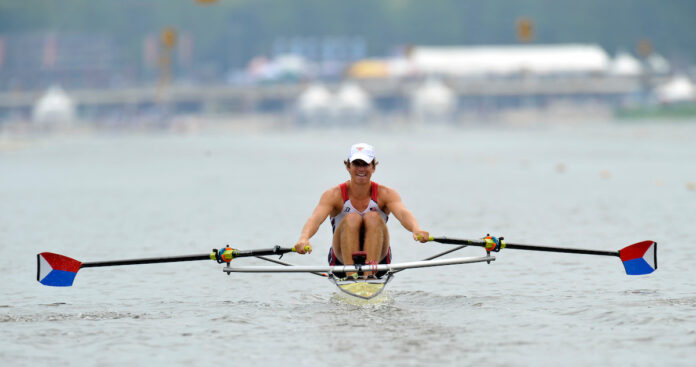
Campbell, Jr. rowing at the 2011 U23 World Rowing Championship. Photo by Peter Spurrier.
BY ED MORAN
PHOTO BY PETER SPURRIER
VIDEO BY ADAM REIST

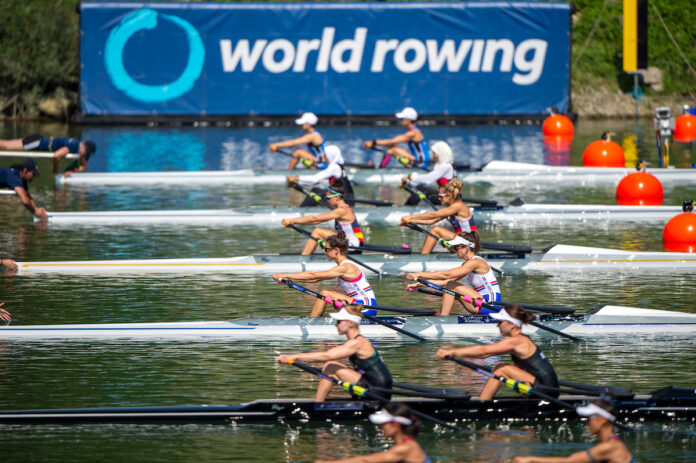
Sitting on the Lake Bled finish line moments after finishing his first race in a senior World Championship, Andrew Campbell, Jr. looked up from his boat to the results board to see that he had just edged Italy’s Pietro Ruta by a heartbeat, and had advanced directly into the lightweight single semifinal.

After the win was confirmed on the big screen, the look on Campbell’s face went from what appeared to be a complete surprise, to one of complete satisfaction. “I looked up and I saw the results and I thought, hey, I beat that guy,” Campbell said after the race.

Later that week, Campbell crossed second in the semifinal to Denmark’s Henrik Stephansen and then wrapped his 2011 campaign finishing fourth in the final. At that time, Campbell was a bit of an unknown in the world of senior lightweight rowing, and everything he was doing was still new to him.

He had by then already marked his name as a competent racer on the world circuit, winning a bronze medal in the junior single in 2010, and another bronze just before that 2011 World Championship at the Under 23 Worlds. But his career on the senior level was just getting started, and Campbell was enjoying every moment of it.

“I’m having fun,” Campbell said that week. “And a lot of this is that I’m young, and I’m not putting limits on myself. I think people who spend too long in the boat, who race for a long time in the boat, can start to put limits on who they can beat, and what they can do, where I’m coming into these races not knowing anyone, and no one knows me. And essentially, I’m operating without limits.”

That week was the beginning of an eight-year career as a senior lightweight rower in which he would go from being a young and relatively unknown 19-year-old from New Canaan, Conn., to someone easily recognizable in the world rowing community.

During that time, Campbell would have success and disappointment, including missing qualification for the 2012 Olympics at the last chance qualifier, to earning a place in the lightweight double final with partner Josh Konieczny at the 2016 Olympics.
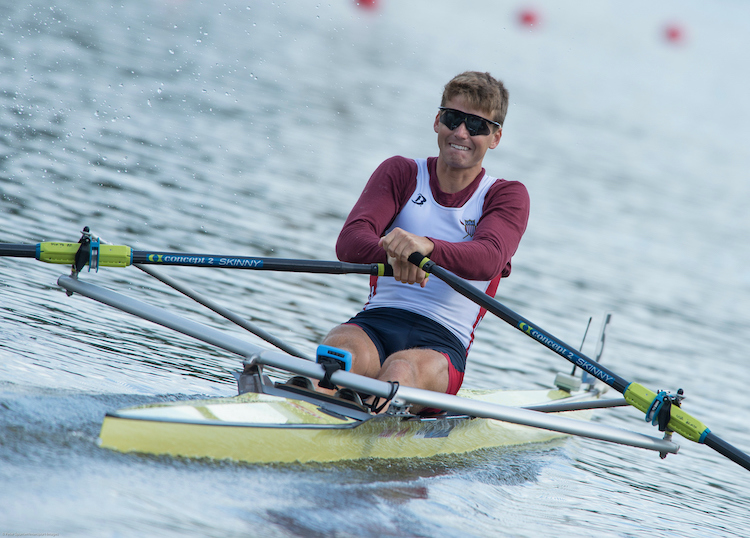
Andrew Campbell Jr. at the afternoon heat of the 2014 World Rowing Championships. Photo by Peter Spurrier.

Through all those moments – which included flipping his single in the quarterfinal of the 2014 World Championships in Amsterdam – Campbell held onto that youthful hope and spirit and saw every race as a chance to learn something new about rowing, about himself.

This summer, at the 2019 World Rowing Championships in Linz, Austria, Campbell’s run came to a crashing end when he and partner Nich Trojan finished 15th overall in the lightweight men’s double, and did not qualify the boat for the 2020 Olympics.

Sitting in the shade of the grandstands on the venue in Linz, Campbell, now 27, began thinking he did not want to go forward with his career.

Qualifying next spring would mean another 10 months of hard training, possibly with a new partner, and certainly, a very slim chance that the boat could be successful enough at the Final Olympic Qualification Regatta to row in Tokyo with only two spots open. “I just didn’t know if I wanted to go through that,” Campbell said. “I’m wasn’t sure what I could gain if I would find some new level of enlightenment.”

Campbell left Austria and went back home to Chicago, where he has been building a career as an algorithmic trading researcher in Citadel’s quantitative strategies business, a career he is enjoying. He had plans to row the champ single at the Head of the Charles and defend the course record he set in 2014, a record that still stands, and a race that he counts as one of his most memorable competition experiences, right up there with making the A final in Rio.

But the night before he was supposed to race in Boston this fall, Campbell tweeted to the world that he was not coming, he said he needed a break, and would be back next year.

He still intends to row the Charles next season, but the doubts that were haunting him in the boatyard in Linz could not be shaken. Last week, Campbell looked back on that day and talked about his decision to end his international career – and the years he had spent happily rowing without limits.

“That was a rough one, there was a lot of stuff kind of coming to a head,” Campbell said in an interview that covered his time as an international athlete, his plans for the future, and how he has found closure.

“Last year was a long one, and this past year more than ever, I’ve had real forces kind of pulling me in all different directions, namely the career thing. I was coming back in the lightweight double and had a new partner. It was like a really hard-fought year, and I could see the writing on the wall at points.

“Our odds were so slim with all the spots (in the lightweight double Olympic program) being cut, I just felt a lot of things pushing against me, and to have it finally be over was this huge relief in some sense or a really momentous reckoning.”

What it really amounted to was the end of a long career.

Campbell, Jr. rowing at the 2011 U23 World Rowing Championship. Photo by Peter Spurrier.

“I came back and contemplated getting back in the boat (for the Head of the Charles) and it just wasn’t happening. I feel a sense of closure now, the sense of closure I needed. I had lost the will to keep fighting at that level.”

When Campbell left Rio after the Olympic final in 2016, he wasn’t completely sure that he would make another run or not. But after some time, he felt that he needed to find out.

As he has done in past cycles, he went back to the single to begin training, and in 2018, he raced the single at the World Rowing Championships in Plovdiv, Bulgaria, and won his second senior bronze medal. The result was enough to move him forward towards another Olympic run, and back to Boston, where he had rowed as a Harvard lightweight, to find a new partner and begin training.

After a brief, informal camp in Boston with some of the other top lightweights in the country, Campbell decided on Trojan as his partner. They won trials, a place on the 2019 US team, and a chance to qualify the boat for Tokyo. But nothing about the spring racing was pointing to an easy qualification.

They were significantly challenged at trials, and at World Cup II in Poznan, Poland they finished third in the C final. They went back to Boston and tried to find their speed, but it just never really came together.

“The coming back part was hard,” he said. “I had a great performance at age 24 (in Rio). Athletes are supposed to peak in their late 20s, and it felt like my story was not done yet. There was definitely some room left to grow. I felt I should come back and give it a shot to kind of test out and see where my real limits lie. I finally kind of figured it out.

“I trained super hard for two years, and I sort of know I didn’t make the kind of progress I thought was possible, and that maybe I did peak in my mid-twenties.

“And that’s OK,” he said. “In some sense, I could control that, and to some extent, I couldn’t. And so, I found a real sense of closure, knowing I had played everything out to its logical conclusion, and knowing that as it stood, my odds for making it to the next Olympics were slim to none.”

And so, with his decision made, and this difficult year behind him, Campbell, is looking forward to building his career, and maybe finding some other sport to stay fit for, and then rowing in “fun races.”

But he has no regrets about leaving international competition.

“I am 100 percent satisfied,” Campbell said. “It was awesome. I enjoyed every minute of it and looking back, I don’t know really know how it all happened. I don’t know how I, of all people, ended up rising into this leadership position in the American rowing scene because I feel like I was just this random kid who was only the fifth-best in learn to row.

“It’s hard to point to towards any specific point in time when I turned a corner, it just seems so surprising that this kid, who was like the fifth best guy in the learn to row, wasn’t making the A quad, and who had to row the single by himself because he was the fifth guy. I honestly can’t even tell you how it happened, but I am glad it did. It took me to a lot of cool places, I met a lot of awesome people I would have never come across had it not been for rowing.

“I just feel so fortunate that I was given this shot to compete at that level.”
Navigating No-Man’s Land

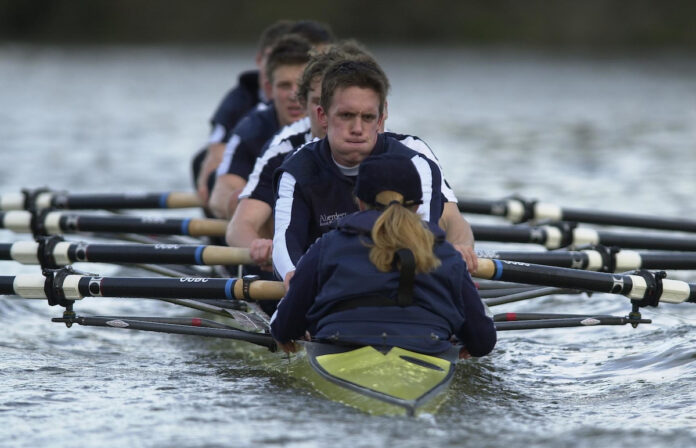
Photo by Peter Spurrier.

BY JOSH CROSBY
PHOTO BY PETER SPURRIER

March and early April in New England are the equivalent to the third 500 of any 2k—that section of the race we rowers lovingly deem “no-man’s land.” Why? For one, it’s often brutal outside. And in many spots, it becomes a waiting game for the ice to melt so you can finally take some strokes in a boat after a long season hammering it out on the rowing machine. Lakes and ponds, meant for oars dipping in and out the water, are instead dotted by ice fishermen still dropping lines. This can be torture.

Back in the early ‘90s, while getting my first competitive strokes at St. Paul’s School, I’ll never forget coach Chip Morgan’s dryland training at the beginning of our spring season. Coach Morgan kept us busy and distracted, waiting for the thaw by being creative with the team’s workouts. We did weight circuits with more bench pulls than I care to remember. We ran hill repeats and charged through the campus woods. We pushed through erg sessions and tests. And just when the ice on Turkey Pond started to loosen its grip, it was a race to the boathouse to grab heavy wooden poles for chopping and shoving ice away from the boat docks. It’s amazing how a few dozen rowers, anxious for a return to the water, can speed up the thawing process.

So, inspired by Coach Morgan, I’m delivering a little something to get you through “no-man’s land” and ready to take on your summer goals. 

15 minute Row:

3 minutes easy intensity, 22-24 strokes per minute
1 minute medium intensity, 24-26 strokes per minute
1 minute hard intensity, 26-28 strokes per minute
Repeat two times.

15 minute Strength Circuit:

Break each minute down by 40 seconds on, 20 seconds off (rest)
1 minute burpees (with push-up and jump)
1 minute V-ups (hold for 10-15 seconds and then repeat for the 40 seconds until able to hold the entire time)  
1 minute box jumps (find a height that is right for you, but 16 inches is usually good place to start)
1 minute push ups
1 minute rest/rehydrate
Repeat two times. 

15 minute Run:

3 minutes easy intensity 
2 minutes medium intensity
2 minutes hard running
30 seconds hard 
One minute walk.

The Land Warm-up

BY OLIVIA COFFEY
PHOTO BY ED MORAN

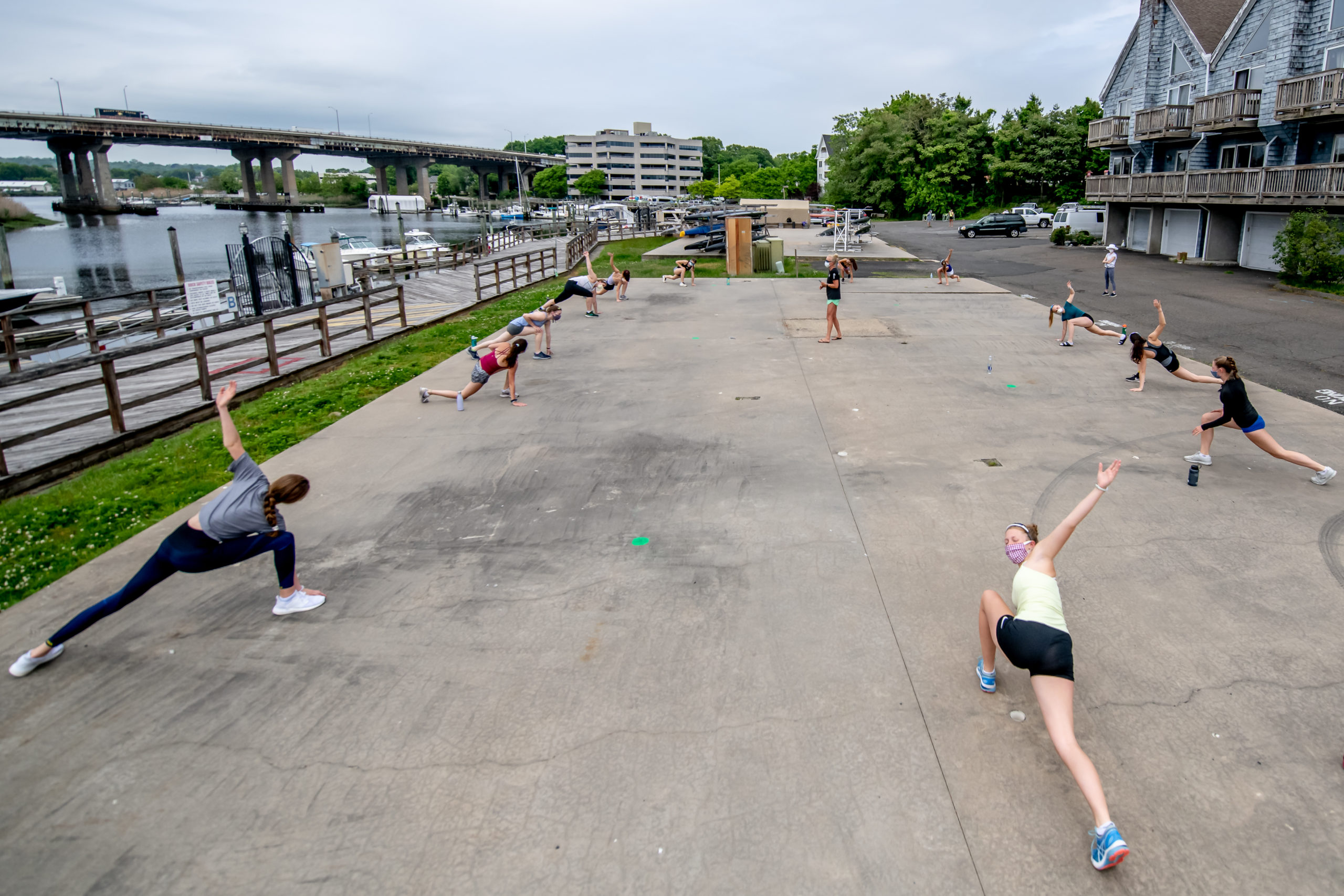
While I haven’t always been the biggest fan of warm-ups, as many of my teammates can attest, as I get older, I find them more and more beneficial. The land warm-up is something I’ve come to rely on to prepare my body to perform the rowing motion comfortably. 

Unlike a pre-race warm-up, a land warm-up is gradual and low intensity. The purpose of the land warm-up is to wake up the body and ready it for exercise. It helps you identify problem areas and can assist with preventing injury. 

After trying hundreds of different warm-up exercises throughout my career, I’ve settled on the routine below, and it has been my go-to land warm-up for close to seven years. I do this routine once a day before every rowing activity, from easy practices to world championship finals. Having a solid routine gives me the confidence to perform and settles my mind before important races.

This land warm-up works well for my body and focuses on opening the hips and loosening the low back, but everyone is different. Take time to figure out what exercises work well for you and make sure every movement is deliberate and pain-free.

While not everyone will have the time to complete a warm-up like the one I’ve described, every little bit helps. Even if it’s just a few movements before you hop in a boat, make sure that you’re giving your body a little extra attention before you ask it to perform.

1 – 10 minutes of easy cardio. The goal is to get the body moving, start sweating, and make sure all the muscles are warm before stretching.

2 – 10 reverse lunges each side with an upper-body twist

3 – Five pushups

4 – Downward dog/cobra x three

5 – Child’s pose, 10 seconds each side x two

6 – Five pushups

7 – Figure-4 stretch, 30 seconds each leg x three

8 – Deep lunge, 20 seconds each leg x three

9 – Hip flexor stretch, 20 seconds each leg x three, with overhead reach

10 – Hip bridge x 10

11 – Windshield wipers x three each side

12 – Side-lying thoracic rotation x 10 each side

13 – Foam roll any body part that needs attention.

Best of 2019

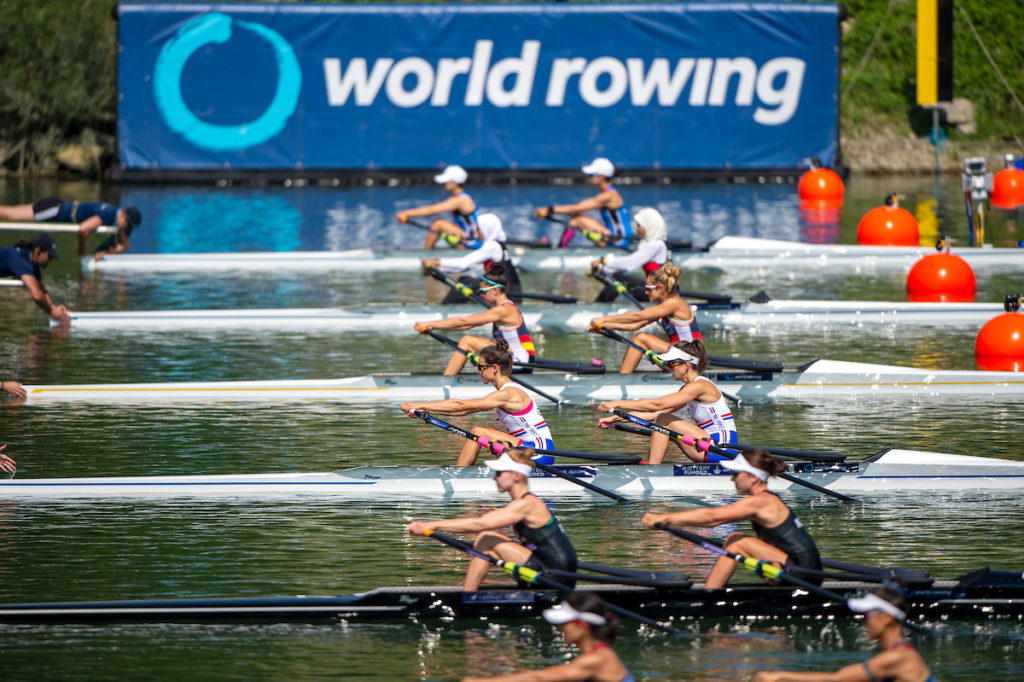
Linz, Austria, Sunday, 24th Aug 2019, FISA World Rowing Championship, Regatta, USA LW2X, Bow Michelle SECHSER, Christine CAVALLO, moving away, from the start pontoon, in their heat, [Mandatory Credit; Peter SPURRIER/Intersport Images] 11:36:45, Sunday

Our take on the athletes, events, and moments that mattered in the year in rowing.

By: Ed Winchester, Photography: Peter Spurrier


Male Athlete of the Year: Oliver Zeidler

Casual rowing fans can be forgiven for not knowing who Oliver Zeidler is. The German swimmer-turned-sculler hadn’t taken a stroke prior to 2016, and 2019 was only his second full season on the international stage. But if Zeidler isn’t a household name yet, it’s only a matter of time. Zeidler comes from long line of German national team rowers—his grandfather is a double Olympic gold medalist for West Germany and his father is a former junior world champion—and looks straight out of central casting in a Dolph Lundgren kind of way. But the real story is his performance on the water. The blond, boyish 23-year-old had a breakout season in 2019, winning his heat, quarterfinal, and semifinal at the Linz-Ottensheim worlds, and finishing first in a final considered one of the most competitive in history—just one second separated first through fifth. Zeidler’s season wasn’t without its bobbles, however. After winning the European Rowing Championships in Lucerne and the second World Rowing Cup in Poland, the high-rating sculler struggled in the rough water at World Rowing Cup III and finished a disappointing 13th. All of which adds to the intrigue of the upcoming season. Zeidler is undeniably a talent, but experience counts for a lot in an Olympic year. Will it matter that he has far fewer strokes under his belt than his competitors? We can’t wait to find out.

Honorable Mention: Hannes Ocik

The fearless rhythm-setter for the German men’s eight keeps rowing fans engaged with a robust social media presence, but it’s his quick work in stroke seat of the world-champion Deutschlandachter that holds our attention.

Female Athlete of the Year: Emma Twigg

Everyone loves a good comeback story, and New Zealand single sculler Emma Twigg’s is as good as they come. Heavily favored to win Olympic singles gold four years ago, Twigg faltered in Rio and finished one spot out of the medals in fourth. And then she walked away. While it’s not uncommon for athletes to sit out part of an Olympic cycle, in the ultra-competitive men’s and women’s singles events, such sojourns are both rare and exceedingly difficult to come back from. (See Mahé Drysdale’s struggles to return to fighting form after a one-year break.) Twigg’s two years away from the sport, however, seem to be just what she needed. Twigg looked stronger than ever in 2019, winning the Princess Royal Challenge Cup at Henley Royal Regatta and finishing first in the second and third stops of the World Rowing Cup circuit. She appeared to be on track for a similar result at worlds, too, pacing the field for 1,500 meters before reigning world champion Sanita Puspure found her extra gear in the final quarter of the race. It may not have been the medal she was hoping for, but there are times in sport when silver is as good as gold. As Twigg learned the hard way in the last quadrennial, you have to peak at just the right time, but with the Olympic Games less than 250 days away, she’s where she needs to be: back in the boat and very much in the mix.

Twigg looked stronger than ever in 2019, winning the Princess Royal Challenge Cup at Henley Royal Regatta, and finishing first in the second and third stops of the World Rowing Cup circuit.

Honorable Mention: Kara Kohler

Michelle Guerette. Gevvy Stone. And now Kara Kohler. The last 10-plus years have been very good for American women’s sculling. With an inspiring third-place showing at worlds, Kohler is within striking distance of the United States’ first-ever Olympic gold in the single.

Event of the Year: 2019 World Rowing Championships

What makes for a memorable event in rowing’s current era? Video streaming technology certainly helps, as England’s Henley Royal Regatta has demonstrated in recent years. Size matters too, with Boston’s Head of the Charles dwarfing all comers on the competitive calendar (11,000 racers over two days can’t be wrong). But in rowing, nothing is more important than what happens on the water. Simply put, good racing wins every time, and there was plenty of it in 2019—from NCAAs to the IRA to the Royal Canadian Henley Regatta. Nothing, however, could quite match the quality of this year’s senior world rowing championships in Austria. Whether you watched it in-person or caught it on cable or online, the level of racing was simply stellar. And because this year’s worlds also doubled as the Olympic qualification regatta, practically every race had significance. The quarterfinals looked more like semifinals and the B finals had as much at stake as the races for medals. This dynamic was especially pronounced in the lightweight doubles, where only the top seven finishers had their tickets punched for Tokyo, down from 11 in 2015. This, of course, is bittersweet. With weight-class rowing facing an uncertain future beyond 2020, Linz-Ottenshiem was likely the last time we’ll lightweights will vying for an Olympic berth.

Honorable Mention: 2019 Henley Royal Regatta

The toast of the British social season just keeps getting better. Along with its best-in-class live streaming, this year’s Henley Royal Regatta also celebrated the centenary of the 1919 Peace Regatta.

Coach of the Year: Gary Hay, Rowing New Zealand

The New Zealand women’s sweep team put the world on notice in 2019. After failing to make the A final a year earlier, the Kiwi big boat stormed to a three-second victory over rivals Australia in Linz-Ottensheim. (The reigning world champion U.S. women’s eight was more than five seconds off the winners.) Even more impressive was the fact that they did it with Grace Prendergrast and Kerri Gowler—who struck pair-oared gold earlier in the regatta—sitting in five and six seat respectively. The architect of the Kiwi women’s rise, Gary Hay, is a longtime Rowing New Zealand coach and former national team lightweight who was among FISA’s nominees for coach of the year 2019. The honor was justified. Hay’s charges executed near-perfect race plans in Austria, in both cases coolly stalking the leaders for the majority of the race before rowing them down in the final 250. New Zealand now find themselves with a sizeable target on their backs heading into Tokyo, but Hay has seen this movie before. The coach headed into the 2016 Olympics with high expectations for several of his crews, only to leave with a pair of disappointing fourths. With New Zealand now rumored to be focusing solely on the eight, Hay isn’t taking any chances. 

Honorable Mention: Dominic Casey

Ireland’s O’Dononvan brothers may have put tiny Skibbereen on the world rowing map, but it’s their coach, Dominic Casey, who has served as the boys’ true north.

International Men’s Crew of the Year: Irish Lightweight Men’s Double

Elite crews survive lineup changes all the time. Most, however, are not as dramatic as the change the Irish lightweight men’s double underwent in 2019. Far fewer still are as successful. To recap: After winning their first world title in the event in 2018, it was looking like Skibbereen’s telegenic O’Donovan brothers, Gary and Paul, would be putting on their podium pants again at next summer’s Olympic Games. Enter Fintan McCarty, who, with twin brother Jake, is part of another improbably fast Skibbereen sibling duo. This is where things get complicated. By the third World Rowing Cup in Rotterdam, Gary was out and Fintan was in. Despite Gary’s efforts to regain his seat, the quicker lineup remained intact for worlds. To some, breaking up a reigning world champion small boat in an Olympic-qualifying year—and in such a competitive event—is a risky move. But the results suggest otherwise. After winning their heat, quarterfinal, and semi, McCarty and O’Donovan were slow out of the blocks in the final, but quickly began working their way through the field. By the time the finishing horn sounded, the new-look combination had built up a more than 2.5-second lead on second-place Italy—a sizeable margin for the typically tight lightweight men’s double. (Gary and Paul O’Donovan also edged the Italians for gold a year earlier, but the margin was a second slimmer.) In a worlds full of unexpected results, this was perhaps the most unexpected of all.

Honorable Mention: Netherlands Men’s Eight

Judging by the impossibly close men’s eight margins at this year’s worlds, the fight for Olympic gold in rowing’s so-called “blue-riband” will be a bruising one. Look to this smooth-rowing sleeper crew from the Netherlands to be right there.

International Women’s Crew of the Year: New Zealand Women’s Pair

Doubling up is a tall order. To put it into perspective, New Zealand’s Kerri Gowler and Grace Prendergast, who rowed both the pair and eight at the 2019 worlds in Austria, had to race a total of six times over the regatta’s eight days. Even more impressive than their schedule, however, were their results: Gowler and Prendergast won every race they contested, picking up a pair of world titles and earning all-important Olympic qualifying berths for the Kiwi women’s eight and pair. And while their stunning eights victory was among the most talked-about moments in Linz-Ottensheim, it was their performance in their signature event—the women’s pair—that truly set the crew apart. Gowler and Prendergast rowed a meticulously executed final, sitting calmly in second behind the Australians for three-quarters of the race before unleashing a punishing sprint in the contest’s closing meters. A day later, they did it again in the eight—again over Oceania rivals Australia—and in the process joined an exclusive club of athletes to strike double Olympic event gold at the same regatta. Any boat that can win a world title in a pre-Olympic year could make a credible case for crew of the year honors, but Gowler and Prendergast are clearly not just any boat. “We worked really hard for this,” Prendergast said after their win in the pair. “I think that was the closest race I’ve ever been in, which made it even more special.”

Honorable Mention: Australian Women’s Four

Australia’s convincing win over New Zealand in the women’s four suggests the dawn of a new Oarsome Foursome era as the straight four returns to the Olympic program for 2020.

Men’s Collegiate Crew of the Year: Yale University

Will anyone solve the Yale men’s eight? While Washington took the team title at this year’s IRA regatta, collegiate rowing’s most coveted event—the first varsity eight—once again belonged to Yale University. For the third consecutive year, and with winning margins that grow every season, Steve Gladstone’s top boat proved unstoppable at the collegiate men’s national championship. When the waters had calmed on California’s Lake Natoma, the Eli varsity had finished three full seconds up on second-place Washington, with rivals Harvard crossing the line in third. It was a command performance by a program at the peak of its powers and among the most memorable at any level over the past 12 months. Sure, Yale’s dominance in the event—and Washington’s before that—may have been a slightly unsatisfying outcome for those who prefer a little more variety in their results. But according to Gladstone, who is quickly closing in on the all-time record for national championships, winning never gets old. “For the athletes particularly, there is a sense of satisfaction that they performed at a high level and they did it consistently through the course of the season. When a group of guys accomplishes what they set out to accomplish there is a profound sense of satisfaction.”

Honorable Mention: Cornell Lightweight Men’s Eight

Coach Chris Kerber’s varsity eight bounced back in a big way in 2019. After finishing last at the IRA in 2018, the Big Red took a nail-biter on Lake Natoma in 2019 with a 0.5-second victory over the Princeton Tigers.

Women’s Collegiate Crew of the Year: University of Washington

Washington women’s coach Yaz Farooq said just the thought of her varsity women’s eight surging through the field in their telltale yellow Empacher gave her the chills. Their win at the 2019 NCAA championships on Indianapolis’ storied Eagle Creek course “was as much mental as it was physical,” added Farooq following the race. “In racing pieces at home we work on taking risks and going somewhere you haven’t gone before.” Of course, looking back on the University of Washington’s remarkable 2019 campaign, however, the Huskies had indeed been there before. With standout wins in the varsity eight, second varsity eight, and varsity four, Farooq’s charges had earned the school its second sweep of the Division I events at the collegiate women’s rowing championship in the last three years. The trifecta also powered the Huskies to their fifth team title and places them within striking distance of Brown’s record seven championship titles.

Honorable Mention: Bates College

With wins in the first and second varsity eights, the Maine-based program picked up a well-deserved third Division III title in 2019.

Tracy Brown Named NRF Executive Director

BY ED MORAN 
PHOTO BY ED MORAN

Nearly a year after stepping into an interim role as head of the National Rowing Foundation, 1992 Olympian Tracy Brown has been named the organization’s full-time Executive Director.

“I am over the moon,” Brown said after the NRF announcement was made Friday morning. “I can’t even put it into words how thrilled I am. I’ve been interim for almost a year now, so it feels good to have this locked down.”

Brown, who joined the NRF in 2018 as Associate Director, became the interim head of the non-profit organization that raises money to help fund U.S. national rowing teams last January after then Executive Director Mara Keggi Ford stepped down.

Brown jumped into the role with a goal of helping the NRF raise $1.2 million in contributions for national team rowing in 2019, while also expanding the current pool of donors. 

 “During this important year prior to the Olympic Games in Tokyo, Tracy has shown significant success in stewarding our current supporters, identifying and capitalizing on opportunities, and has developed a strong pipeline of new donors critical to the long-term support of our National Team,” said NRF Co-Chair Jamie Koven.

“Tracy’s leadership and initiative have put the NRF in a strong position for exceeding our year-end goals and we’re excited to be working with her and the rest of the NRF team as we head into the next Olympic quadrennium,” added NRF Co-Chair Marcia Hooper.

Brown, who rowed on three past US national teams, including the 1992 Olympic squad, said this past year has been an exciting and successful one for the NRF and the goal to bring in new support and donors.

“I think we had a couple of really nice wins this past year,” Brown said. “One of the things I was really focused on was bringing in some new supporters to the organization. There had been a bunch of really super loyal people that had been with us a long time, but I think with the help of USRowing, and good collaboration between our organization and theirs, we were able to really reach out and connect with new supporters, especially the new parents of some of the under 23 and under 19 athletes that are coming into the system. 

“A lot of them have stepped into being great supporters of the NRF. Our mission has been about expanding our base and letting people know who we are. And we’ve had some great success with that,” she said.

According to Brown, the NRF’s funding goal for 2019 was $1.2 million. She said the NRF is within reach of meeting that mark and donating it to USRowing. The goal for 2020 is $1.4 million and the NRF is hoping to raise that funding in time for the 2020 Olympic Games in Tokyo. 

“For us, our goals are really about the financial support of the national team athletes, and we need to bring in as much as we can prior to the Olympics,” she said. “The Olympics are going to be a little bit earlier this year, and we are encouraging people to make their gifts to the athletes earlier this year rather than waiting until later.” 

Brown said donations are typically made in the fall and winter, and that the NRF is hoping to raise the necessary funding much earlier this year. 

“It’s exciting,” Brown said about her appointment. “But I am also feeling the pressure because I know what the athletes need, and I love them all personally. I feel like they’re all my children, and if we don’t make our numbers, it affects them.”

December Race Calendar

The 2015 British Rowing Indoor Championships. Photo by Peter Spurrier.

Dec 5-8 USRowing Annual Convention

The last time Philadelphia played host to the USRowing annual convention, in 2015, the event saw record-breaking attendance. You can expect similar turnout out this year, with the convention’s comprehensive coaching programming, special offerings for referees, and a “Best Coxswain Track Ever” providing attendees with plenty of new learnings. www.usrowing.org

Dec 7 Oxygen Optional Tournament

Kansas State Rowing Association plays host to the second annual Oxygen Optional Tournament. Held at the Chester E. Peters Recreation Complex, the event features 500-meter side-by-side erg races with competitors seeded according to submitted 2k erg scores. 

Dec 7 Mizuno British Indoor Rowing Championships

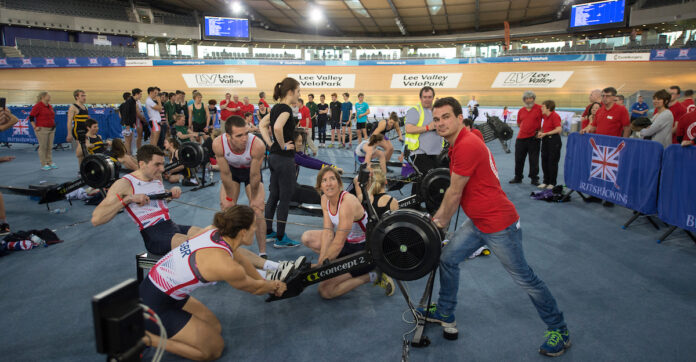
This year’s British indoors features 160 Concept2 machines “lined up and ready for action, with the motivating backdrop of bright lights, big beats, and a roaring crowd,” say organizers. Maybe they’re on to something. Last year’s event attracted more than 1,800 racers across all ages and abilities. www.britishrowing.org

Dec 8 LBRA Christmas Regatta

After going long for most of the fall, the annual Long Beach Rowing Association Christmas Regatta mixes things up with a dramatic reduction in distance. The USRowing-registered on-water contest sees rowers of all ages and ability testing their speed over 850-meter sprint races. www.longbeachrowing.org

Dec 8 Upper Potomac Erg Sprints

It seems a little early to be thinking about laying down a 2k on the erg, and that’s exactly the point. At the second annual Upper Potomac Erg Sprints, racers can establish their baseline 2,000-meter time that will help them when the indoor competitive season arrives in earnest in the new year. Rock Ridge Rowing in Alexandria, Va., hosts the event, which takes place at Rock Ridge High School. president.rrcrew@gmail.com

Dec 14 PRC Annual Winter Triathlon

San Francisco’s Pacific Rowing Club hosts its annual triathlon, which features a 12k erg followed by a full lake run, and then a run up 12 flights of stairs. For their effort, participants are awarded with a post-workout waffle breakfast. Entries are capped at 150, so sign up early to save your spot. c.wawrzonek@pacificrowingclub.org

Jan 18 Spring Sprints #1

Plant High Rowing Association hosts its first Spring Sprints of the 2020 competitive season. Held on the Bypass Canal in Tampa, Fla., the annual event marks the return of sprint racing with with events available across all classes of boats. www.planthighrowing.com

Jan 11 European Indoor Rowing Championships

The European Indoor Rowing Championships head to the Czech Republic in 2020, where some of the world’s fastest over 2,000 meters will do battle at Královka Hall, a world-class basketball facility. The event also does double duty as the Czech Rowing Indoor National Championships. www.worldrowing.com

The Contender

RowingNewsMatlackGuerette

Data Driven

The impact of Big Data in the world around us is unmistakable. From the news we read to the ads bombarding us, the analytics of daily life are far from simple. Yet for most of us, having neither the inclination nor the expertise to pull back the curtain, we simply go about our business, aware of these powerful forces in the abstract, but unable to put them to work for ourselves in any practical, meaningful way.

How we interact with technology and the ever-increasing amounts of data available to us isn’t much different in rowing. There is no doubt that advances at the cutting edge of sport science, materials technology, data collection, and manipulation are pushing our sport forward at the international level like never before. But how much are things actually changing for the average club rower, coxswain, or coach?

Impact Factor

As someone who feels he has at least a passing familiarity with our sport’s big innovations and most recent advances—many readers can probably relate—I was admittedly biased as I set out to answer this question. Of course the sport has changed. With all the new monitors, apps, force gauges, and more now available, how could it not? A call to New Zealand quickly disabused me of my assumption.

When I rang Rebecca Caroe, rowing polymath and owner of the rowing company and website rowperfect.co.uk, I asked her about which new technologies were having the biggest impact in our sport. I had anticipated a standard sort of answer that would confirm my initial conclusion. Caroe, after all, as host of the site’s podcast “RowingChat,” has interviewed dozens of experts and innovators in our sport from around the world, and is as up-to-date as it comes in terms of knowing what is out there making a difference in rowing.

“There are two things that are having a really big impact,” she tells me. “One is the ability to speak to each other, to communicate through a lot of different media. The second is using data as an additional layer of both input and output in the coaching process.”

“In terms of collaboration and communication tools, many apps aim to make it easy for people to upload their data with a couple of clicks,” explains Caroe. “That data is all pooled into a single place that makes it easy to share with whoever the coach wants to share it with—the cox, the team, the individual.”

“This collaborative approach to collecting the data and then interpreting it means that the conversation about how to adapt your program going forward is much easier to have.”

So far, so good. But when I ask about new innovative advances such as NK’s EmPower Oarlock, it is clear that she is thinking about trends in change on a far broader scale. “[Things like] the EmPower oarlock are so leading edge that they are having almost no impact across the sport as a whole [yet]. If you are talking adoption curve, it is really exciting for the 1 or 2 percent, for the rowing geeks, but they are in a massive minority.”

Early Adopters

When it comes to early adopters, national teams have always been an obvious starting point. The British company Peach Innovation has been a leader in the field of integrating biomechanical data collection with instrumentation in the boat itself. Peach’s PowerLine Rowing Instrumentation and Telemetry (usually called simply the “Peach system”) became increasingly available for use at the elite level through the 2000s.

The ability to measure everything from the forces applied by individual rowers on oarlocks and foot stretchers to oar angles at the entry and release has made Peach a big a part of the buildup to the last few Olympic Games for many national programs. Yet for all the benefits it brings, it is generally beyond the scope of teams without the budget to support both the system and the biomechanical experts required to sift through millions if not billions of data points and provide something practical and meaningful to coaches and athletes.

I have seen the Peach system in use only a handful of times and have helped install it only once, rigging up a shell with the futuristic-looking instrumentation. After taping and zip-tying the yards and yards of cables running from every oarlock, along each rigger, and down through the boat, the result was an impressive sight.

Jim Dreher and Coleen Fuerst were early adopters of the Peach system in their own coaching as well as research and development at New Hampshire’s Durham Boat Company. They have spent over a decade working with Peach and more recent, less expensive systems and shared some of their thoughts with me about the move toward more and more accessible feedback in our sport.

“Rowing is a full-body sport where you are part of a mechanism,” says Dreher. “It lends itself to analytics.”

“The Japanese were the first [to experiment with biomechanical feedback] back in 1964,” he continues, “but the ones who did a lot work were the East Germans. The Germans still probably have the most sophisticated system, but it is not commercial.”

At the core of those early systems was something called a “data logger,” Dreher explains. “That gives you all the data from the sensors in the boat to be reviewed later. A technician would have to analyze the information, give it to the coach, and the coach would give feedback to the athletes. This is not the most effective system.”

A better way would certainly be in skipping the middlemen to provide feedback directly to athletes in real time, and once again, according to Fuerst, the Germans have been at the leading edge, while this sort of thing wasn’t even on the radar for most North American coaches. “We asked a question to coaches during a presentation at the 2009 Joy of Sculling Coaches’ Conference to see who was familiar with force measurements and only two or three raised their hands,” recalls Fuerst. “I had a picture from around that time from one of the German training centers with a sort of tablet at each stretcher in the boat. They were way, way ahead.”

Innovation Takes Time

Caroe provides a bit of perspective on this discrepancy between the minority of early adopters and the rest of us. “Let’s talk about data as a tool that we are using,” she suggests. “There are a lot of different numbers that you can collect in rowing, but let’s just talk really basic stuff: strokes per minute, 500-meter splits, those two would be level 1. Level 2 might be distance moved per stroke, watts produced, and heart rate.”

“Stroke rate and splits everyone pretty much understands,” she continues, noting that the familiarity is strengthened by exposure to these on the rowing machine. Despite a clear understanding of the measurement, Caroe believes that many people still do not use 500-meter splits in on-water training. “Looking back to the adoption curve, these basic measurements are only now hitting the mass majority.”

“When we talk about distance per stroke, watts, and in many cases heart rate, these are still in the early stages in rowing,” she says. “If you are in a high-performance program, your coach may have you row on the ergometer with watts displayed, but when you look at club programs or high schools, these people have not yet incorporated watts into their practices.”

“Innovation in rowing,” Caroe proposes, “happens very, very slowly, and then happens all at once.” She points to something as simple as electronic amplification systems in the boat. “These took a very long time to get adopted, and even today there are only three international brands that sell these products.”

Empowering the Rower

One of those brands is the American company, Nielsen-Kellerman (or ‘NK’), whose recent work on a more compact, wireless system to collect and present data in real time to rowers in the boat has resulted in the much publicized EmPower oarlock.

“Absolutely it is changing the sport,” says Michael Naughton, vice president of product development at NK. “In the last few years of new technology, what was common was to measure the speed of the boat. That is a result, it is not your effort. In a single you can more closely tie the result with the effort because it is only one person, but what the EmPower oarlock does is to quantify the effort of the individual athlete in any boat. It is tremendous, it is taking the erg and putting it on the water.”

While ergs aren’t exactly about to start floating, the metaphor is apt given the ability to gather potentially more objective data on the factors that contribute to an individual’s performance within a crew.

“Peach broke ground,” Naughton is quick to acknowledge. “They have done a great job in measuring individuals.” A simple, real-time application of that information is what he and NK believe will push the sport forward even more, by putting the power of a system like Peach into the hands of individual club rowers.

One thing Naughton and NK believe will help make the data more accessible is by presenting it in a digital format, as numbers on the monitor are similar to a NK SpeedCoach display—already a familiar sight to rowers around the world—rather than a graph representing the force curve of power application during the stroke.

“This product is not a tool for the biomechanists of the world. They need data to pore over on a computer. We weren’t making a product for three people. We made a product that every junior, master, college rower, and coach can use.”

Athlete Autonomy

Central to NK’s approach with their new oarlock is the idea of putting objective information about the stroke right in front of the athlete for what Naughton calls “next-stroke improvement.”

Such immediate feedback is also a big part of what Dreher and Fuerst are working on with Durham Boat Company’s indoor tank system in particular, where they use a modified version of Peach to provide a similar real-time experience to rowers. “The time has come for force measurement in the tank,” Dreher believes, describing how the global demand for such smart tanks is higher than ever.

“The tank is so good for providing individual biomechanical feedback because you are isolated from many of the environmental factors that affect the stroke,” Fuerst adds “Even the rowers within the same boat influence each other if their timing is a little bit off or one is pulling harder than another.”

Out on the water, Fuerst and Dreher work with other similar systems including Finnish company Quiske’s range of sensors that link to a regular smartphone and Colorado-based SmartOar. They’ve seen first-hand the powerful potential of these feedback technologies for changing how athletes (and coaches) go about the business of producing better boat skills and faster on-water speeds.

“A recent example is a sweep rower who came to us late in the summer,” says Fuerst. “She arrived too late to prepare for any races, but I decided to see how quickly I could bring her along using data analytics.”  With only a basic introductory session or two to a more stable recreational single, the would-be sculler jumped into a racing single and received no on-water coaching.

“She spent a couple of weeks learning the river,” Fuerst says. “Then we put the Peach system in the boat. I coached a few times after she came in from her row as we went over the data from that session and she really got it.”

Building on the positive results of the delayed feedback provided by Peach, Fuerst decided to install the Quiske system on the same single to allow for real-time feedback as well. The novice sculler, who had already demonstrated some incredible advances in a short time began to take the coaching into her own hands once she could see what was happening as she was actually doing it.

“I had her doing short pieces out there and she could see and feel the results of all the little changes she was making to find what worked to move the boat,” says Fuerst. “She was out there playing around with the force curve and I was amazed at how well her curve looked.”

Dreher compares this process of self-discovery by the rower to a scientific experiment. “They are positing a certain theory if I row a certain way, this should happen. They can then prove or disprove it by getting out on the water (or in a tank) and trying it.

“It isn’t quite autonomous coaching yet,” he says. “But certainly this real-time feedback is one step closer. It is still a coach’s tool, but it really helps and it speeds up the learning process. That has always been a problem with traditional coaching. The coach is the interpreter for athletes and with all interpreters there is always some misunderstanding. With the real-time feedback you don’t really need that and that is the beauty of it.”

While such democratization of data may seem like it could diminish the role of the coach, this just isn’t the case says Naughton. “It is a supplemental tool for coaches,” he explains. Ideally, it is a tool that doesn’t require you to do anything that you aren’t already doing in your standard practice. It doesn’t mean that a coach is changing how they coach, but that they can now provide an objective target for the rower to work on.”

In this way, he feels, coaches will find it easier to be more effective and efficient in how they deliver feedback. “As a coach, I can say I want your slip under 10 degrees and as an athlete I can see if I hit it.”

The ultimate impact of these technological advances appears to be in engaging the athletes more and more as partners in their own development. We’ve known for years that learning and skills acquisition for the long term is most effective when someone figures it out for themselves.

I finished up my own research with a visit to Volker Nolte, whose expertise on rowing biomechanics and coaching have been a regular feature in this magazine over the years. I wanted his opinion on the interplay of real-time feedback, the collection of individual athlete data, and the role of coaching.

I ask if the future lies in coaches providing more individualized support to their athletes to reach higher and higher levels of performance. “Yes. Exactly,” he says. Everything from rigging to training plans can be tailored to an athlete’s needs. We just need to make sure we are collecting the right data to inform those coaching decisions.

“With newer technology we will know more,” Nolte says of this and of our tendency as rowers and coaches to push for conformity in the data that each rower produces. “It is more and more the case that variability may be better.” With the advances happening faster and faster around us, there is wisdom in Nolte’s words. We must be aware of the facts and adjust our beliefs accordingly.

Paradigm Shift

When I set out to write this article, I had assumed the answer to my question was that training for most rowers today was already significantly different thanks to all of the advances at the elite end of the spectrum, but now I’m not so sure. What is clear, however, is that a big change is coming to our sport on the broadest scale possible.

It is no longer a question of what that revolutionary change will be, but how soon the technology to enable it will be available at a low enough cost. Whereas many of the advances of the past have been changes to the hardware of our sport, we are just now feeling the rumblings of something far more seismic with far greater implications. It is nothing short of a paradigm shift in the dynamics of power relations, athlete autonomy, and self-directed learning.

Creating an athlete-centered environment, where rowers are engaged as partners in the development process, is something many of the best coaches and teams have always attempted to do. The ability to achieve this more easily, with less experience and on a far grander scale is the essential mechanism for this lasting transformation not just in rowing, but in all sports.