Home Blog Page 21

Doctor Rowing: How to Watch the Head of the Charles


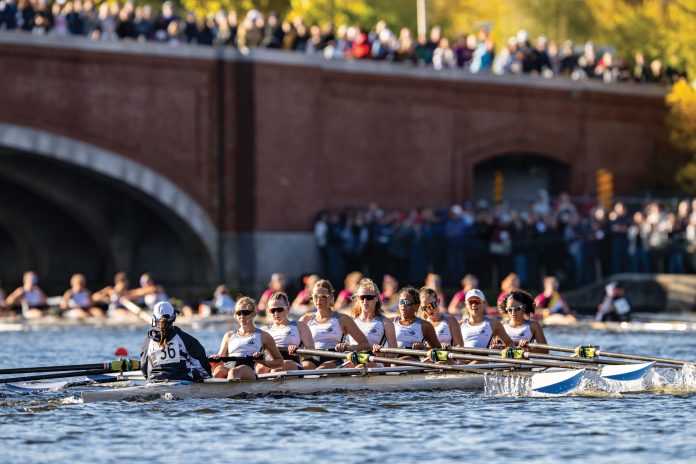
Many of you have seen him at the big head races, binoculars bored into his eye sockets, a faded USA Rowing hat pulled forward over his balding pate. Most likely, he’s wearing a threadbare Syracuse betting shirt, despite never having rowed himself. This will be his 26th consecutive Head of the Charles. Recently, I caught up with rowing’s super fan—Duane J.  Chapin.

“I first came to Boston in 2000 to see my cousin Jimmy Joe row. He was good, really good, so big and powerful that he made the oar look like a toothpick in his hands. Seeing that big broad back in a boat made you think that you’d need to load up a camel train to cross that expanse.

“He’d told me that it would be a fun day, with a lot of kegs along the riverbanks, so I thought, Why not? Back then, kegs were allowed. The next year, they were banned because of public drunkenness, but one of the MIT frats buried a bunch of kegs the night before along the shore and the beer kept flowing.

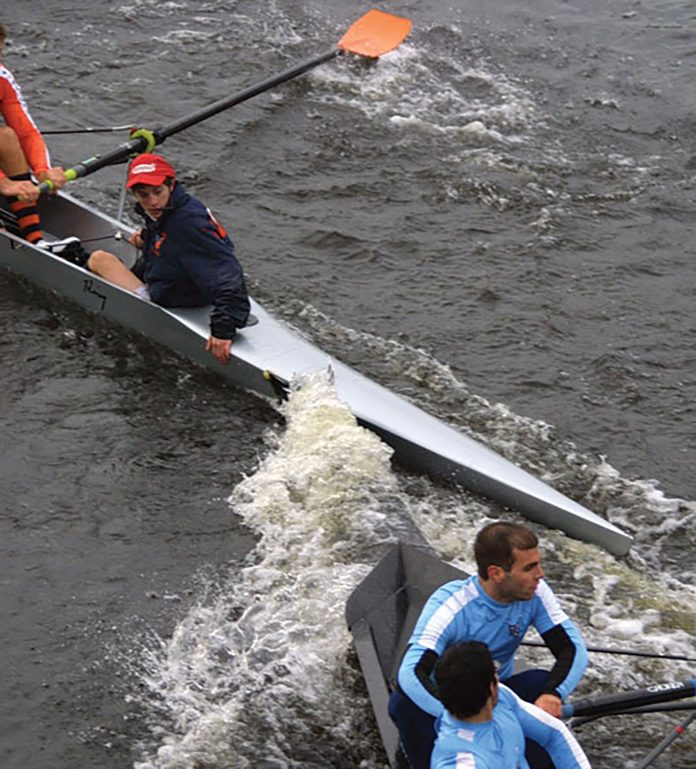
“I got to Harvard Square late and wasn’t sure where to go but I followed the stream of people down toward the river. One guy said, ‘Go to one of the bridges.’ The first bridge was the Anderson Bridge, so I walked up to get a look. Below me, I saw a couple of boats pointed at each other, trying to squeeze through at the same angle, neither one giving an inch.

“Hello, I said. This looks more exciting than I thought it would be. Sure enough, both of the boats kept playing their game of chicken. They collided. One guy kept rowing, even though his oar was smashing against the rowers in the other boat, catching one guy in the back, another under the chin. A lot of cursing and shouting.

“My God, I thought, this is it. A sport to rival roller derby or UFC fighting. The people around me were into it, too, howling for more. From then on, every time a pair of boats converged on the bridge together, we screamed our encouragement. ‘Don’t yield! You can both make it! Full speed ahead!’

“I didn’t see any other real crashes that day, just a couple of oars that smacked against the unforgiving bricks, but I was hooked. This was serious stuff, monster trucks with college degrees.

“Imagine my surprise later on when I found out from Instagram that I hadn’t even been watching at the best bridge. Well, I’ve made a point of coming back and watching from all different points, and I can tell you that there are no bad bridges; some are just more dangerous than others. All near misses are alike; each crash is exciting in its own way.

“The Footbridge is underrated. Sure, you rarely see a boat hit the abutment, but it’s so low that a fan can get close enough to almost be part of the race. My cousin Jimmy Joe said he’d never forget the time a few years ago that I had my buddies hang me over the side by my ankles. As his boat came under the bridge, I shrieked, “Two-man, look out for the bridge” from about five feet over his head. You should have seen the look on his face as he panicked and caught a crab.

“I know, you’re thinking that I’m one of those yahoos who think it’s pretty funny to drop water balloons, but I draw the line there. There’s no excuse for physical interference. But if you can’t handle a little crowd noise, well, maybe you shouldn’t be out there. Why not try croquet, chess, or interpretive dance?

“The River Street and Western Avenue bridges, down nearer to the start, have their devotees. The arches on these two are narrow and dark underneath. On a really sunny day, sometimes a sculler coming out of them will be momentarily blinded. I’ve seen some terror-stricken dudes when the crowd begins roaring, ‘Look out! Look out!’

“The other bonus about watching here is that most of the time, even on nice days, there’s choppy water between the two bridges, the product of the seawall that runs between them. One year, I saw some poor guy who wasn’t prepared hit the chop and flip. And that wasn’t the worst of it; someone had their phone out and posted the video of him diving under water for the next 10 minutes every time the next sculler came by. Dude was lucky he wasn’t decapitated.

“Jimmy Joe says that there’s nothing better for team unity than being told to row all eight square blades on your way down to the start. Togetherness is built—everyone hates the cox. There’s no feeling in all of sport like hammering your knuckles into the gunnel on a raw autumn day, Jimmy Joe says.

“Another favorite trick of ours is to pick out crews on shore with overweight coxswains, usually in the masters events. Like those poor bastards in the coxed four don’t have enough to worry about without dragging some guy who 20 years ago weighed 120 down the course. I swear I’ve seen ’swains who outweighed their strokes. Anyway, we like to yell things like, ‘Hey, you need a coxswain in that boat’ or once they’ve gotten into the boat and it settles low in the water, ‘Hey stroke, you’re rigged too low. You’ll never make it through the race with your blade on the water.’

“OK, the big one. The Eliot Bridge. This is the one with all the best social-media posts. This is where you want to be when the championship eights come churning down the course. Looking downstream, anybody who is more than a length outside the buoys as they come into view is not going to make it. But don’t focus solely on the bridge. I’ve seen some great stuff on the Cambridge and BB&N docks. Boats making spectators jump over their oars. Boats running up onto the dock, coxswains never saying a thing. Collisions between launching and racing shells.

“This year, there’s repair work going on, so the right-hand arch is closed off. Without it as an escape valve for crowded boats, I predict a banner year for crashes. The mother of all collisions is a three-boat squeeze in the championship eights through the center arch. Like sharks with blood in the water, the crowd at Eliot will go nuts.

“People think that rowing is a gentleman’s sport, a tea-and-crumpets, pinky-upraised kind of affair. Bull! If you want to see war, this is the place. Look at how those big dudes and women, too, in the black shirts, most of them probably ex-Marines, intimidate that boat beside them. Watch the coxswains try to figure out if they should keep rowing with only six oars.

Remember, this sport is all about pain; if you want to be at the point where pain and misfortune converge, the Eliot is it. On Sunday from 2:15 on, that’s where I’ll be. Enjoy yourself at the Head. There’s something for everyone.”

Last Tens—Head of the Charles musings:

Definitely playing my Old Man card here, but rowing your brains out in a hard race and then having bags of beer lowered down by alums on the row back—a tradition that has been lost—that was the best. I miss the days when you could have a beer after the race without having to pay outrageous prices.

Now that the Yankees beat the Sox in the playoffs, will some New York crew dress in Yankees uniforms to row the Charles? Like Brown did in Mets uniforms in 1986.

Does anyone row head races naked anymore? It’s been done: Head of the Trent, in the ’90s.

Do any coxswains have CoxBox speakers mounted on the bow deck facing forward to yell “Yield!” at crews they are overtaking?

Will some crazy invention be unveiled? Concept2’s Big Blade made its debut here in 1991.

Doctor Rowing, a.k.a. Andy Anderson, has been coxing, coaching, and sculling for 55 years. When not writing, coaching, or thinking about rowing, he teaches at Groton School and considers the fact that all three of his children rowed and coxed—and none played lacrosse—his single greatest success.

2026 IRA National Championship Returns to Lake Natoma

The 2026 IRA regatta, the national championship for D-I men’s heavyweight, men’s lightweight, women’s lightweight and D-III men’s heavyweight crews, will run from Friday, May 29th through Sunday, May 31st, 2026.


The 123rd IRA National Championship will be hosted at the Sacramento State Aquatic Center on Lake Natoma, May 29 to 31, 2026, after six years on the East Coast. The IRA regatta is the national championship for Division I lightweight and heavyweight men’s programs, lightweight women’s programs, and Division III men’s programs. “Visit Rancho Cordova and Visit Folsom continue to be valued partners helping our teams procure hotel rooms, facilitating local connections, and providing significant sponsorship to defray referee and staff travel costs,” said IRA commissioner Laura Kunkemueller.

Jean-Christophe Rolland Re-elected to a Fourth Term


By Katie Lane

Olympian Jean-Christophe Rolland—president of World Rowing, the sport’s international governing body, since 2013–was re-elected unanimously.

“I am deeply honored to be re-elected to serve as president of World Rowing,” Rolland said. “Serving our sport is my only ambition, and it is a privilege to lead our organization for another four years, working with our members, athletes, and partners to continue shaping the future of rowing.

“I am proud of what we have achieved and I look forward to building on this momentum together and continuing to respect strictly the values of Olympism and our sport.”

The “ever challenging world of sport” calls for an even stronger foundation and ability to adapt to change, Rolland said. The work World Rowing has done, and continues to do, is aimed at securing rowing’s future by broadening its reach, enhancing its image, and diversifying sources of revenue.

Rolland listed ways rowing has changed and adapted already— the introduction of mixed boats at World Rowing events, the revision of the progression system for classic rowing events, and the development of coastal and indoor rowing contests.

“These changes, supported by a strong consensus within our community, demonstrate our readiness to adapt to a dynamic world, while safeguarding our sport’s essential values.”

The 2025 election occurred at the World Rowing Ordinary Congress in Shanghai after the World Rowing championships. Elections were held also for vice president (Annamarie Phelps of Great Britain) and treasurer (Gerritjan Eggenkamp of The Netherlands).  
Katie Lane

Full Circle: New Boathouse for the Arlington Side of the Potomac

The Arlington Boathouse Foundation's mission is to work with the Arlington County government and National Park Service to build a community boathouse facility down river from Key Bridge in Rosslyn.


By Terry Glavin

High-school rowing teams often forge strong bonds among young people and, nearly as often, their families.

Organizing road trips to regattas, often with younger children in tow, parents augment the small coaching staff, feed voracious athletes, and share the emotions of victory and defeat. If they see a need, they fill it quickly.

When freshman Sean Bamman went out for the rowing team in 1989 at what was then called Washington-Lee High School in Arlington, Va., his needs were great.

Bamman had a season of rowing experience and good grades. But his single mother was a high-school dropout who had given birth to him when she was 15 and later became a heroin addict. Until he ran away to his grandmother’s home when he was in ninth grade, Bamman had moved with his mother from one crummy apartment and seedy motel to another, when they weren’t living in a car. For a college essay, he counted the places they had lived. He stopped at 43.

“It’s weird, because a lot of people describe the water of the Potomac as being rather choppy and chaotic,” Bamman said. “But to me, it was kind of like this safe haven from all the crap I was dealing with.

“It was magical.”

Although Bamman thought he was hiding his situation well, he was self-conscious and feared people were scrutinizing him for signs he was poor and parentless. His situation must have been obvious to anyone who cared to look; neither his mother nor grandmother ever attended any of his rowing events.

“A lot of the team, the team’s families, kind of adopted me in different ways,” he said.

Unbeknownst to him until much later, an anonymous family was paying his rowing fees and regatta travel expenses— costs he assumed his grandmother was covering. A teammate’s mother found him jobs that provided spending money for clothes and other things kids in normal situations enjoy.

In his junior year, when his grandmother lost a job and had to move out of the school district, Bamman lived with a teammate’s family so he could continue to attend and row at W-L.

“There were other families, too, that were from the team who would provide for me in the nicest ways, like, ‘Hey Sean, I’ve got this extra pair of shoes. They don’t fit me. Do you want them? I can’t return them.’ You know, in a way that didn’t hurt your pride.

“So, it was a village, and it was a very supportive group, and I am again very fortunate to have had the friends and teammates and their families who did look after us.”

Because his grandmother lived nearly all her life in Arlington, it remained home base despite the many moves. The strong bonds formed on the team and the lifelong nature of the sport have helped keep many former teammates and W-L alumni in touch.

Arlington, and W-L in particular, have a long and distinguished rowing history, dating to 1949 when Charlie Butt began building his legend as founder and coach of the W-L rowing team. During the 41 years he coached, W-L varsity eights won the Princess Elizabeth Challenge Cup at the Henley Royal Regatta two times as well as many national championships.

“We had a really good freshman eight,” whose members included Michael Callahan, later an Olympic rower and today the head coach of the immensely successful men’s rowing program at the University of Washington. “There was a good energy to the team then, from varsity down to freshmen, and we had a lot of good wins and a lot of fun,” Bamman said.

Butt, an MIT graduate and engineer with the Navy Bureau of Aeronautics, coached until 1991, when he retired because of acute leukemia, from which he died the following year. His son, Charley Butt, is the Bolles-Parker Head Coach for Harvard Men’s Heavyweight Crew. In addition to coaching, he was instrumental in creating the rowing facility at the Occoquan Reservoir and devoted much of his energy late in life to establishing a boathouse on the Arlington side of the Potomac.

At the time, the W-L team was rowing out of the century-old Potomac Boat Club, with its walls of photographs of winning teams and famous rowers. Bamman, who lives in Arlington today, continues to row with Potomac.

It was there that in June 2024 he spoke with Nancy Butt Packard, one of Coach Butt’s daughters, and learned that the boathouse effort, an idea he’d heard about when he was a high school rower, was making quiet progress. Nancy Butt is a director of the Arlington Boathouse Foundation (ABF) that was formed in 1991 to fulfill Coach Butt’s vision. Last December, Bamman joined the ABF board to lead its fundraising campaign.

Since its founding, the all-volunteer ABF has been grinding through the regulatory process, seeking approval from multiple jurisdictions, advisory councils, and agencies, even as the need for a new boathouse—obvious in Coach Butt’s time—has grown with the local population and the surging popularity of rowing.

Arlington is walled off from nearby water by the George Washington Memorial Parkway, completed in 1932. As a result, rowers and other water-sports enthusiasts in Virginia must cross to the Washington, D.C., side of the Potomac to launch their boats.

“Arlington County does not have a single access point to the Potomac River,” Bamman said. “The Arlington County Boathouse would be that access point. Having this one boathouse would all of a sudden open it up to 800 acres of what we could call green space or water space.”

On the D.C. side are the Thompson Boat Center, dedicated in 1961, and the Potomac Boat Club (PBC), established in 1869. Farther away are the Anacostia Community Boathouse on the Anacostia River and the Dee Campbell Rowing Center, in Alexandria, Va., south of Arlington County. None of these facilities has the capacity to handle the increasing number of  young athletes the sport has attracted in recent years, said Lena Wang, PBC president and a lifelong Arlington resident who rowed for Wakefield High School there as well as with a PBC junior program when the club hosted them.

These facilities house multiple clubs and high-school programs, and “there is no room for a school or club to grow due to the limited rack space,” she said, not to mention the fees charged by the corporate owners.

The Thompson Boat Center is home to 13 high-school crews, two college teams, and two masters programs, all of which store their equipment and launch from there.

Washington-Liberty High School, as W-L is known now, keeps its boats currently at Columbia Island Marina, on the Pentagon Lagoon and accessed from the Virginia side of the river even though it’s part of the District of Columbia. Columbia Island, next door to the Pentagon and Ronald Reagan Washington National Airport, has no boathouse, and the W-L boats are stored there on roofless racks. The marina is managed by Boating in D.C. under a concession agreement with the National Park Service.

W-L’s rowing program moved out of PBC in late 2024 after the needs of the club and the youth program began to conflict.

Ground for the Arlington Boathouse won’t be broken for a while, but several developments represent great progress, said Paul Holland, ABF president since the middle of 2024 and a board member for almost 20 years.

“Recent developments—including Arlington County’s adding the project to its 10-year capital-improvement plan, an agreement between ABF and the Arlington Community Foundation, and ABF’s commitment to raising $2 million in support of the project—are very exciting,” Holland said. A senior program analyst with Reston-based Leidos, the defense industry’s largest IT services provider, Holland rowed starboard to his twin brother’s port for W-L before rowing as a Princeton heavyweight.

As part of its agreement with ABF, the Arlington Community Foundation will handle private donations, enabling the boathouse foundation to receive larger tax-deductible contributions.

The venture has been complicated by a lack of waterfront land and the tangle of overlapping jurisdictions involved, including Arlington County, the National Park Service, and the District of Columbia (overseen by Congress).

In 2018, after considering possible sites, the Park Service chose a slice of waterfront just north of the channel between Arlington and Roosevelt Island. Plans call for a 14,000-square-foot boathouse and a 300-foot-long floating dock.

The boathouse and dock will occupy the so-called “lower site,” a small area wedged between the parkway and the river. A building with locker rooms, showers, bathrooms and service-vehicle parking will be situated at the “upper site,” out of the flood plain and on the other side of the parkway. That property of two-thirds of an acre is owned by Arlington County. The two sites will be connected by an existing pedestrian bridge.

An agreement for the use of the sites was signed in 2019 with Arlington County, the National Park Service, the National Capital Planning Commission, the D.C. State Historic Preservation Office, and the Virginia State Historic Preservation Office. The agreement gives the county until 2029 to complete the lower site.

While the plans do not include on-site parking, hundreds of spaces are available in parking garages in the Rosslyn central business district, half a mile or so from the lower boathouse site. The site also is less than a 10-minute walk from the Rosslyn Metro station, which connects with three lines. It’s also adjacent to a bike path and hiking trail.

The estimated cost of the lower site: $15 million (split 60-40 county and private funds).

In 1992, Arlington County voters approved a $1-million bond issue for the early stages of the project. In November 2022, Arlington residents approved a bond issue of $2.93 million for planning the boathouse, part of a larger budget item for park-related capital projects. The county’s capital-improvement plan for fiscal years 2025 to 2034 calls for $9.6 million in boathouse funding in fiscal year 2028, but the Arlington County Board will have to ask voters to approve that bond issue.

Said ABF President Holland, “I am optimistic the project will be completed and we will be rowing out of the facility in the early 2030s.”

“After decades of advocacy and planning, this boathouse is long overdue” said Jay Fisette, a supporter of the project when he was an Arlington County commissioner from 1998 to 2017. “The use of the Potomac River for non-motorized boats benefits everyone who wants to exercise in nature–especially our young adults.

“Let’s get this done.”

Bamman graduated from W-L and the University of Virginia, where he had a need-based scholarship. He rowed at first with UVA’s club team but realized he wanted to concentrate on his studies. At UVA, he made connections that helped him found a successful company that provides real-estate, zoning, permitting, and engineering services for wireless carriers. He and his wife have four children, including two sons who show signs already that they share their dad’s love of rowing.

He’s glad to help push the Arlington Boathouse over the finish line for the county and the sport.

“It’s like rowing—it kind of recharges me. I think not only of the connection I have with Charlie and his vision but also the future of rowing in the area and how much Arlington County has given me.

“The three primary high schools that row are rowing out of three different locations, and we need them to row under one roof. There’s such a great need because all the other places are at or beyond capacity and with expiration dates. New facilities are going to open rowing to the next generation.

“Rowing and Arlington gave me so much opportunity. To go from basically nothing to where I am now—working on this project some 30 years later—is like coming full circle.”

How you can help: Donations toward the boathouse project can be made via the Arlington Community Foundation’s website. Further information about donations is available from the Arlington Boathouse Foundation’s website arlingtonboathouse.org or by contacting Sean Bamman at sean.bamman@arlingtonboathouse.org.

World Champ Murtagh Returns to Boston for Head of the Charles

Ireland's Fiona Murtagh beat Great Britain's Lauren Henry by .03 to win the 2025 World Rowing Championships in Shanghai, China. PHOTO: Lisa Worthy.


By Katie Lane

This year’s World Rowing champion in the women’s single Fiona Murtagh will return to Boston to compete in the 60th Head of the Charles Regatta, October 17-19. Murtagh captured the gold medal for Ireland by .03 in Shanghai in September, ousting Great Britain’s Lauren Henry at the line.

“October in Boston is my favorite thing in the world,” said Murtagh. “It’s been so long since I’ve experienced that and I’m just really looking forward to it. It’ll be a great opportunity for me to catch up with people and experience something new.”

Murtagh is no stranger to the Head of the Charles. While rowing for Fordham University, Murtagh won back-to-back in 2014 and 2015 in the women’s club four, holding the course record of 18:19 until 2023 when Duke University improved it to 17:46. In her final year at Fordham, she raced in the club eight that placed fifth overall.

“Ten years can really change a girl, especially going from an eight to a single,” said Murtagh. “Racing the single, let alone racing the single at the Charles, has been a bucket list item.” She noted that this year will be interesting, having to navigate the course herself rather than having a coxswain.

“The Charles is interesting because of the steering. It has corners and turns. If anyone reading this is watching on the day I come down the course and wants to give me a shout so I don’t hit a bridge that would be great!”

Outside of steering, Murtagh is looking forward to coming down the course and “just giving it a go and having fun.”

Murtagh will race bow #4 in the women’s championship single on Saturday October 19th, 2025.

Winklevoss Twins Give $6.5 Million to U.S. National Team

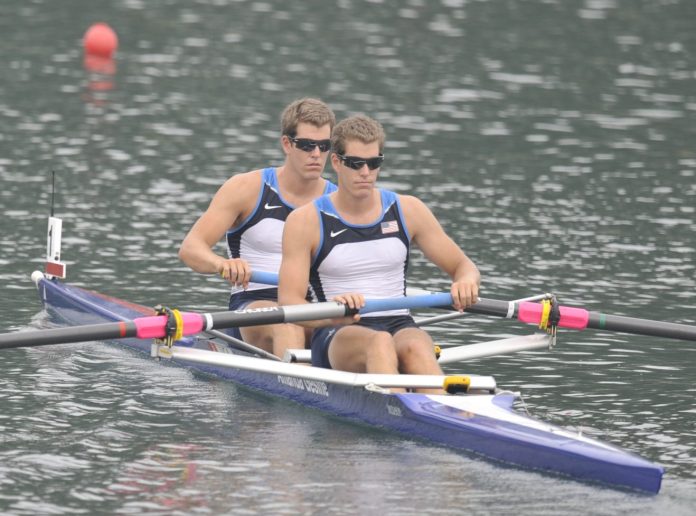
Cameron and Tyler Winklevoss represented the United States in the men's pair at the 2008 Beijing Olympics, advancing to the grand final. PHOTO: Intersport-images..com


Cameron and Tyler Winklevoss have made a record $6.5 million donation to USRowing to support the U.S. National Team—renamed the Gemini.com U.S. National Team—through the LA2028 Olympic and Paralympic Games. The gift is the largest ever made to the United States Rowing Association (USRowing). The Caspersen Boat House at the training center on Mercer Lake in West Windsor, N.J. will be expanded and the new facility will be named the Winklevoss Training Center.

“This is really substantial,” said USRowing Olympic boss Josy Verdonkschot, The McLane Family Chief High Performance Officer. “This extraordinary contribution provides the foundation to further professionalize and elevate our high-performance environment.”

The Winklevoss twins began rowing at Saugatuck Rowing Club, coached by James Mangan before heading to Harvard, where they rowed in Harry Parker’s heavyweight program. At the Beijing Olympics in 2008, the brothers, coached by Ted Nash, raced in the grand final of the men’s pair, the pinnacle of their nearly decade-long U.S. National Team careers. They went on to found the crypto currency platform Gemini and Winklevoss Capital.

“Rowing has taught us some of the most valuable life lessons,” said Cameron Winklevoss. “So we’re passionate about increasing access to the sport and cementing its future in the United States.”

Getting Ahead at Head Races

Nearly 10,000 athletes will row at the each of major U.S. autumn regattas, Head of the Charles, Head of the Schuylkill, and Head of the Hooch. PHOTO: Lisa Worthy.


Autumn is the exciting time of head races, which have their own unique rules and challenges. They come in a variety of formats and are contested on different courses over different distances.

Featuring individual boats starting at set intervals and racing against the clock, head races require rowers, and especially coxswains, to possess skills and qualities that are completely different from those exercised in side-by-side races.

Consequently, you have to prepare specifically for this type of race, beginning with physiological conditioning, since these races are significantly longer than sprint races and therefore require endurance above all else.

The energy supply for a long-distance race is approximately 95 percent aerobic and five percent anaerobic. Although the anaerobic component is important at the beginning and end of the race, as well as when a rival boat needs to be overtaken quickly, and although sometimes it can determine the outcome, the aerobic component is more essential for success.

The second most important factor in a head race is the ability to steer the fastest route to the finish line. This begins with knowing the course by studying it on a map and identifying crucial sections and features—turns, bridges, buoys, obstacles. Seek out someone who knows the course from experience and can give you advice and pointers. Also, try to row the course before the regatta to gain familiarity. Note landmarks that will help you plot when to begin steering, where to steer, and how far you’ve come.

Then there’s race strategy, which begins with the optimal approach to expending your energy throughout the race (explained in detail in my new book, Rowing Science). In short, you should start five to 10 strokes before the actual starting line. Race organizers usually give you the necessary leeway to line up at the start and accelerate toward the starting line. The key is to reach the starting line exactly at the middle of your race pace, not at the highest possible speed.

You then use up your high-energy phosphates for a short 10-stroke sprint before switching to your race pace—the fastest pace you can maintain for most of the distance. It’s important to transition slowly from the fastest speed achieved in the 10 starting strokes to race pace to make the most of the speed gained.

You also need to produce some lactate, which kick-starts your cardiovascular system for peak performance. The trick is to avoid accumulating too much lactate while finding the most efficient stroke rate for your race pace. I call this “red-lining,” where you push the limits of your aerobic system without accumulating too much lactate.

Intrinsic to this approach is finding your best stroke rate. Too low a rate requires a higher force output, which tends to produce more lactate. Too high a rate can lead to technical deficiencies because you either shorten your stroke length, making propulsion less efficient, or you rush your recovery, interrupting your flow and reducing the recovery time your body needs. In training, you need to find the right mix of stroke rate, stroke length, and force output; it should feel fast but sustainable.

The final step is to hit the right finishing sprint. This shouldn’t occur over a long distance or by significantly increasing your speed; actually, if you can do that, you went too slow up to that point. Depending on your experience and fitness level, the sprint could be as little as 200 to 400 meters or 20 to 40 strokes. Break it into smaller chunks of seven strokes, increasing your effort and stroke rate with each interval.

Setting the correct rigging is also important and is based on your training, wind and water conditions, and expected pace changes in the turns and when overtaking competitors starting directly in front of you. If you expect pace changes, you should lighten your rigging a bit.

Last but hardly least is mental preparation. Be prepared for commotion in the starting area. Some boats may not follow the traffic rules; others may cause distraction and anxiety. You may be subjected to unwelcome jolts from your opponents before the race even begins.

A head race also requires a different level of physical exertion and fatigue tolerance over a longer period of time. The ideal is to find your flow—a level of exertion that feels fast but easy, focuses your mind on the immediate moment, and allows you to perform confidently and well. This requires full concentration on the task at hand.

Head races can be exciting and fun, and by emphasizing long-distance training and perfect technical rowing, excellent preparation for next spring’s sprint races.   

Volker Nolte, an internationally recognized expert on the biomechanics of rowing, is the author of Rowing Science, Rowing Faster, and Masters Rowing. He’s a retired professor of biomechanics at the University of Western Ontario, where he coached the men’s rowing team to three Canadian national titles.

Prepping for Fall Head Races

Prior preparation prevents poor performance. PHOTO: Lisa Worthy.


Jitters the morning of a race are a positive signal that you are ready for a challenge. How the rowing universe decides to test you over a given course is unpredictable. It can tangle your rudder ropes to complicate your steering or give your boat some extra oomph to cruise past a crew you’ve been chasing all season. Prepare for your events well before you get to the course.

Train for event-specific conditions. In addition to the right endurance work and distance trials, be prepared for the climate in which you’re racing, especially if it’s different from the one at home. If a warmer location, do some rows during a hotter part of the day; if a cold location, make sure to have warm clothes, especially for head and hands. Before you travel, make a list of everything you plan to bring and plan for nasty weather as well.

Know the course. Study the twists and turns of the race route and row workouts that include similar turns. Commit the image of the map to memory and design your race plan with words or moves that will help you stay in the moment. Row over the course before the race to identify landmarks.

Train your eating. Experiment with pre-row meals or snacks. Once you establish what works for you, stick with that on race day, too. If you race at an unusual time of day, use some weekends to simulate your actual race day and develop an eating/warm-up plan.

Arrive early; don’t crowd your day. If you are traveling to a race, it can take several hours for your body to recover from the dehydration you can experience on an airplane. Avoid alcohol and caffeine, drink lots of water, and wear compression socks on the plane.

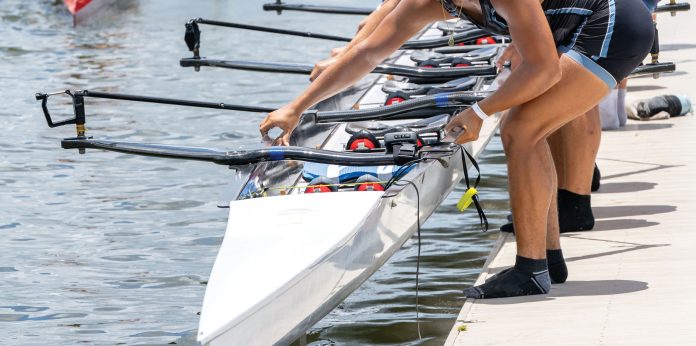
Consider arriving 48 hours before the start so you have time to adjust and relax. If racing close to home, arrive at least 90 minutes before you launch so you can pick up your number and rig your boat.

Marlene Royle, who won national titles in rowing and sculling, is the author of Tip of the Blade: Notes on Rowing. She has coached at Boston University, the Craftsbury Sculling Center, and the Florida Rowing Center. Her Roylerow Performance Training Programs provides coaching for masters rowers. Email Marlene at roylerow@aol.com or visit www.roylerow.com