Home Blog Page 2

Predicting the Podium: How Good Are Collegiate Rowing Polls?

Photo: Lisa Worthy.


By Kieran Harrington

On April 28, the Collegiate Rowing Coaches Association released its Week 8 CRCA/Pocock Coaches Poll, the ninth of the 2026 season, including the Feb. 17 pre-season edition.

By the end of the season, all three national collegiate championship leagues—NCAA for women’s varsity programs, IRA for men’s varsity programs, and the ACRA for club programs—will have published multiple coaches polls.

The polls are administered by the coaches’ associations: CRCA for the NCAA; Intercollegiate Rowing Coaches Association (IRCA) for the IRA; and the American Collegiate Rowing Association for themselves.

National rankings provide an immediate shorthand for programs, regattas, and fans, indicating how a crew’s season is going, the challenge of the next race, and the importance of a result. A ranked crew gets more attention, period. And in Olympic sports like rowing, which are losing ground in the allocation of athletic department resources in the age of NIL and conference realignments, earning positive attention is vital.

While these rankings generate interest throughout the season, their predictive accuracy varies. For the NCAA, the championship seeding polls are different—and run separately— from the CRCA polls. For the IRA, polls operate under a joint agreement between the IRCA and the IRA. The ACRA is its own authority.

A comparison of final polls from recent years with actual NCAA championship results suggests a clear pattern: Accuracy is highest at the top of the rankings, while variability increases significantly in the middle of the field.

In 2024, the final CRCA/Pocock Coaches Poll aligned closely with championship results at the top, with most remaining teams deviating by only one or two positions, producing a mean absolute error (MAE) of 1.78 positions. This indicates moderate predictive accuracy, with errors concentrated outside the top five.

In contrast, the 2025 championship results diverged more substantially from the final poll. Although Stanford University was projected correctly to win the team championship, Yale University outperformed its ranking to finish second. The University of Texas and the University of Washington, both projected to finish on the podium, placed third and fourth, respectively. Overall, the poll produced a lower mean absolute error of 0.89 positions, indicating stronger numerical accuracy

Similarly, the IRCA releases a poll series projecting the top collegiate men’s programs. In 2024, the IRA varsity men’s heavyweight eight championship concluded with the University of Washington finishing first, which was consistent with the final Week Six poll. Beyond the top position, however, the poll showed more variability. Notably, Harvard (second) was ranked sixth, and Brown (eighth) was ranked as high as second in the poll. Calculating the MAE across the top 10 crews yields an error of approximately 1.78 positions, meaning that on average the poll was 1.78 places off of the IRA championship results.

In the 2025 IRA varsity men’s heavyweight eight championship, the University of Washington, Harvard, and Dartmouth finished first through third, while the final poll had California ranked first and Washington second. While much of the top five remained similar in composition, several crews experienced notable positional shifts—most prominently, California, which was ranked first in the poll but finished seventh, and Brown, which outperformed an eighth-place ranking to finish fifth. The MAE was almost two positions, with California’s unexpected finish in the petite final after crabbing in a rough semifinal contributing significantly.

The ACRA polls and results reveal similar measures of error, with an MAE of 0.9 when compared to the final results.

In 2024, the women’s varsity eight ACRA medals were captured by Vanderbilt, Purdue, and Northwestern. The polls proved to be almost two spots off, with the average error 1.9 places from the actual finish. Improving only slightly in 2025, the polls were 1.7 places off in their predictions of the ACRA medal winners— Vanderbilt, Northwestern, and Bowdoin.

As the 2026 season enters its final weeks, historical comparisons suggest that ranking systems are most reliable in identifying the top-performing programs, while mid-tier placements remain considerably less predictable.

The upcoming ACRA, NCAA, and IRA championships will provide a further test of the pattern.
Washington Unanimous #1 in Week 4 Poll

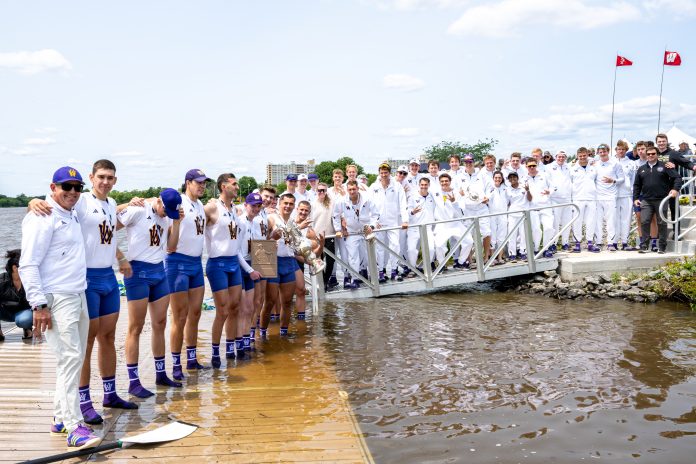
Washington won the James Ten Eyck Memorial Trophy at the 2025 IRA National Championship with the highest overall points (285). The Huskies also won their 21st national championship in the varsity eight, won the second varsity eight, and the varsity four. Photo: Lisa Worthy.


Division I-II Heavyweight Men’s Varsity 8

Rank School (1st place votes) Points Previous
1 University of Washington (9) 225 1
2 University of California – Berkeley 216 2
3 Princeton University 207 3
4 Harvard University 198 4
5 Stanford University 186 5
6 Brown University 178 6
7 Dartmouth College 166 7
8 University of Pennsylvania 159 8
9 Northeastern University 150 11
10 Yale University 147 10
11 Boston University 142 12
12 Syracuse University 132 9
13 Cornell University 115 13
14 Columbia University 106 17
15 University of Wisconsin 97 14
16 Temple University 92 18
17 Drexel University 79 16
T-18 Georgetown University 66 19
T-18 US Naval Academy 66 15
20 La Salle University 54 21
21 College of the Holy Cross 48 20
22 Santa Clara University 29 T-23
23 Marist University 26 22
24 Gonzaga University 20 NR
25 Oregon State University 11 T-23
Saint Joseph’s University (9), MIT (1)


Division III Heavyweight Men’s Varsity 8

Rank School (1st place votes) Points Previous
1 Trinity College (5) 89 1
2 Wesleyan University (1) 85 2
3 Tufts University 78 3
4 Williams College 72 4
5 Marietta College 66 5
6 Colby College 60 6
7 Bates College 54 7
8 Ithaca College 47 8
9 Hamilton College 42 9
10 WPI 37 10
11 US Coast Guard Academy 30 11
12 Milwaukee School of Engineering 20 12
13 Skidmore College 18 13
14 Washington College 12 14
15 Franklin & Marshall College 10 15


Lightweight Men’s Varsity 8

Rank School (1st place votes) Points Previous
1 Harvard University (10) 100 1
2 University of Pennsylvania (1) 88 3
3 MIT 83 2
4 Princeton University 74 5
5 Yale University 62 4
6 Georgetown University 52 6
7 Cornell University 45 9
8 Dartmouth College 43 7
9 US Naval Academy 28 8
10 Columbia University 20 10
11 Mercyhurst University 10 11

Texas Displaces Stanford Atop CRCA/Pocock Coaches Poll

CRCA/Pocock Coaches Poll


Division I

Rank Team 1st Place Votes
1 University of Texas 17
2 Stanford University 8
3 University of Tennessee
4 University of Washington
5 Yale University
6 University of California, Berkeley
7 Princeton University
8 University of Virginia
9 Brown University
10 Syracuse University
11 University of Central Florida
12 Rutgers University
13 University of Alabama
14 Duke University
15 University of Miami
16 Ohio State University
17 University of Michigan
18 University of California, Los Angeles
19 Oregon State University
20 University of Pennsylvania
21 Harvard-Radcliffe
22 University of North Carolina
23 Dartmouth College
24 Indiana University
25 University of Oklahoma

Division II

Rank Team 1st Place Votes
1 Western Washington University 4
2 Cal Poly Humboldt
3 Embry-Riddle Aeronautical University
4 Seattle Pacific University
5 Rollins College
6 University of Central Oklahoma
7 Thomas Jefferson University
8 Nova Southeastern University


Division III

Rank Team 1st Place Votes

1 Williams College 7
2 Trinity College 4
3 Tufts University
4 Bates College
5 Wellesley College
6 Wesleyan University
7 Smith College
8 William Smith College
9 Colby College
10 Hamilton College
11 U.S. Coast Guard Academy
12 University of Rochester
13 Ithaca College
14 Skidmore College
15 St. Mary’s College of Maryland

Lightweight 8+

Rank Team Sum of Points
1 Harvard-Radcliffe 252
2 Princeton University 231
3 Boston University 186
4 Georgetown University 180
5 Stanford University 177
6 Massachusetts Institute of Technology 144
7 University of Wisconsin-Madison 135
8 Sacred Heart University 108

ACRA Week 4 Poll

Story and graphic courtesy of ACRA.

Men’s ACRA Varsity Eight

Rank Team (First Place Votes) Points
1 Purdue University (11) 119
2 Bucknell University (1) 107
3 University of Notre Dame 92
4 University of Virginia 80
5 Orange Coast College 73
6 University of Delaware 59
7 Rutgers University 47
8 Washington State University 31
9 University of California, Los Angeles 23
10 Fordham University 10
Other: Minnesota (9) Michigan (5), Middlebury (4), George Washington (1)

Women’s ACRA Varsity Eight

Rank Team (First Place Votes) Points
1 Vanderbilt University (6) 68
2 Middlebury College (1) 61
3 Purdue University 58
4 University of California, Santa Barbara 41
5 Northwestern University 35
6 Bowdoin College 28
7 Orange Coast College 27
8 Clemson University 19
9 Michigan Stage University 17
10 University of California, Irvine 12
Other: FIT (7), Rhode Island (7), Vermont (3), Florida (2)

Team USA Defeats World All Stars at Lenny Peters Cup

U.S. national team boss Josy Verdonkschot's Team USA won the 2026 edition of the Lenny Peters Cup.


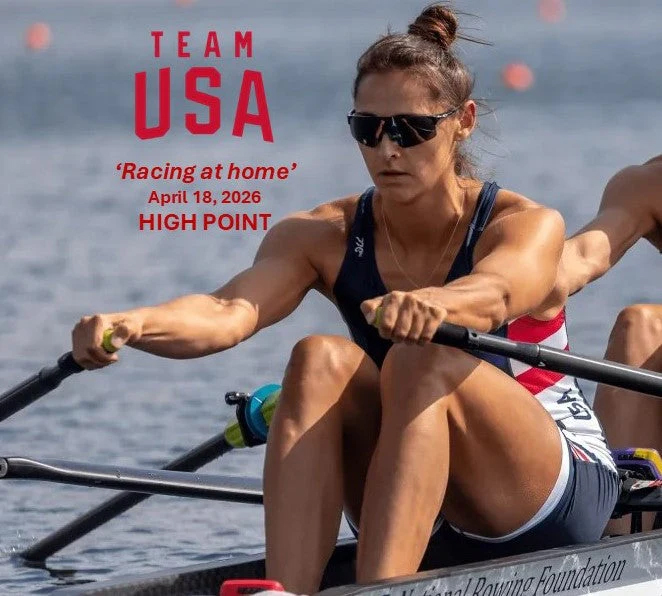
Team USA defeated an all-star world team to win the Lenny Peters Cup at the Bethany Medical North Carolina State Rowing Championships in High Point, N.C., on Saturday, April 18.

Created as a Ryder Cup-style contest to add interest to the regatta, this year’s edition featured Olympians on both squads, as Team USA avenged last year’s narrow defeat to win all but two races in hot, sunny conditions on Oak Hollow Lake.

“It’s cool to be walking around and have high schoolers know me by name, saying they’re going to watch racing, and that they’ve been following results since last year,” said U.S. Olympic sculler Grace Joyce, who defeated Brazil’s Beatriz Tavares in singles competition before falling to a world team mixed quad later in the program. “It’s very special.”

“We were doing some pretty nice regional regattas before Covid, when we lost most of our teams,” said regatta director Gene Kininmonth, who is also the head coach of local club Triad United and founded High Point Rowing Club in 2012.

“We realized we’re going to have to have a new revenue source, and so we looked at regattas for doing that. We went big, coming out of Covid, and we’ve just put our heart and soul into it.”

With the support of Lenny Peters, a physician and philanthropist, Kininmouth, a former Australian national team oarsman, introduced the Team USA-versus-the world concept, added VIP amenities for spectators, produced a nine-camera video livestream, and, this year, sold out entries for the overall regatta that includes youth, collegiate, and masters events.

“We’ve gone as high end as we can, and it’s paying off,” Kininmouth said.

“This is a good way for us to give the athletes a little change of scenery, and it’s a great way also to promote rowing,” said Josy Verdonkschot, The McLane Family Chief High Performance Officer for USRowing. “It’s a huge regatta, it’s a nice setup, and everything is well arranged for the athletes.”

Verdonkschot, along with USRowing’s high-performance sculling coach Fiona Bourke and team manager Will Daly, brought the eight members of Team USA and a fleet of shells to share with the world team.

“It’s awesome—a nice atmosphere and a well-organized competition,” said Nicholaj Pimenov, who won the Lucerne World Rowing Cup and silver at worlds last year for Serbia with Cal alum Martin Mackovic, who also raced in the Lenny Peters Cup. “It’s not a World Rowing event, it’s even better. You can enjoy rowing.”

Pimenov and Mackovic defeated Team USA’s Jacob Plihal and Caleb Nollenberger in the men’s double and later won in the mixed-quad race against Team USA.

“It’s good to have little challenges like this,” Verdonkschot said, “because otherwise it’s just boring training.”

“It was super fun to see where in my race plan I need to improve and what’s going well,” Joyce said. “It’s the first time ever I’ve seen my name and face on a banner. I’ll be trying to take that home with me.”

Lenny Peters Cup & North Carolina Rowing Championships

Saturday, April 18, American scullers Sophia Vitas and Evan Park will defend their home water against a formidable Canadian duo: Olympic gold medalist Avalon Wasteneys and sculling standout Katie Clark. Photo courtesy Lenny Peters Cup.


In addition to the USA versus The World competition of the Lenny Peters Cup, the North Carolina Rowing Championships features 85 races between 522 boats racing throughout the day in collegiate, high school, and pro events.

The regatta will be the largest ever in North Carolina history on Saturday, April 18.

SCHEDULE  |  LIVESTREAM  |  RESULTS

A Time to Rig and a Time to De-Rig

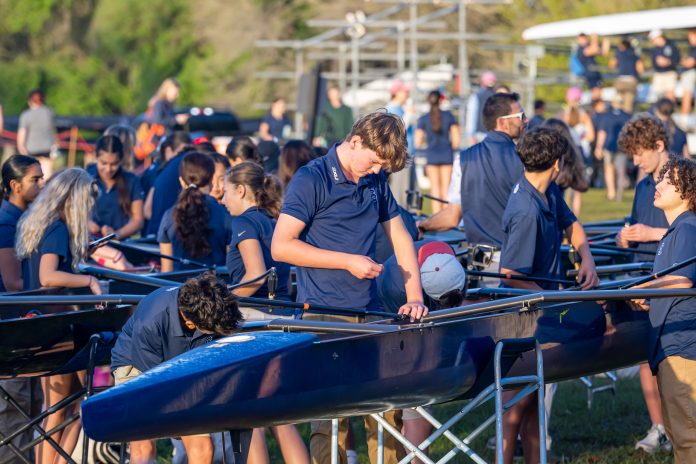
If you’ve de-rigged properly and organized and loaded the trailer well, unloading and rigging should be easy. Photo: Lisa Worthy.


With spring racing season comes frequent de-rigging and re-rigging of your racing shells. Coxswains who are attentive and efficient make trailer loading and rigging safer, easier, and faster for everyone and set themselves up for the best possible arrival on race day.

First, de-rigging. This is a good time to take stock of your tools and ensure that you have the wrenches you need to get the boat de-rigged efficiently. If your rowers are standing around waiting for tools consistently, this means it’s high time to ask the coach to pick up a few more wrenches. It’s also an opportune time to take inventory of all the hardware on your boat—bolts, nuts, washers, wing nuts, spacers. Make sure that each seat has the full complement of parts and that you have a few spares, too. 

Check the boat for damage: dings and scratches on the hull, bent backstays or pins, seat wheels that can’t spin, loose tracks, and foot stretchers that aren’t seated properly. If you notice a larger issue with the rigging, like inconsistent placement of washers or backstays, gather your rowers to clarify how the hardware should look on the boat after it’s rigged.

Know your team’s system for where hardware and seats go (securely fastened on the boat or in a separate container) so  you’re confident these will arrive safely and you’ll know where to find everything once you get to the racecourse. It may or may not be your official job to ensure that riggers, oars, and slings get on the trailer, but you should always check. After all, you can’t race without the necessary equipment.

When loading a trailer or putting boats in slings, be mindful of the safety of the hull. You’ve probably heard that most damage to boats happens on land. If you’re maneuvering your boat in a tight space during trailer loading, ask another coxswain to watch the bow if you’re with the stern, and vice versa.

Always, always make sure slings are pushed all the way out at the base. Best practice: Roll your boat to waists and slide the slings underneath it rather than roll it down into slings and risk putting the corner of a sling through the hull. (It happens, and it’s not pretty!)

If it’s windy, you’ll want to keep extra hands on the boat at all times until the hull is safely in the boathouse or strapped down on the trailer. You should also be skillful strapping a boat to a trailer. If not, practice. Most teams have coxswains or rowers who are designated boat-strap experts; shadow them and ask them to inspect your work until you’re confident of your ability.

If you’ve de-rigged properly and organized and loaded the trailer well, unloading and rigging should be easy. Sometimes you’ll find a bolt or rigger that doesn’t fit on the boat properly. Don’t force it! While some boats might need a little bit of a squeeze to get parts back on, more likely this indicates that you’re installing the hardware in the wrong place or that something shifted in transit. Call over a coach for help.

After your boat is rigged, go over each seat carefully and check everything that could come loose. While your rowers may rig the boat, you should check every station before each race. Like a  pilot performing a pre-flight inspection, you want to make sure you’re ready for racing.

Get the small things right, too. Regatta sites are often full of  mud, gravel, or sand, so if you have boat covers or bags, make sure the insides stay off the ground and are free of dirt and debris so your boats won’t get scratched. If you drop hardware in the mud, rinse or wipe it off so grit doesn’t get stuck in bolt threads.

At some programs, coxswains are involved heavily with rigging and help coaches set oars and even spread the boat. You don’t need to know every skill but you should know all the parts of a boat so you can describe equipment problems accurately to facilitate solutions. A pin or collar shifting around on the water is an immediate issue your coach needs to address off the water; a loose backstay is a problem you can handle quickly yourself.

Trailer-load days are a great way to assume a leadership role in a way that’s visible and meaningful to your team and coaches. Take charge with enthusiasm and you’ll show up at the regatta site confident that you and your team have everything you need to succeed. 

Hannah Woodruff is an assistant coach and recruiting coordinator for the Radcliffe heavyweight team. She began rowing at Phillips Exeter Academy, was a coxswain at Wellesley College, and has coached college, high-school, and club crews for over 10 years.

Trinity Men, Radcliffe Lightweights Win Knecht Cup

Sunny weather greeted college rowing fans at the 2026 Knecht Cup Regatta.


The Knecht Cup Regatta brought 390 crews to Camden, N.J.’s Cooper River racecourse for two days of six-lane racing over heats, semifinals, and finals in breezy, sunny conditions, April 11-12.

Reigning Division-III men’s national champion Trinity College (Conn.) successfully defended their Knecht Cup varsity eight title from last year, beating Division-I MIT by less than a second. Purdue, second in last year’s ACRA club national championship, finished third, with La Salle, Temple, and Embry-Riddle filling out the grand final. Trinity’s second and third varisty eights took first and second in the DII/DIII varsity eights event.

“The team had a great weekend in New Jersey and are honored to earn victories in two events,” said Trinity head coach Kevin MacDermott. “The racing was intense, every crew learned a ton, and the weather was gorgeous.”

Radcliffe women’s lightweight eight won the women’s varsity eight grand final over UMass in second and Bucknell in third. Boston College, Temple, and the Boston University lightweight varsity rounded out the grand final of the event that attracted 34 entries from across the country.

“We are growing the event. We’ve added trophies, honoring very special legends in the rowing community, and also adding some Para events,” said regatta director Laura Knecht Blanche.

The regatta is named for Bill Knecht, the Olympic champion oarsman who won in the 1964 U.S. men’s eight, served as president of the National Association of Amateur Oarsmen (a precursor to USRowing). co-founded the National Rowing Foundation, and developed the Cooper River rowing course.

Newly named trophies will recognize the legacy and impact of Albert P. Wachlin, Lois Trench-Hines, Mark Valenti, and Ann and Marie Jonik, among others.

“It’s a great opportunity,” said Kemp Savage, who brought his Eastern Michigan University squad to gain valuable racing experience before the Mid-American Conference championships, an automatic qualifier for the NCAA championship. “With the AQ being the thing that everyone looks for from the MAC teams, all this practice and focus to get out here and get three good races in, six-wide, that’s, for us, really something we needed.”

“I’m looking for continuing to open up the regatta to invite more teams to make the racing as great as it can be,” said Blanche.

RESULTS  |  VIDEO  |  TROPHIES