Home Blog Page 18

The Principles of Periodization

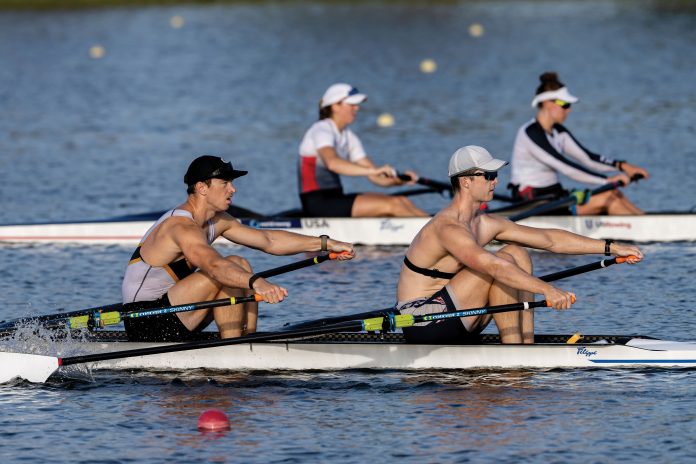
The U.S. National Team trains at Nathan Benderson Park in Sarasota, Florida. PHOTO: Lisa Worthy.


Periodization is a tried-and-true method for organizing training. The first to use the term was Soviet physiologist Leonid Matveyev in 1964. In studying Olympians, he discerned patterns in the training of successful athletes that led him to develop the concept.

In the years since, much research has been done on periodization, but the main principles still apply. Periodization is a system for training in which load and recovery vary based on physiological principles.

Typically, a gradual increase in training volume and intensity is followed by periods of lower training loads. The idea is that progressive increases in training demands should be followed by periods of lower training loads to enable an athlete’s body to adapt and to improve performance.

The goal of training periodization is twofold:

—to maximize fitness and athletic performance while minimizing overtraining and the risk of injury;

—to manipulate training variables so that athletes peak at the desired time.

Athletes need to develop several sport-specific qualities to perform well—strength, endurance, technique, tactical skill, psychological toughness, etc. Since such qualities can’t be acquired simultaneously, certain periods of the training year are reserved for focusing on them sequentially.

Matveyev’s training model consists of three phases: preparation, competition, and transition.

The preparation phase is for building basic athletic skills, such as, in rowing especially, endurance, strength, technique, and the ability to recover from strenuous training.

In the competition phase, athletes increase the intensity of exertion to transform basic skills into racing speed, while learning the rules of competition, improving tactical skills, and building sufficient endurance to withstand the rigors of competition.

The transition period is for healing injuries and recovering from training and racing.

Because most rowers have a spring and autumn season, the sequence of preparation, competition, and transition should be carried out twice a year. Double periodization can be very successful when all phases are planned and timed well, beginning with the climactic regatta and going backward from there.

Usually, coaches are quite capable of executing the preparation and competition periods, but they find it harder to acknowledge the importance of the transition period. Some coaches figure that everyone just needs a break or they fear losing the fitness gained in previous phases.

The transition period is an essential part of Matveyev’s scheme and, when designed correctly, can benefit athletes enormously. It provides a respite from rowing and the stress of competition and an opportunity to recharge by enjoying other sports—swimming, surfing, hiking.

It’s also a time for attending to injuries that may not have healed fully and for improving in such areas as balance, coordination, rhythm, and flexibility.

During this phase, basic fitness can be maintained with an easy run on the beach or a leisurely bike ride in the mountains. Training volume and intensity should yield to fun, refreshment, and rejuvenation.

Volker Nolte, an internationally recognized expert on the biomechanics of rowing, is the author of Rowing Science, Rowing Faster, and Masters Rowing. He’s a retired professor of biomechanics at the University of Western Ontario, where he coached the men’s rowing team to three Canadian national titles.

Gold at Worlds for U.S. Women’s Four

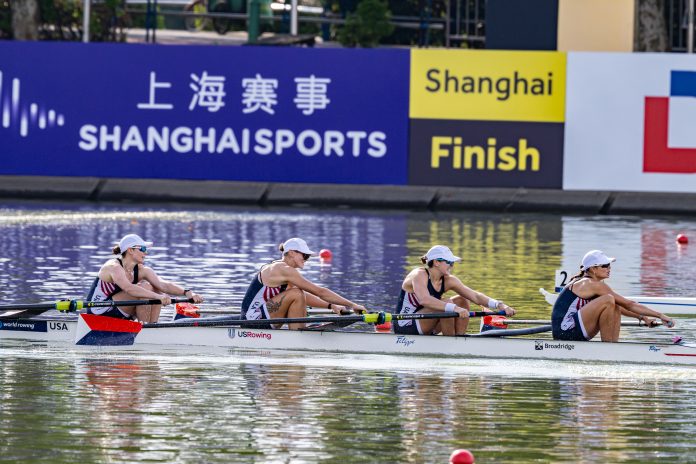
The U.S. four of bow Camille Vandermeer, Azja Czajkowski, Teal Cohen, and stroke Kaitlin Knifton won gold at the 2025 World Rowing Championships. PHOTO: Lisa Worthy.


The U.S. women’s four of bow Camille Vandermeer, Azja Czajkowski, Teal Cohen, and stroke Kaitlin Knifton hung on to win the 2025 World Rowing Championships, less than a second ahead of Romania in second and New Zealand in third. The Netherlands, Great Britain, and China rounded out the A final.

U.S. Women’s Pair Wins Bronze, Sechser Sets Fastest Semi Time at Worlds

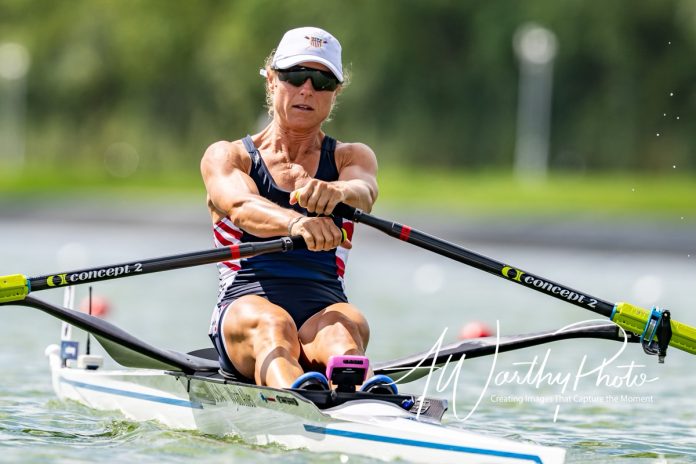
Michelle Sechser posted the fastest semifinal time at the 2025 World Rowing Championships, Shanghai, China, Sept. 21-28. PHOTO: Lisa Worthy.


The U.S women’s pair of Holly Drapp (Univ. of Washington ’22) and  Jess Thoennes (Univ. of Washington ’18) won the bronze medal on Thursday, day five of the 2025 World Rowing Championships in Shanghai, China. Romania won in 7:08.5, France was second in 7:13.3, and the U.S. pair finished third in 7:13.9

Michelle Sechser set the best time in the semifinals (8:01.2) of the women’s lightweight single, winning hers by open water. Ireland’s Siobhan Mc Crohan won the other semi in 8:06.2, making Sechser the favorite for Saturday’s A final.

Both U.S. eights advanced from their heats to the A finals. Neither Canadian eight finished first or second, nor had the one of the next fastest two times, and will race in the B finals at these worlds, which no longer feature repechage heats.

The U.S. men’s quad finished fourth in the A final, the best finish for the U.S. in the event since 1998. Canada’s women’s quad finished sixth the A final. The U.S. women’s quad finished fourth in the B final, for 10th overall.

Schedule  |  Livestream  |  Results

Salary Surveys Reveal Variation and Discrepancies

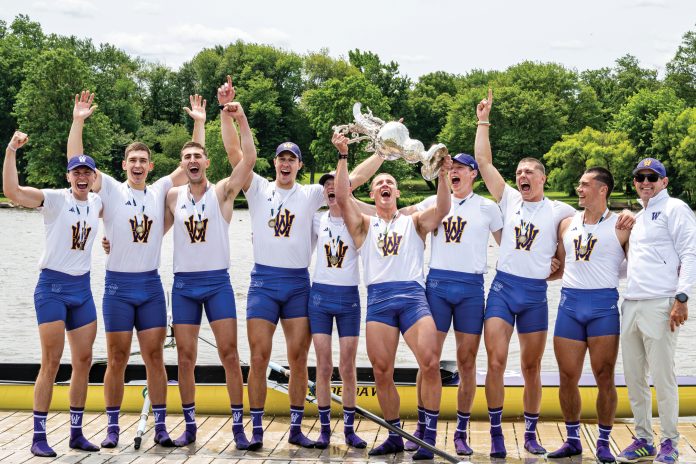
Michael Callahan (right), head coach of the two-time defending national champion University of Washington heavyweights, is the top-paid coach in men's rowing. PHOTO: Lisa Worthy.


The pay of head rowing coaches varies widely—from less than $50,000 to over $300,000–surveys by the sport’s two coaches associations show.

Division I NCAA women’s head coaches make more (median pay: $107,499) than IRA heavyweight men’s head coaches (average $85,000 to $99,000).

Power 4 conference (Big 10, Big 12, ACC, and SEC) women’s head coaches were paid even higher salaries, with median compensation of $137,499. Median pay for NCAA Division II head coaches was $54,999, and higher for NCAA Division III head coaches at $72,499.

“We do these surveys as a service to our members and the sport in general,” said Chris Clark, co-president and co-founder of the Intercollegiate Rowing Coaches Association, for men’s coaches. “Without them, it’s an opaque market—to the disadvantage of the coaches.”

The survey by the Collegiate Rowing Coaches Association, for women’s coaches, received 73 responses, with 62 disclosing salary data. The IRCA survey collected responses from 55 institutions, representing 95 percent of the association’s membership, with 46 completing the full survey. Many coaches’ salaries and contracts are public information, available online and through information requests and reporting services.

“Things being more public is only good, for the coaches,” said Texas head coach and CRCA board member Dave O’Neill, “even if it’s uncomfortable.”

Most of the coaches contacted about the salary surveys were unwilling to comment on the record—a reflection of the sensitive nature of the subject as well as the tendency of rowing coaches to avoid controversy. Many head rowing coaches consider their positions dream jobs unlikely to be improved by change, although many complain about the low wages.

Each survey broke down pay by position—head coach, associate head or first assistant coach, and third assistant—and conference. Benefits like health insurance, retirement plans, and leave were common among all leagues and both surveys. Club memberships and cars were among the benefits listed in coaches’ contracts, as were additional job responsibilities, such as meeting with local businesses and running summer camps.

The CRCA survey did not address funding sources, while the IRCA survey noted a variety of ways coaches get paid, commonly through booster, alumni, and charitable family foundations.

Last year, the eventual national champions lost their regular-season contest against their bitter rivals but won the season finale against another program when the rivals failed to advance to the final. That storyline earned Ohio State’s head football coach, Ryan Day, over $10 million in compensation from his Big 10 school.

The same storyline earned Washington men’s rowing head coach, Michael Callahan, less than three percent of that—about $330,000 total salary, mostly earned through performance bonuses—making him the highest-paid men’s college rowing coach in America.

(Ryan Day’s total makes him only the fifth-highest-paid college football coach. Top of the heap: Georgia’s Kirby Smart, at over $13 million).

At the 2024 Olympic Games, 17 Huskies competed, winning 11 total medals. Callahan coached the U.S. men’s Olympic eight, winners of the bronze medal—with four Huskies on board. As this issue went to press, 22 Huskies headed to Shanghai to compete in the 2025 World Rowing Championships, with the largest number of them there to compete for the United States.

Callahan and Washington’s head women’s coach Yaz Farooq were paid roughly the same amount the year before, according to Washington state data, which likely makes Farooq the top-paid women’s coach.

Private institutions, like NCAA DI team champion Stanford and DI varsity eight winner Yale, do not report salaries and contracts publicly.

The pay disparity gets even worse among assistant coaches. Ohio State’s football staff has seven members making over a million dollars each, and the 11th-highest paid staffer—linebackers coach James Laurinaitis, who took home $350,000—still earns more than the top rowing coaches. The average assistant coach, according to the IRCA salary survey, makes about $50,000.

Comparing rowing to college football, with its billions of dollars in TV revenue, is apples to watermelons at best, of course. Comparing rowing to track & field, with its large rosters of student-athletes racing in an Olympic sport, is more apt.

There again, however, colleges underpay rowing coaches compared to their peers. For example, Ohio State paid women’s rowing head coach Emily Gackowski $160,000 and track & field/cross-country head coach Rosalind Joseph $212,180—over $50,000 more—despite the fact that rowing typically serves a bigger roster.

Rowing, along with every other sport that is not football or basketball, faces an uncertain funding future as the NCAA falls apart in the wake of the Supreme Court’s NCAA antitrust decision and settlement, which allows college athletes to be paid directly, players to profit from their name, image, and likeness (NIL), and massive increases in TV broadcast payments to football conferences.

Football programs today spend as much as they receive for broadcast rights (and sometimes more), The Atlantic reported recently. Result: The vast increase in revenue has not produced balanced budgets or surpluses to support non-revenue sports.

Among college Olympic sports, a further division between those that charge admission (volleyball, softball) and those that don’t (rowing) has led some universities to set up NIL opportunities for “ticketed” sports and not for others.

Much attention has been paid to the rise of international recruits in both men’s and women’s varsity rowing programs (funded by a school’s athletic department as opposed to club programs, which are funded by student activity fees and dues). A commonly expressed concern has been whether the displacement of domestic athletes by internationals has hurt the development of U.S. Olympic rowers. The salary surveys, however, finger a more likely culprit: the demise of novice and freshman programs and their coaching positions.

The top assistant rowing coach used to be the freshman or novice caoch. Not so anymore. Instead, those positions have been replaced almost totally by recruiting coordinators.

Practically no walk-on opportunities exist in the top IRA and NCAA Division I programs—sources of the entire 2024 U.S. Olympic squad (with the exception of three-time Olympian Meghan Musnicki, who began rowing at Division III St. Lawrence University).

Some of the most successful U.S. Olympic rowers ever, such as Susan Francia, who, like Musnicki, is a two-time Olympic rowing gold medalist, learned to row in college. Today, that opportunity barely exists in Division I rowing, the surveys show. One coach said he would be laughed out of his athletic administration offices for even suggesting the reinstatement of a novice coaching position. There is no real pathway to the Olympics in U.S. rowing besides Division I varsity programs, currently.

Following the money is a good way to understand how a situation came to be. The CRCA and IRCA surveys help head coaches receive better pay for the valuable work they do, but more TV money hasn’t led to more opportunities for student-athletes—the ostensible purpose of college sports.


Letter to the Editor: HOCR Youth Singles

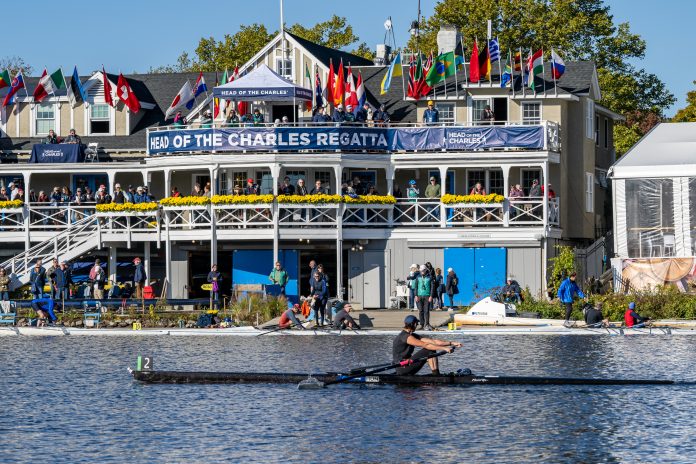
The Head of the Charles course runs past Cambridge Boat Club. PHOTO: Lisa Worthy


After two consecutive years of trying to enter one of my athletes who has proven to be one of the top youth scullers in the country into Head of the Charles, only to have her waitlisted both times, it dawned on me: Why can’t HOCR use a merit-based system for youth single events? It’s the only event in rowing where the rower represents the entry 100 percent.

In addition to “10 Ways to Save Rowing” (June issue), I suggest adding an 11th: Make singles entries based on merit. Though I’m referring specifically to Head of the Charles, this could be applied to other races where entries are at a premium, and it may make some regattas more attractive to faster single scullers.

Head of the Charles boasts of being the most prestigious regatta in the country and hosts athletes and teams from across the nation and around the world. Why wouldn’t the regatta committee want the most diverse group of fast athletes racing for medals in this event? As it stands, there are typically about 45 spots available for women’s and 50 spots for men’s youth single entries at the Charles.

The athlete at my club rows on a very small team in a part of the country where rowing isn’t well known, and she has dedicated a lot of extra effort because of her love of the sport. She has put in countless hours with the team and on her own to become the best athlete she can be. Unlike the Charles River, there are no rival boathouses on our body of water, no early-morning rows alongside other strong competitors to inspire our athletes to get faster every day. I would argue that it’s more difficult to train without a large team pushing you on.

At HOCR, there are five more entries available in the boys’ singles event than in the girls’, which are allocated specifically for local clubs along the Charles River. These club members have the opportunity to row this iconic river every day. Why not reward a well-deserving female athlete who has overcome the disadvantage of her geographic location and who may never have another chance to race in such a legendary event?

To make this a merit-based system, there’s a simple solution. The committee would gather the names of the athletes who made the grand finals at USRowing Youth Nationals in the youth and U17 singles, and the grand final from Scholastic Rowing Association of America nationals in the senior single. HOCR organizers would extend invitations to those athletes directly or wait to see who registers and make sure they are priority entries. That would mean monitoring 18 to 22 athletes of each gender.

I imagine there would be some overlap with guaranteed entries, and several athletes would have graduated to college programs or wouldn’t be interested in racing. With 10 to 15 merit-based entries for each gender, there still would be plenty of entries available for the regatta’s traditional lottery system.

HOCR invitations would be an honor to receive and a goal for which rowers could strive. The impact of such an opportunity for small-club rowers would be far-reaching. Beyond the incredible rowing experience for the athlete, it would bring attention to the rowing club, thereby motivating other young rowers to strive for such success, inspiring others to try the sport, and stirring regional interest in the sport through media coverage.

Imagine what a handful of these fast rowers from all corners of the country could do to promote this niche sport, increase participation, and help strengthen USA sculling as a whole on the national stage.

Ted Riedeburg
Director, Head Coach
Rock City Rowing and
Episcopal Collegiate School
Little Rock, Ark.

Corporate Logo Coming to College Boathouse

Texas rowers at the 2023 Henley Royal Regatta. PHOTO: Lisa Worthy.


The brand logo of Humann, maker of nutritional supplements, will appear on 11 University of Texas athletic facilities, including the Longhorns’ football field and boathouse.

“What starts at Texas changes the world,” said Texas athletic director Chris Del Conte, of Humann, which grew out of a University of Texas Health Science Center research program.

“If we were going to make the decision to put a brand on our fields, courts, and across all our athletics venues, it had to have an incredible story. What began with Texas researchers has been used by our student-athletes for over a decade to help them perform better on the field and aiding people to be at their best heart health for everyday life.”

This will be the first time that a commercial logo appears next to the iconic Texas Longhorn at the university boathouse, as well as 10 other athletic facilities.

U.S., Canadian Crews Advance at World Rowing Championships

The U.S. men’s quad of bow Nathan Phelps, Jacob Plihal, Cedar Cunningham, and stroke Chris Carlson racing at the 2025 World Rowing Championships in Shanghai, China. PHOTO: Lisa Worthy.


U.S. lightweight single sculler Michelle Sechser set the fastest time in the heats of her event at the third day of the 2025 World Rowing Championships, in Shanghai, China. The Canadian women’s quad of Shaye De Paiva, Cassidy Deane, Kristen Siermachesky, and Alizée Brien finished third in their semifinal to advance to the A final.

The U.S. men’s quad of Chris CarlsonCedar Cunningham, Olympian Jacob Plihal, and Nathan Phelps also advanced to their A final, a first for the U.S. since 2001. The crew won bronze at the Lucerne stop of the World Rowing Cup earlier this summer. Five seconds separated the six finalists’ times in the semifinals, with Italy and Great Britain each winning one. Finals are scheduled for Thursday at 3:12 am on the East Coast, 3:12 pm in Shanghai.

The 2025 World Rowing Championships run through Sunday, September 28.

Schedule  |  Livestream  |  Results

From The Editor: Essential Opportunities

Michael Callahan (right), head coach of the two-time defending national champion University of Washington heavyweights, is the top-paid coach in men's rowing. PHOTO: Lisa Worthy.


In his column for the October edition of the print magazine, Doctor Rowing writes, “Scratch any rower and he’ll tell you who helped him rise.”

That’s certainly the case with Olympic champion Pete Cipollone, winner of eight Olympic and worlds medals (five of them gold) back in the late 1990s and early 2000s, when the U.S. National Team ruled the world in eights.

Cipollone credits coach Mike Teti with “one of the most important pieces of coaching I ever got,” which you can read in October’s Coxing column by George Kirschbaum.

Teti continues to foster U.S. Olympic success, coaching at California Rowing Club, where most of the U.S. National Team men’s four and eight that won Olympic gold and bronze in Paris trained when they weren’t in USRowing selection camps or on training and racing trips.

Clubs provide essential opportunities and support for athletes outside of the schools and universities that expose most rowers to the sport for the first time. The head coaches (if not the assistants) of the top collegiate programs benefit from better pay owing in part to the salary surveys of their coaching associations, the Collegiate Rowing Coaches Association (for women’s programs) and the Intercollegiate Rowing Coaches Association (for men’s). Read more about it in the October issue of Rowing News.

As opportunities to walk on to a college varsity program as a novice disappear, clubs become an even more important part of our sport. Also in the October issue of Rowing News, Amy Wilton tells the instructive stories of the advent of several clubs founded through the passion of rowers bent on sharing the transformative power of our great sport with others.

May it inspire you to do the same.