

Recruiting: Why You Should Get Started Early

Many readers have heard me emphasize the importance of starting early in the rowing recruiting process. Recently, a parent of a ninth-grade rower asked me a great question: Why should we begin thinking about university selection when our teenager is only a freshman?
The answer goes far beyond simply “better early than late.” Early preparation gives student-athletes the foundation they need to be successful academically, athletically, and personally when it’s time to make one of the biggest decisions of their lives.
Academic Preparation
There’s a common misconception that the only thing that matters in rowing recruitment is your 2K erg score. That’s not true. College coaches and admissions offices are looking for a complete student-athlete—someone who performs at a high level both on the water and in the classroom.
Strong grades, a challenging course load, and competitive SAT or ACT scores all play a major role in admissions. Many of the top rowing programs are at elite universities with rigorous academic standards. Beginning to focus on academics early—as early as ninth grade—helps students establish habits, motivation, and results that align with the schools they may one day want to attend.
SAT/ACT Preparation
While many universities are currently test-optional, this policy is evolving. Some schools have already reinstated testing requirements, and others are expected to follow. Knowing the score ranges for your target universities early allows you to plan ahead.
Like rowing, standardized testing rewards practice and preparation. Working with your school’s counselors or independent experts can make a measurable difference. Consistent effort, whether on the erg or in test prep, leads to improvement and confidence when it matters most.
Athletic Development
If your goal is to row for a university program that demands top-level erg performance, the path begins long before your senior year. Setting clear goals early and developing a structured training plan will give you time to make steady, sustainable progress.
Your local coach is your best starting point. Discuss your long-term goals and how to integrate any additional training into your team’s program. The key is balance—improving without overtraining and staying aligned with your current team’s priorities.
The Bottom Line
Starting early in the rowing recruiting process isn’t about rushing decisions; it’s about preparation. Building strong academic habits, developing athletic potential, and understanding what universities are looking for gives student-athletes more choices and less stress when the time comes to commit.
Robbie Tenenbaum coached at the NCAA level for over 30 years and with the U.S. Junior National Team for eight. He now helps rowers and families navigate the university recruiting process.
The Pause That Refreshes

For most of our readers, the time has come to take the docks out and put the boats away for the season. The days are shorter, and the weather in many parts of the country is unsuitable for rowing. Therefore, we must turn to other sports. Even athletes who row in milder climates should consider this, since there are good reasons to leave the boats alone for a while.
Does this mean you should take a break and rest? No! Regular exercise is important not only for maintaining your fitness but also your general health, whether you’re an ambitious competitive athlete of any age or a relaxed recreational rower. Numerous studies show that physical activity is the best thing you can do for your health and to prolong your lifespan.
If you want to maintain or improve your performance level, you should continue training, since physical performance declines over time. If you don’t train regularly, your body will lose strength and endurance, and if you take a break from training, you’ll have to begin at a lower performance level when you return.
This doesn’t mean, however, that you must row or train with the same intensity as during regatta season. Instead, work on the fundamentals—basic endurance, general strength, agility, and flexibility—since they form the foundation for successful, targeted rowing training.
Since you’re no longer bound to a planned and time-consuming rowing workout, you can focus on expanding your movement repertoire. Activate muscles that are neglected during focused rowing training. Improve your balance, coordination, reflexes, rhythm, etc.
Do what you enjoy or what challenges your agility. Play sports with special people— children, grandchildren, friends you haven’t seen in a while. Kick a soccer ball, swat a pickleball. Go jogging or cross-country skiing together.
Such shared experiences are beneficial and enriching. They offer a mental and emotional break from stress, and varied activities are crucial for a happy, healthy life. They fortify you for returning to school or work and the strenuous training to come.
Just as important as exercising is engaging in activities that promote mental well-being. For recreational athletes, staying motivated is essential; for competitive athletes, being mentally prepared for training and competition is paramount. A conditioned mind is as critical to athletic success as a conditioned body. Taking a break from rowing can provide a surge of new physical and psychological energy.
All of the above applies to coaches as well. Coaching is often so time-consuming and strenuous that it’s difficult for coaches to integrate physical activity into their daily routine. Coaches, too, should use their time outside of regular training to do something good for themselves through exercise.
Volker Nolte, an internationally recognized expert on the biomechanics of rowing, is the author of Rowing Science, Rowing Faster, and Masters Rowing. He’s a retired professor of biomechanics at the University of Western Ontario, where he coached the men’s rowing team to three Canadian national titles.
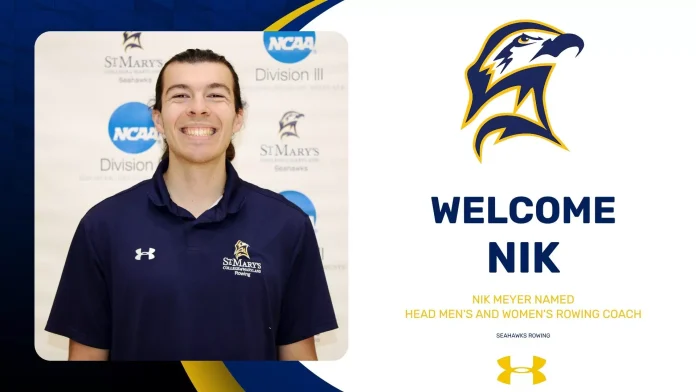
St. Mary’s College of Maryland Names Nik Meyer to Lead Rowing Programs
By Katie Lane
After spending six years with the Seahawks as an assistant coach and then interim head coach, Nik Meyer has been named head coach of the men’s and women’s rowing programs at St. Mary’s College of Maryland.
“This is my first head-coach position, which is really exciting,” Meyer said. “I’ve been in assistant-coach roles for the last six years, so I’ve had a lot of time to think about how I would run a program if I was at the helm. To finally have that opportunity is really exciting.”
Saint Mary’s College of Maryland (SMCM) has seen notable success over the 10 years it has operated as a varsity program. SMCM captured the program’s first-ever Mid-Atlantic Rowing Conference Championship and made its first NCAA appearance in 2022 when Meyer was an assistant coach.
When Meyer was promoted to interim head for the 2023-24 season, the team won its second Mid-Atlantic Rowing Conference championship and qualified for the NCAA championships.
For his leadership during the 2023-24 season, Meyer earned MARC Women’s Coach of the Year honors as well as Collegiate Rowing Coaches Association (CRCA) Mid-Atlantic Region Coach of the Year.
SMCM won its third conference title in 2025, made the grand finals at the NCAA championships, and the coaching staff was named CRCA Co-Staff of the Year for the second straight season.
“I want to keep up that success by improving the women’s team placement at the NCAA championships and getting the men’s team an IRA bid,” Meyer said. “Both those goals are going to take a lot of effort, but I’m hopeful that we’ll be able to get there with the dedication that I’ve seen from my athletes. We have a lot of mutual understanding and respect for each other, so we’re driven to enable each other’s success.”
In addition to his time with the Seahawks, Meyer coached Blair Crew Inc., from 2018 to 2021 and Elizabeth Seton High School from 2018 to 2021.
Meyer graduated from the University of Maryland in 2021 with a bachelor’s degree in mechanical engineering. Originally from North Potomac, Md., Meyer has earned a USRowing Level 2 coaching certification.
‘I’m Not Recruitable. Now What?’
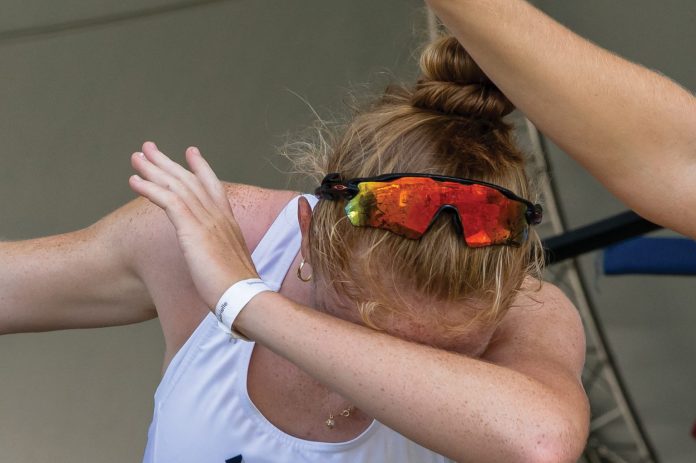
It’s not uncommon for high-school seniors to feel anxious about recruiting. Maybe you’ve dreamed of rowing at a varsity level program, but after sending dozens of emails, the responses have been limited—or worse, nonexistent. Perhaps you were in touch with several schools and, suddenly, the communication has gone silent. The questions naturally follow: Did they forget about me? Are they no longer interested but didn’t say so?
The good news is that you still have options, even as a senior.
1. Apply Anyway
Sometimes coaches may hesitate to pursue an athlete because they’re uncertain about admissions. If you’re truly interested in a school, it can be worthwhile to apply regardless. Once admitted, you can reach out again with a fresh update:
“Coach, I wanted to let you know that I’ve just been admitted to your university and would love the chance to learn more about opportunities to walk on to your team.”
Admission can change the conversation significantly,
2. Broaden Your Outreach
If one coach isn’t responding, consider copying others on the staff in your emails. Every coach sees athletes differently, and sometimes another set of eyes on your profile can spark interest and reopen communication. You have nothing to lose by casting a slightly wider net.
3. Pick Up the Phone
Yes — the “cold call” still has value. Call the coach’s office during working hours. If no one answers, leave a short, professional voicemail. Introduce yourself, state your interest, and ask for a convenient time to talk. Direct contact can sometimes get attention when emails don’t.
4. Seek Guidance
If you’ve tried multiple approaches without success, it may be time to consult with your current coach, a trusted mentor, or a recruiting expert who can evaluate your situation and help refine your strategy.
5. Explore Alternatives
If varsity rowing isn’t the path forward, it doesn’t mean the end of your rowing journey. Many universities—including top academic institutions—have competitive club programs that offer meaningful athletic and social experiences. For countless athletes, these programs provide a fulfilling balance of academics and rowing.
The recruiting process can feel uncertain, but you have more options than you may realize. Whether through persistence, strategy, or finding the right environment, there is a place for you to continue your rowing journey.
Robbie Tenenbaum coached at the NCAA level for over 30 years and with the U.S. Junior National Team for eight. He now helps rowers and families navigate the university recruiting process.
Doctor Rowing: Joe Burk’s Character of a Champion

This autumn, Dotty Brown alerted our readers to Ed Woodhouse’s biography of Joe Burk, the great sculler who later became the head coach at the University of Pennsylvania and was so influential for generations of oarsmen.
What prompted a Harvard oarsman to write a biography of a Penn coach? Woodhouse was part of the legendary Rude and Smooth crews of the 1970s. Why had he cast his eyes away from the Charles? Had he forgotten his own coach, Harry Parker?
“I am very taken with the idea of mentors,” Woodhouse told me. Scratch any rower and he’ll tell you who helped him rise.
“I started seeing how so many of the people I learned about were connected. You can draw a line from George Pocock to Rusty Callow, Burk’s coach at Penn, to Burk to Harry Parker, my coach.”
“I think that it is so impressive that despite losing the singles trials for the 1936 Berlin Olympics to his fellow Penn AC sculler, Dan Barrow, Burk did not sulk, but instead went back to his family farm in New Jersey, got back in his single on the Rancocas Creek, and decided to do this by himself, rowing his own style with his own strategy.
“The main contact he had with the rowing world from 1937 though 1940 was his correspondence with George Pocock. Burk was a brave individual, willing to trust his own intuition and setting his own course.”
Burk rowed a short stroke, all legs and arms, and he kept pushing the rating up until he could row a race at 40 and above. Pocock offered advice about this unconventional style from afar: “If what you’re doing makes you go fast, do it.”
Burk credited Pocock with supporting his experiments with technique by suggesting, for example, that he limit his layback as part of rowing a higher cadence.
Woodhouse offers this insight into Burk’s training philosophy:
“Burk was trying to stroke more quickly not because it was harder but because it was easier. It was analogous to a runner’s shortening his stride and increasing his leg turnover instead of running with an excessively long stride.”
As we talked about Joe Burk, it became clear that while Woodhouse is impressed with Burk’s accomplishments in sculling (in 1938, Burk broke the Diamond Sculls course record at Henley with 8:02, a record that would stand for 27 years) and coaching, what really impresses him, and anyone who knew Burk, is his character. Hence the book’s subtitle: An American Ideal.
“It impressed me that after losing the chance to compete at the Olympics in 1940—they were canceled because of the impending World War—Burk served his country and joined the Navy.”
This second act of Burk’s life, that of war hero, is especially compelling. He was a decorated PT boat commander in the Pacific theater.
The latter part of the book describes the third act of Burk’s life—coach and mentor.
“In talking with men who rowed for him at Penn, time and time again they talk about Burk as a revered father figure. Even when moved from the varsity to the JV, his oarsmen mention his fairness and the care he showed them,” Woodhouse said.
When the weather was raw and cold in Philadelphia, Burk would jump off the dock into the Schuylkill to demonstrate that it was safe to go out on the water. That toughness and his war record inspired a number of his men to serve in a different, controversial type of war, Vietnam.
Woodhouse has done an impressive amount of research to track down some of the ideas that inspired Burk. In the ’60s, a New Zealand running coach named Arthur Lydiard had pushed his athletes to great heights. At the 1964 Olympics, Peter Snell had won double golds in the 800 and 1,500 meters. Lydiard advocated a regimen of high mileage at moderate pace and introduced the idea of periodization in athletic training, a cornerstone of today’s training methods.
At Penn, Burk adopted Lydiard’s approach. For anyone who is interested in the history of training and how it intersected with race results, Woodhouse has unearthed some great stuff. In the fall of 1966, Penn was rowing 18 miles every day, and 24 on Saturday.
There is also lots of great stuff about the Penn/Harvard rivalry. Harry Parker, the Harvard coach, had rowed for Burk at Penn. When Parker launched his own sculling career, he worked with Burk. The result was that Parker represented the USA at the Rome Olympics in 1960.
Their rivalry as coaches peaked at the 1968 Olympic trials when the two crews went stroke for stroke down the 2,000-meter course. In the photo finish, Harvard was proclaimed victor by five one-hundredths of a second. Ever gracious, Joe Burk congratulated his protege.
I visited Joe Burk and his wife, Kay, at their retirement cabin in Montana and can confirm that meeting them was an uplifting experience. Woodhouse quotes Nick Paumgarten, longtime head of the Friends of Pennsylvania Rowing, who summed up the modern view of Burk, calling him a total gentleman, a gracious loser, and a great winner.
It gives me great pleasure to recommend Ed Woodhouse’s book. He will be at the Heads of the Charles and Schuylkill selling, autographing, and talking about this wonderful man, Joe Burk.
Doctor Rowing, a.k.a. Andy Anderson, has been coxing, coaching, and sculling for 55 years. When not writing, coaching, or thinking about rowing, he teaches at Groton School and considers the fact that all three of his children rowed and coxed—and none played lacrosse—his single greatest success.
Taking Advantage of Turnover

Turnover. It’s an inevitable fact of coaching any sport at any level. Assistant coaches move on to bigger roles. Head coaches advance to higher-profile teams. Graduate assistant coaches, well, graduate.
According to the 2025 Salary Survey of the Intercollegiate Rowing Coaches Association, the average tenure of an associate head coach/first heavyweight assistant coach ranges from three to five years. For second assistant coaches, just two to three years. That makes for a lot of movement each year. Turnover isn’t something to be feared but rather understood as a fact of life and embraced for the opportunities it presents. For the coaches just now settling into a new role or those adjusting to new members of their staffs, there’s a real opportunity to hit the ground running, reinforce positive culture, or jump-start changes to get things moving in the right direction.
If done well.
This is a common topic of discussion among coaches I work with in my leadership coaching practice as well as younger coaches I mentor as they take the first steps in their professional coaching careers. One head coach I work with cited hiring his new assistant coach as the single biggest decision he had to make this summer. He had to fill the gap left by a much beloved assistant who had moved on to lead his own program and ran a real risk of losing team buy-in and setting back the advances the team had made in the past year, from both a performance and culture standpoint. He was right to take this decision very seriously.
Often, though, the focus is squarely on the actual hiring process—finding the right assistant coach or the right next job—and the next steps get overlooked. But the reality is that the real hard ongoing work comes after that. And that’s where the biggest opportunity for positive growth exists.
Building trust and getting into a collective rhythm take time. Finding your footing as the new coach in town or figuring out how to rebuild the structures of a high-functioning staff takes focus and flexibility. A few good practices can help everyone get off on the right foot and begin building momentum.
The first step is to establish roles early. Clear responsibilities reduce unnecessary friction and allow everyone to focus their limited attention on what matters most. Ambiguity around who handles inbound recruit emails or orders lunch while the team is traveling will just lead to frustration. (But don’t overlook the need for flexibility to allow for coaches to do work that they are especially skilled at or interested in when the time comes.)
Next, create early wins together. As with a crew or across a whole team, trust isn’t created in one grand moment. Instead, it is hard won through an accumulation of small wins. Having opportunities to get some wins individually and as a staff, and to have those wins acknowledged publicly and celebrated, go a long way toward building confidence in each other’s competence.
Finally, communication, and especially listening, need to be prioritized. New coaches should approach a situation with curiosity and humility. Yes, sometimes things are going to be done differently here. Give it a try and see how it goes, remaining open to the idea that this may be a better way to run things or an opportunity for you to offer a respectful suggestion.
Returning coaches can model the same by being open to fresh ideas and asking for contributions. The best staffs I’ve been a part of were those where everyone had an opportunity for input that was taken seriously. Of course, it can never all be implemented, but the best ideas and the most satisfaction come from a staff that is open-minded and valued. And it’s simply more fun to work with people you like, trust, and value—and who have the same attitude toward you.
Turnover is going to happen. But if you approach it not as a disruption but as an opportunity, you can strengthen culture and performance. Just like athletes adjusting to new lineups, coaches who embrace transition with a clear vision and trust in each other will be the ones whose teams move fastest in the long run.
Madeline Davis Tully competed as a lightweight rower at Princeton and on the U-23 national team before coaching at Stanford, Ohio State, Boston University, and the U-23 national team. Now a leadership and executive coach, she is the founder of the Women’s Coaching Conference.
