

To continue reading…
This article is exclusively for Rowing News subscribers. For as little as $5 a month, you can get access to the best quality, independent reporting on all the issues that matter to the North American rowing community.
Already a subscriber? Login
Rowing Canada Aviron, the national governing body of the sport, named Olympian and two-time world champion Jeff Powell as the next CEO this winter.
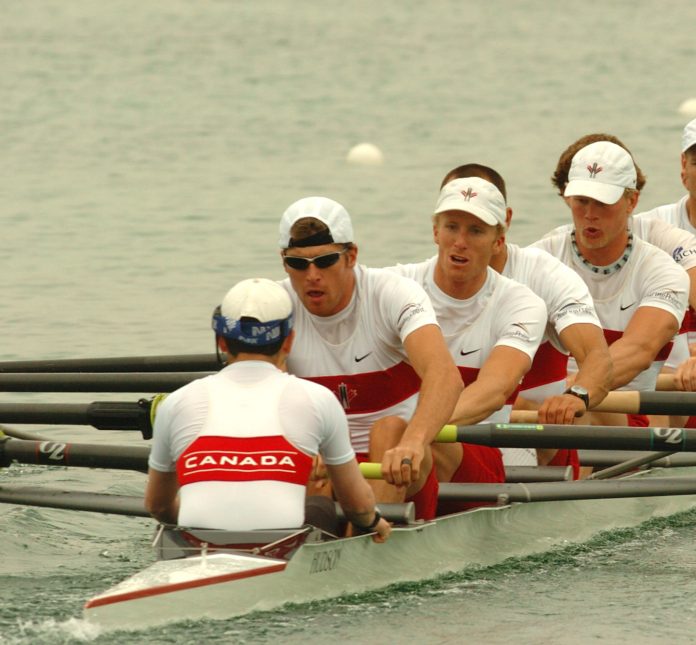
The 48-year-old native and resident of Winnipeg assumes the role this month as the organization casts a rescue net under a once-proud rowing program that won four gold medals at the 1992 Olympics, including in both the men’s and women’s eights, and another six medals at the 1996 Games.
Recently, not so much. Canada failed to qualify a men’s crew for the Paris Olympics and hasn’t raced a men’s eight in the Olympics since 2012. The women’s eight won silver in Paris, and the women’s lightweight double—the only other Canadian crew to qualify—finished eighth. Jacob Wassermann was Canada’s lone Paralympic competitor in Paris.
“Re-establishing Canada in a position where we believe it ought to be is without question a priority of the organization,” Powell said.
“He’s a man of high drive, high standards, and very confident in implementing his ideas,” said Adam Kreek, remembering his teammate of 20 years ago. “He will piss off many people, and this is exactly what the organization needs. He has the hard edge of a high performer and is willing to lean into conflict.”
Powell returns to rowing from the Canadian Sport Centre Manitoba, where he was CEO. He replaces Terry Dillon, who resigned June 30, and succeeds interim CEO Jennifer Fitzpatrick, who will be returning to her role as Director of Partnerships and Sport Development.
Rowing News: How did you get your start in rowing?
I played basketball all through high school and thought I was going to be a university basketball player. Then I went on an exchange program for a year to Japan and I came back and I wasn’t that good at basketball anymore. So I was kicking around looking for a new sport in 1996, the summer of the Atlanta Olympics.
Canada did very well in rowing in those Games, and so I and probably 50 other university-age kids were showing up at the tarmac of the Winnipeg Rowing Club at 5:30 every morning the rest of that fall. It was a great social group, with outstanding parties, and I just kind of stuck with it from there, never intending that it should reach the levels it did.
Rowing News: But it reached the highest level. You stroked the 2002 and 2003 world-champion Canadian men’s eight and competed in the 2004 Olympics. What led you to pursue elite-level rowing?
Well, I got into it. I don’t want to underweight the value of a great social group—it was just a great time and place to be rowing. We had a good coach. We had a good time, and some of the performances began to follow. It just seems like it built on itself pretty naturally.
I had some modest success on the North American circuit—the old Canada Cup that we used to have in Montreal the week after [Canadian] Henley, which was an interprovincial event. I won a few medals there and mistakenly had it in my head that I was therefore qualified to join the national training center.
I went out there, was last at everything for about six months before I got very lucky; I got to spend about three days with Kevin Light, who showed me what was required. Things really took off from there, but it was a little bit the same thing—we had a great group of guys with a great coach all dedicated to the same task and had some success with the results.
Rowing News: Tell us the story about flipping in the single. How did that get to you?
Oh man. I got up to Victoria, I was last at everything, right? Of course, no one’s coaching me and no one’s paying any attention to this guy who can barely keep up. So one day, Terry Paul and Sarah Pape took pity on me and said, “We’ll work with Powell over here.”
So he pulled me over to the side and wanted to fix my catch position. He gets me sitting there. I need to reach a little farther. I need a little longer arms and I’m inching up the slide. He says, “Right, you’re good there. I want you to take a stroke now.”
So I begin to take the stroke, but over the course of all this adjusting and moving, one of my blades has come off the square and I start rowing and it just pulls me right over, and I get partway through this roll and I can remember thinking, “This isn’t good.”
I roll over and I hit the water and it’s March in Victoria, the water is six degrees or something and blasts all the air out of me. I come up for air. I’m sputtering like a drowned rat, gasping, dog-paddle over to his Zodiac coach boat, and he looks at me, deadpan, and he’s like, “That didn’t go very well for you, did it?”
That was the first ever national-team coaching I got.
Rowing News: How do you go from flipping the single to the stroke seat of the best eight in the world?
I can’t tell you how important Kevin was in that journey. He and Joe Stankevicius, who also rowed in that eight, rowed in a pair and they were very good. Joe picked up a minor injury and sat out probably three rows—it wasn’t very long.
Kevin was looking around for a partner, “Well, I guess Powell’s here, I’ll row with him.” He could’ve taken those rows off. If we’d been slow, no one would’ve thought it was him. And I had never imagined that someone could pull as hard as he pulled when we were out there together.
You remember Mike [Spracklen] was all about the competitive work, right? We weren’t just paddling. I still have the journal I was keeping at the time: “I don’t know if I can do that, but it’s probably what I need to try to do if I want to have a go with this.”
Kevin was this model of honest, incredibly hard work, so why don’t I do that? And then I remember thinking, “I can’t do this, but I can probably do it for the first 100 meters of the first piece on Monday morning,” and then the next week I’ll try to lead to the first buoy on Elk Lake. It built from there, but it was a pretty humble beginning, to be sure.
Rowing News: Tell us about your coaching.
I retired [from elite rowing] and felt like I needed to start a real job, you know, suit-and-tie, nine to five. Turns out that some of those can be a touch on the soul-sucking side. I always had dabbled in coaching, and we ended up starting a real small high-performance program here at the club, and I had maybe five athletes in that group, three of whom ended up rowing for Canada in one capacity or another. I was doing that part-time, and eventually my wife said, “Listen, you’re working full-time at this ‘volunteer’ coaching job. You need to make a bit of a call here, buddy.”
There was an assistant-coach position at the training center in London, and I was lucky enough to get in there and had a great quadrennial working with John Keough and Michelle Darville, a brilliant coach who has just come off the success with the Dutch Olympic program [after coaching the Canadian women’s eight to gold in Tokyo].
We ended up taking a development eight over to Europe for a bit of a tour. We rowed the Holland Becker and then we actually beat the German Olympic eight at Henley that year to win the Remenham [Challenge Cup, for top women’s eights].
I know a lot of this is in and around high performance, but I coached best the year after that when I came back to Winnipeg and got a “real job” again and ended up coaching a group of masters, and the lesson I learned was about the efficiency of their coaching.
I’m seeing these guys once or twice a week, and if it took me four sessions to get something across, that’s half the month. That artificial restriction on my time with the athletes was probably the top of my coaching. It was incredibly rewarding for me. It’s not the case that the national-team stuff was the best I ever did.
Rowing News: Why are you taking the CEO job?
There are a couple of factors. Obviously, the organization and the sport have been very, very good to me. It means a great deal to me. It’s near and dear to my heart.
The second is I’ve been in my role here [Canadian Sport Centre Manitoba] for about 10 years now, and it’s probably time both for the organization and for me to look at different opportunities. I’ve moved this organization forward, and it’s for the next person to take it on its journey. And moving into a bigger organization—with a little more scope and different challenges—is a great development opportunity for me professionally.
The final thing is we’re empty nesters. Both of our girls have moved out to pursue their passions, so the time and energy are there to be able to dive in and give all of myself to a cause like this. A lot of things came together.
Rowing News: Are you planning any sort of revival of the rivalry with the USA?
There is certainly no grand plan to force a rivalry, and I don’t want to give the impression that there is. Both eights were great and I relished every bit of it. I am well aware that they got us in the race that mattered in Athens, but another story:
We went over to Henley in 2003 and we raced Mike Teti’s U.S. eight in the final. We put in a big start, got out ahead, and won pretty handily, to be totally honest.
Kreek and I are walking through the boat tent afterward, and Mike walks across and recognizes us. He comes over and sticks out his hand, and says, “You know, boys, just wanna say that was a real shit-kicking out there today.”
So that’s my memory of that rivalry, and it was great. That was a brilliant time for both countries in the big boats, and I would love, love, love to see it again. I know we’ve got our work cut out for us at home, so we’ll start getting our own house in order and move forward and go from there.
Rowing News: What do you want the North American rowing community to know about Rowing Canada and Jeff Powell?
I appreciate that the interest often is in the national-team stuff and high performance in the big competitions. I do have a lens now, particularly through one of my daughters, with more of the club-level coaching, around what it is to drive sport development, growth in sport, and build passionate members of the community.
The most basic unit of sport is the quality and frequency of the interactions with it. Whether it’s for my daughter or in my role as a volunteer club coach right now, whatever it is, in everything I do, I try to operate through the lens of “Does this increase either the frequency or the quality, or both, of the interactions that people are having with rowing?” That is critical to how we build sport systems.
The other piece—and this is a broad philosophical discussion about where we are in the world in 2025–involves how good we are at having difficult conversations. Something we need to be skilled at when we’re talking about achieving the highest performance, when we’re talking about building the kind of organizations and structures we want, is understanding that it means making tough choices and that caring, passionate, well-meaning people will disagree. I really value people around me who are able to have those hard conversations productively.
If I put those two together, that’s the system and organization that I think will have success here.
