

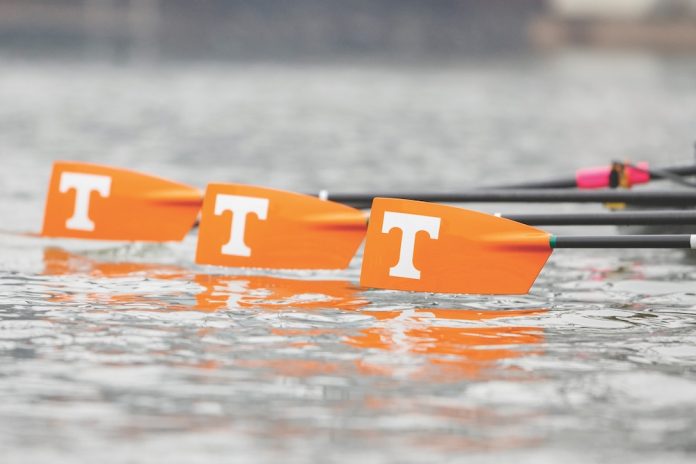
And just like that, they were gone. Less than two weeks after coaching Southern Methodist University to a historic top-10 finish at the 2023 NCAA Rowing Championships, Kim Cupini left Dallas for the University of Tennessee. But she didn’t just leave. A good portion of the SMU team—athletes and coaching staff—went with her.
To continue reading…
This article is exclusively for Rowing News subscribers. For as little as $5 a month, you can get access to the best quality, independent reporting on all the issues that matter to the North American rowing community.
Already a subscriber? Login
In all, 17 student-athletes and three coaches went from Dallas to Knoxville to become the core of the 2023-24 Tennessee Volunteers women’s rowing program.
Unprecedented in size, it was the boldest mass transfer in NCAA rowing history, and it reflected how collegiate rowing at the highest levels operates now under the new and evolving reality of the transfer portal, extended Covid eligibility, and the trickle-down effect of NCAA rules on rowing.
Despite appearances and the teeth-gnashing of doomsayers, it was not, however, the beginning of an NCAA rowing transfer-portal apocalypse. Rather, it was the predictable result of a top athletic program demonstrating real support and directing major resources toward women’s rowing.
Behind Tennessee’s move is the same factor that for decades has powered top programs, from East Coast Ivies to West Coast state schools: institutional support.
Financial support for coaches’ salaries.
Admissions support for recruits.
Cultural support that makes student-athletes, coaches, and staff feel like what they’re doing matters—to the university, to the powers-that-be.
The annual migration of coaches, coaching staffs, and student-athletes among NCAA athletic programs has transformed big-time college sports, especially football. Beginning in 2021, the NCAA removed the requirement that student-athletes skip a year of competition when they transfer.
Transfers propelled the University of Washington’s quick rise to the top of college football. The Huskies had 26 transfers on their roster last year, and then 20 of 22 starters, The Wall Street Journal reported, left the program after the national-championship game.
Coaching staffs also move with head coaches. ClutchPoints reported that Jedd Fisch brought 21 staff members with him when he left Arizona to replace Kalen DeBoer as Washington head coach when DeBoer departed Washington after only two years to replace Alabama’s retiring Nick Saban.
Many of the same relaxed rules that enable such musical chairs in college football apply also to women’s rowing. The NCAA database of athletes eager to change schools is called the transfer portal, and it’s become, in effect, a free-agent marketplace.
“That’s what the NCAA wanted—to open the portal so athletes could move about and do what they want,” said Yale women’s head coach Will Porter. “For rowing, there’s always a trickle-down effect from the bigger sports.
“All of our transfers have been fifth-year kids, with an extra year of eligibility because of Covid, going to get master’s degrees.”
As a large state school with a more flexible academic program, Washington is in a different and advantageous position, though it shares the same goal: developing a championship crew.
“There’s been a lot of interest from people in transferring,” said UW women’s head coach Yaz Farooq. “We get contacted constantly, but we still have the same standards as for the rest of our team. We want to know that this person is a good teammate, that they’re interested in actively contributing to our squad.”
Tennessee’s sudden influx of talented and accomplished rowers and coaches was different from the way Deion Sanders achieved quick (and short-lived) success with Colorado’s football team. All the women transferring to Tennessee had committed to being coached by Cupini and her assistant coaches, while Coach Prime assembled a team of free agents essentially from a variety of programs.
By rule, Cupini couldn’t recruit her SMU rowers to join her at Tennessee. Her assistants who had not yet left SMU could say what they wanted until they, too, departed. As for the athletes, they were free to talk among themselves, something they did at home, and around the world, once they heard the news.
“I honestly think each person made their own decision,” said Hannah Richardson, a sophomore from Australia who transferred from SMU to Tennessee. “I didn’t feel any peer pressure to go either way. It wasn’t really, ‘My teammates are leaving, so I’m going to leave.’ It was more like, ‘What are the opportunities for me at Tennessee?’
“Doing a little bit of research into the way Tennessee Athletics treats their athletes and the setup here, it didn’t take me long to figure out that I wanted to transfer.”
Richardson was home in Australia and slept through the team Zoom meeting when Cupini’s move was announced.
“I must have turned off the alarm in my sleep. So I woke up to a bunch of messages on my phone. ‘What is everyone going to do?’ And I was like, ‘Do about what?’”
In total, 17 rowers went to Tennessee, something fifth-year captain Megan Hewison attributes to Cupini’s coaching, training techniques, and knack for breeding a winning team culture.
“I was a captain at SMU for three of the four years I was there, so I’ve got a close relationship with Kim and knew that I wouldn’t want to row my last year anywhere else. I also knew that a lot of the girls who had been in the eight and influential on the team at SMU would want to follow Kim as well.”
The transfer portal is open only for a certain period each year, but when a head coach leaves, the athletes in that program are granted a special window to enter.
“We need to get the ball rolling,” Hewison recalled thinking. “Not only do I want to go to Tennessee to be with Kim because she’s such a great coach but I also want Tennessee to be fast and I want all my teammates to come with me. That was the thought process.
“We had lots of Zoom calls without the coaches, just our SMU team talking through all the different reasons for people to stay or to go, and at the end of the day everyone made their own decision.
“The team understands that we’re not a Yale, we’re not a Washington or a Stanford. We’re not getting the best recruits, at least at the moment. We don’t have the best people coming in, so you’ve got to decide that you’re going to make the difference. You’ve got to make the best people through the training and the commitment.”
Hewison, who rowed out of Leander Club last summer as part of Great Britain’s national team, appreciates what Tennessee offers.
Unlike most other schools, Tennessee provides the maximum amount of so-called Alston money. Alston money is financial support for student-athletes that was allowed by the Supreme Court’s 2021 National Collegiate Athletic Association vs. Alston decision, which held that NCAA rules restricting certain education-related benefits for student-athletes violated federal antitrust laws. It’s $3,000 per semester, $6,000 per year, up to $24,000 over four years. Each school can choose how much is given to which sports.
“I’m not someone driven by money. I came here for the coaching and the resources,” Hewison said. “But I’ve rowed at a lot of very good clubs, and the Tennessee boathouse is phenomenal. It’s crazy.”
The Wayne G. Basler Tennessee Boathouse sits right on campus, where the Tennessee River flows past Neyland Stadium in downtown Knoxville. The three-story facility, now undergoing renovation, is full of boats, ergs, and exercise equipment, of course, but also features offices, a kitchen, a lounge, a recovery room, and laundry services.
For all that, the main reason Hewison came to Tennessee was to be coached by Cupini.
Why?
“The results.”
“All of the training that every team around the country does is hard. It’s going to be hard no matter what team you’re on, so you might as well make it worth it. It’s nice beating big teams that have five-star recruits. We don’t; we just put in the work.”
At Tennessee, sports have always been huge, and the Volunteer brand is strong far beyond Knoxville, stronger than the brand of most professional sports teams and energized by zealous booster clubs across the country.
Spyre Sports, the Tennessee-focused college sports collective, or unofficial agency, has raised its annual fundraising goal from single-digit millions to at least $25 million. “We think that goal is absolutely attainable,” Spyre president Hunter Baddour told The Athletic.
Tennessee’s athletic director, Danny White, who moved to Knoxville from the University of Central Florida, where during his time women’s rowing was the top-performing academic team in the American Athletic Conference, takes athletic success across all sports very seriously.
In 2023, the Volunteers finished sixth, their best place ever, in standings for the Learfield Directors’ Cup. This award is given annually by the National Association of Collegiate Directors of Athletics to the college or university that is most successful in 19 sports that hold championships sanctioned by the NCAA and the National Association of Intercollegiate Athletics.
In the Directors’ Cup contest, women’s NCAA rowing counts a lot. Stanford, last year’s Directors’ Cup victor, earned 100 of its 1,412 points by winning the NCAA rowing championship. The year before, 2022 NCAA rowing champion Texas won the Directors’ Cup. Even last place (22nd) at the regatta earns 30 Directors’ Cup points. After the 2021 Covid season, Tennessee qualified for the NCAA championship regatta for the first time since 2010.
White gets paid for climbing the Directors’ Cup ladder; for last year’s sixth-place finish he received a bonus of $184,400, The Knoxville News Sentinel reported. Tennessee was 12.75 points behind fifth-place Florida, which doesn’t compete in varsity women’s rowing, and 26.75 points out of fourth place. Just qualifying for the NCAA championship regatta could be very good for Tennessee’s Directors’ Cup standings in general and for White, the top athletic decision-maker, in particular.
“It’s been unreal,” said Cupini of the support and enthusiasm she and her team have experienced at the University of Tennessee.
“When we go to Florida for training trips, people run out onto the docks. Certain cities set up things so high-school kids can come out and watch. The fan base is insane—like nothing I’ve ever seen.”
A wholesale team transfer like the one that followed her from SMU to the University of Tennessee is an anomaly, Cupini insists, and unlikely to become the new version of recruiting in NCAA rowing.
“All of our transfers either rowed for me at SMU or already were transferring into SMU,” Cupini said.
More money at Tennessee has made a big difference for Cupini’s assistant coaches. After a career spent flipping rowing programs—first building up San Diego, then bringing SMU to new heights—Cupini now has the budget to pay her assistants well.
“I brought over people I’ve been working with for a while, including some people at SMU and then some people from other schools. We actually kept a gentleman on from Tennessee as well. So we have a really super, complete, diverse staff.”
Money for scholarships, however, is limited. Division I rowing programs are allowed a maximum of 20 scholarships, but minimum team size for the NCAA championships is 23 (two eights and a coxed four, not including spares and non-racing members of the team traveling for the experience).
That’s rare among NCAA sports. Basketball starts five players, but has 15 scholarships for women, and even football’s starting offense and defense combined number only 22, for which they can give out 85 full rides.
“Roster management is always a challenge,” Cupini understated.
“Because our sport is so new and unique, we need to educate the people who make the financial decisions about our sport, and the sheer numbers of our sport. We need to make sure that we’re treated the same [as every other sport] and that the women get what they need.”
