

To continue reading…
This article is exclusively for Rowing News subscribers. For as little as $5 a month, you can get access to the best quality, independent reporting on all the issues that matter to the North American rowing community.
Already a subscriber? Login
By Martin Cross
This was a championship for the ages. Not because of the crowds (most of the grandstands were thinly filled). Or the weather, which was blisteringly hot and savagely humid, creating real problems for athletes and coaches (though the latter may have benefited the best-prepared teams).
No, this was an event packed full of some of the best racing, the smoothest rowing and sculling, at a venue that was Olympic quality. Having been to most worlds since 1974, I’m trying to remember a better championship and, to be honest, I’m struggling.
With that in mind, it’s hard to know what to turn to first. If you watched them, you won’t be surprised that I’m going to pick the men’s and women’s singles. Lauren Henry had been sensational throughout the season. The British Olympic quads champion had dispatched all her opponents, while posting stunning times.
Even when she was unwell at Lucerne, the 23-year-old still won. But with her second-half tactics well known to her opponents and a decent gap between Lucerne and worlds, the chance was there for someone to lead out and stay in front.
Ireland’s Fiona Murtagh was that person. Her wily coach, Dominic Casey, with a hatful of Olympic medals and a fearsome belief in Murtagh’s potential, was the person who stoked her confidence. The 30-year-old Galway native led by a street at the K. Moreover, Henry’s customary third quarter seemed to make no impression. But then the fireworks began. Henry, uncharacteristically looking around, turned in a sensational sprint. It failed by just three one-hundredths of a second. A new rivalry has been born in our sport.
The men’s singles was even better, maybe because till late on the medals were contested by four athletes. Oli Zeidler led out (no surprise there) but the 2024 Olympic champion did not dominate. Instead, his nemesis from the Tokyo Games, Stefanos Ntouskos, stayed close. The former lightweight’s amazing coach, the Italian Gianni Postiglione, had, for a change, experienced an injury-free run into the championships. That allowed the Tokyo gold medalist to stay close through the K.
Ntouskos’s technique was strikingly different from that of his rivals. The Greek sculled with his exaggerated body rock and powerful finish. In the final quarter, Simon Van Dorp, the University of Washington Husky, was there pushing his bow level with Zeidler and the Greek. But with just 250 meters to go, the Dutch sculler began to run out of juice.
As Ntouskos hit the front again, Zeidler found a sprint from nowhere and began to charge. The neutral athlete, Yauheni Zalaty, always a great sprinter, was there, too. On the line, it was the 28-year-old Ntouskos, with Zeidler in second, and Zalaty picking off the fading Van Dorp. It was a sensational race.
Could it get any better? The answer was an emphatic yes. Picture this: two Shanghai natives, both Olympic champions at Tokyo in the quad. They’d won the women’s doubles in both World Rowing Cups this season. For Chen Yunxia and Zhang Ling, this was meant to be “their” championships. Up against them: The Netherlands double that had been rowed down crushingly by the diminutive Greeks at Henley.
Rose de Jong in the bow seat had also lost the Olympic quad’s gold on the last stroke in Paris. These two crews rowed the whole course with no more than three-tenths of a second separating them through any mark. To say it was compelling would be an understatement. In the end, de Jong and Benthe Boonstra found something to snatch a narrow victory over the hometown favorites. We were speechless!
Then what about the men’s quad? The flamboyant and sometimes unpredictable Italians, led by their talismanic stroke Giacomo Gentile, were up against the reliable British with their turbocharged third quarter. It had seen the rest of the world off in Lucerne, but not the Italians, who chose not to race there.
In the final, the Italians were sculling beautifully, with so much synchronicity that it almost took your breath away. At 500 meters, they had clear water on the British and extended that by the K. Into the third quarter, it was game on. The British were coming … except they weren’t. The fabled British third quarter never materialized, and the Italians never let up. Italy took gold at a worlds for the first time since 2018.
If the Italian quad was one contender for crew of the championships, then another must have been the British men’s four. Rumors abounded that they’d gone sub 5:40 for 2K in training. So in Shanghai, the three Cambridge oarsmen in the stern and Dan Graham, from Caversham squad, looked like they had taken the sport to another level. They won–looking long, easy, and effortless—by a length over Romania.
Credit should go to their coach, Paul Stannard, though for most of the season the light-blue oarsmen were coached by Rob Baker. The Cambridge chief coach must now be ranked up there with the world’s best coaches. In addition to that, the former Harvard Crimson rower Douwe de Graf, who anchored the boat from the three-seat, must be ranked now as MVP of the British team. The fabled Sinkovic brothers, triple Olympic champions, had to be content with the B final.
The U.S. women’s four was outstanding, too. Jesse Foglia, their coach, had helped them build a solid if unspectacular first quarter. But when they passed the 500-meter mark, the fireworks began. They rowed a blistering second and third quarter, which made them untouchable. Even the multi-Olympic champion crew from Romania couldn’t get close.
The Longhorn/Husky combo in the stern of Kate Knifton and Teal Cohen was phenomenal. The fact that both hailed from the Lone Star State was icing on the cake. Moreover, their victory laid to rest the relative underperformance of the U.S. women in Paris and represented a triumph for coach Josy Verdonkschot.
The former Dutch women’s coach must have had mixed feelings when he saw some of his former athletes in the Dutch women’s eight take a clear-water lead in the first quarter over not just the Romanian Olympic champions (who had dominated in Paris) but also the new U.S. crew, which had hoped for more.
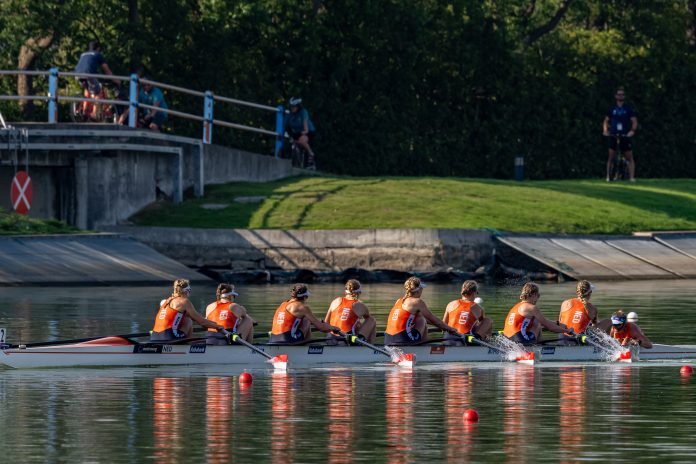
It was a joyous rip-roaring row from The Netherlands eight, who rarely dropped below 42. They won by clear water. The fact they moved so fluidly and easily enabled them to maintain their high rating—beautiful catches, a powerful middle, and an easy, clean finish. And soon we were in for double Dutch delight.
The evidence that the Dutch had managed their post-Olympic transition better than any other team came when the men’s eight stormed down the course with the same pulsating high-rating style. For once, it gave them a clear-water victory over their archrivals from Britain. And the fact that the guys from The Netherlands looked like they had loads of fun throughout the season did not go unnoticed.
In the same final, the U.S. men’s eight rowed a storming race. Those that had seen the fatigue of the men’s four in the early rounds of the regatta may well have questioned Verdonkschot’s decision to make the four double up into the eight. But all questions were answered when the crew, led by the Olympian Pieter Quinton and debutant Gus Rodriguez, posted a stunning third 500 meters to nearly catch the British napping. Their bronze medal was a towering achievement and reflected well on their great coaching team of Casey Galvanek and Brian de Regt.
The athlete of the championships was undoubtedly Romania’s Simona Radis. To be fair, the double Olympic champion was already the world’s No. 1 female oarswoman. That looked unlikely to change when she and her new partner, Maria-Magdalena Rusu, bossed the women’s pairs—although, in the first 1,000 meters, it seemed a new contender might be emerging as Hezekia Peron, a relatively unknown Frenchwoman from the Dordogne, showed that she was not awed by Romania. Silver was a brilliant bonus for the 20-year-old future French star. Americans Jess Thoeness and Holly Drapp rowed through the field to beat the fancied Italians for bronze.
What made Radis sensational on the water at Shanghai was the way she stroked the Romanian mixed eight. They were simply untouchable, and much of that stemmed from Radis’s leadership. At the finish, the 26-year-old had a margin of over five seconds on the Italian crew. Moreover, she and her crew mates posted the phenomenal time of 5:34. As if that wasn’t enough, the Romanian’s boat contained the first ever husband and wife, Maria and Florin Lehaci, to win a world gold medal together.
This new event was a riotous success, as were the mixed doubles, won by Ireland. On this evidence, the mixed eights look certain to make an Olympic appearance in the Brisbane Games of 2032. Tellingly, the crews seemed happy to row their eights with little training beforehand. In doing so, it seemed they caught the zeitgeist of what was an important departure for the sport.
Another crew that caught the mood of the championship was the Dutch women’s quad. Their stroke, Tessa Dullemans, was also in the crew that had been rowed through on the line by the British. And the Olympic champions had two returners from their Paris boat on board. Added to that, the British had a powerhouse in the stroke seat, Becky Wilde, who took a bronze in Paris, too.
By now, you’ve probably guessed what The Netherland’s strategy might have been: front-load the first half of the race and trust that superlative technique would see them home. This time, there was no fairy-tale ending for the Brits, who took a well-deserved silver after a season blighted by injury and illness. The celebrations were sweet for Dullemans & Co.
You also had to admire the sheer audacity of the Polish federation’s selection policy. They took the two powerhouses out of their fancied quad: Miroslaw Zietarski and Mateusz Bisksup. It was a gamble, but they trusted that the two men who had finished sixth in the Tokyo doubles final would reprise the speed they had shown in the European championships.
The men’s doubles looked like an absolutely stacked event, but in the final, the men from Bydgosz and Gdansk repaid their federation’s trust by dominating the field in the first 1,500. Nik Pimenov and Martin Mackovic from Serbia closed fast at the finish, but Mackovic, a former Cal Golden Bear, couldn’t quite get his bow in front of the tiring Poles.
While the Poles, at 32 and 31, may be moving toward veteran status, it was a youngster from New Zealand, Oli Welch, who looked stunning in the men’s pair. The 22-year-old was rowing at bow behind the 25-year-old Ben Taylor. Such was their dominance—ahead of Romania and Switzerland they won by a shade under five seconds—that it was tempting to wonder whether a new Kiwi pair had been launched. OK, so they’ve got a lot to do to rival the feats of Eric Murray and Hamish Bond, but Shanghai was a start.
Michelle Sechser, who has evolved from youngster to evergreen, took gold in the lightweight singles. But the 38-year-old had to hold off an incredible sprint from the Chinese sculler Pan Dandan. The noise from the excited Chinese TV announcers nearly drowned out our own TV remarks that afternoon. Still, the Californian held on for a famous victory.
The men’s lightweight singles went to the Uruguayan Felipe Kluver Ferreira. His Tokyo lightweight doubles teammate, Bruno Cetralo Berriolo, excelled, too. The self-styled “Montevideo Butcher” (when he played soccer, the ball might get past him but not the man) made the A final of the men’s singles. A great result for Latin America.
Although the lightweight doubles were disappointing in terms of entries—just four contested the men’s event—they were valuable in providing a space for developing nations like Indonesia, Peru. and Tunisia. The first two of those crews won medals.
The Para boats produced some outstanding performances. The 24-year-old Anna Sheremet shrugged off worries of the conflict in Ukraine to take her first gold medal at this level. In the men’s edition, Britain’s Ben Pritchard blasted out and aimed to hang on. The 2024 Paralympic champion was hanging on indeed— barely—in the final quarter and looking for the red buoys with 350 meters still to go. At the finish, he managed to stay ahead of Ukraine’s Roman Polianskyi and the evergreen Aussie Eric Horrie.
In the PR3 mixed double, Germany set a new record, with stroke survivor Katerin Marchand and her partner, Valentin Luz, destroying the world’s best time. China took the PR2 mixed double, and it was a familiar story in the PR 3 coxed four, with Britain winning another gold. In the past, the USA four had challenged the British for the gold, but this time the Germans, with Marchand doubling up in the bow, vanquished the American crew, which slipped back to fourth. China, racing in a stern-coxed boat, took silver.
The championships had begun with a spectacular opening ceremony that featured a robot rower and the mayor of Shanghai (his presence a big deal in this part of the world). They closed with an innovative medal ceremony in the heart of Shanghai. It was an appetizer for World Rowing’s forthcoming sprint events, which will be held in the center of the south China city next year.
Yes, rowing will be coming back to Shanghai, and it’s no surprise. We loved it!
Martin cross is World Rowing’s race commentator. For over 18 years, he rowed for Britain, earning Olympic gold and bronze medals. He has provided expert commentary at six Olympic Games. He coaches rowing at Hampton School in London and interviews rowers and coaches on his Crossy’s Corner YouTube channel.
