

To continue reading…
This article is exclusively for Rowing News subscribers. For as little as $5 a month, you can get access to the best quality, independent reporting on all the issues that matter to the North American rowing community.
Already a subscriber? Login
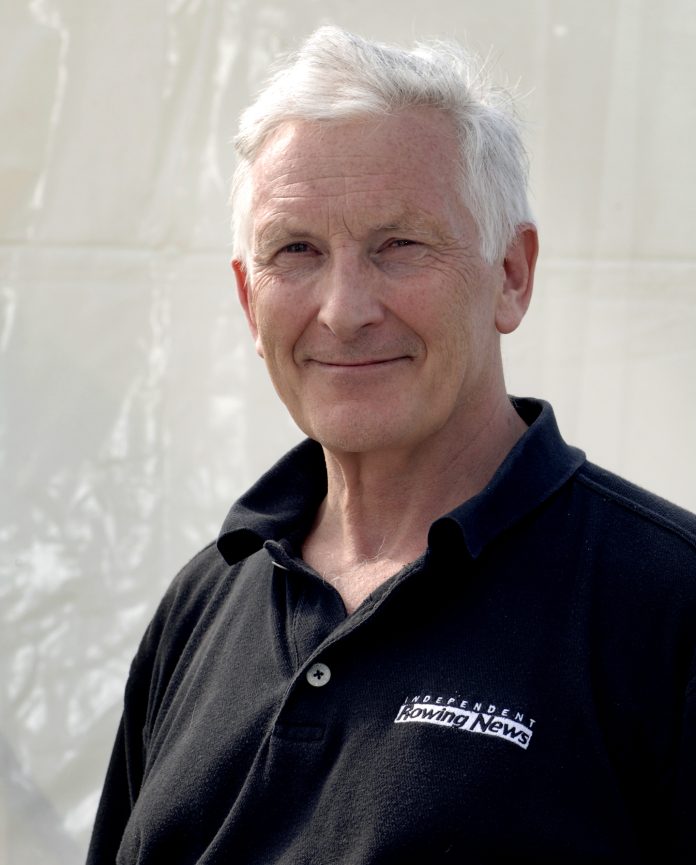
Chris Dodd, the greatest rowing journalist of all time, died on Jan. 25 in Great Britain. He was 83.
Dodd, who covered rowing for The Guardian, reported on more major regattas better than anyone else and wrote several books on the sport, including most recently (with Hugh Mathewson), More Power, the story of Olympic rowing coach Jürgen Gröbler.
“Nobody in the field—past or present–has come up to Chris’s standards,” said Martin Cross in The Guardian. “A quietly spoken private man, he was head and shoulders above the rest of his journalistic colleagues, of whom I was one.”
Dodd loved rowing and served the sport not only by telling its stories but also by being a friend and supporter of those who aspired to do the same. He shared his intellect, experience, and sharp wit generously.
A side-eye glance paired with a few words under his breath in the press box could be both the truest and funniest words a fellow journalist might hear in a season of covering rowing. He may or may not have coined the term blazerati for the blue blazer-wearing officials and bureaucrats of elite rowing, but none wielded it more deftly.
Christopher John Dodd was born in Bristol, UK in 1942 and became The Guardian’s rowing correspondent in 1970. He was the founding editor of Regatta magazine, the defunct publication of Great Britain’s Amateur Rowing Association—now British Rowing—and also wrote The Story of World Rowing. He was a driving force behind the founding of The River and Rowing Museum in Henley-on-Thames, which opened in 1998 and closed last year due to financial struggles.
In 2022, British Rowing awarded Dodd its Medal of Honor for his outstanding service to the sport.
“I am somewhat astonished as well as flattered to hear that I am to be awarded British Rowing’s Medal of Honor,” Dodd said at the time. “Flattered because it boosts my ego; astonished because I have sometimes given British Rowing, once the Amateur Rowing Association, a hard time in print.”
He supported and encouraged Rowing News and other new rowing media with his words while also representing the old guard of rowing journalists, including his late friends Peter Spurrier, Mike Rosewell, and Geoffrey Page, with whom he founded the British Association of Rowing Journalists (BARJ).
It was the natural formalization of the band of correspondents who more often than not gathered for drinks at the end of the workday and usually a meal at the end of the regatta, which could be as much fun as the event.
BARJ pushed back against press offices for regattas and rowing associations transitioning from media liaisons to public relations and marketing organs. His career spanned the arc of journalism from when basement printing presses dimmed the lights of The Guardian building to the dim lights of digital-only outlets that have superseded many actual publications.
“Chris was the quiet man of the traveling British rowing pack, but there was always something going on–a plan to be hatched or a story to be told,” said Mike Haggerty, Dodd’s longtime friend and rowing correspondent for the Associated Press. “He always knew exactly what he was doing and where he was going, and you were always going to be entertained in his company.”
In the bibliography at the back of More Power, Dodd wrote, “One of the extraordinary things about rowing is the stream of writing dedicated to it.”
He was the greatest source of that stream.
