

To continue reading…
This article is exclusively for Rowing News subscribers. For as little as $5 a month, you can get access to the best quality, independent reporting on all the issues that matter to the North American rowing community.
We’re not even halfway to the LA2028 Olympics, despite what the calendar says. Sure, 2026 seems like the midpoint between 2024 and 2028, but in terms of international elite rowing, there are still three years to go.
First, there is this year. As we’ll document and dissect in the next issue of the magazine, the 2026 World Rowing Championships in Amsterdam in late August were the proving ground for the different approaches nations and their various coaches and national-team staffs have taken for this quadrennial.
For the successful, the results are affirmation of their preparations. For those who finished out of the medals—or even worse, not even in the grand finals—it’s time to make significant course corrections before the penultimate event of the Olympic cycle, the Lucerne world championship that will determine who qualifies for the very limited spots in the Olympic regatta. That will be the end of the second year.
Those who fail to qualify will be back to Lucerne in year three for the Final Olympic Qualifying Regatta (FORQ), while qualifiers can train straight through to Los Angeles.
For USRowing, expectations remain high, despite two mostly disappointing Olympics: the disastrous (zero medals!) Tokyo Games, and the Paris Games, where the men’s four (gold) and eight (bronze, despite having had to qualify through the FORQ) saved the day for the U.S., followed by the Para coxed four’s winning silver four weeks later in the Paralympic regatta. Hosting the Olympics, as well as the 2028 World Rowing Senior, Under 23, and Under 19 Championships at Nathan Benderson Park in Sarasota in August 2028, only raises the pressure.
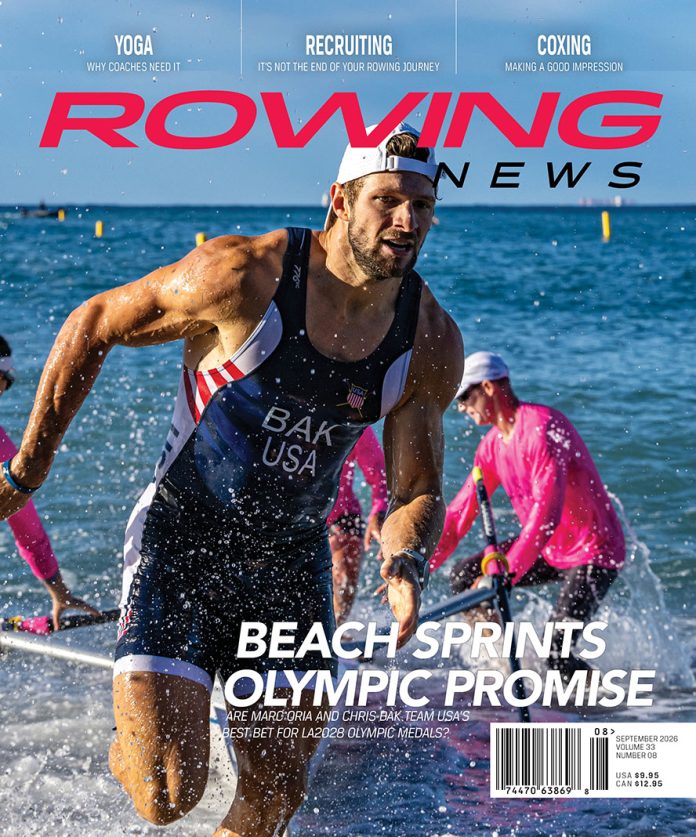
The U.S. needs to win only three medals in the Olympics to improve upon the 2024 Olympics, and most—possibly all—of those medals could come from our sport’s new Olympic discipline, Beach Sprints. Making its debut at LA2028, Beach Sprints offers three medals—men’s and women’s solo and the mixed double—which could come from only two athletes. Luckily for the USA, one of those athletes, Chris Bak, is the most decorated competitor in Beach Sprint history, with six total medals, four gold.
In his latest feature for Rowing News, beginning on page 34 of the September issue, “The Coastal Rowing Whisperer,” Frank Fitzpatrick profiles the coach behind all that success, Marc Oria, a former Spanish elite flat-water oarsman who emigrated to the U.S. to work in higher education, which he still does in addition to leading USRowing’s Beach Sprints program.
This and recent issues of Rowing News are full of newcomers, including, in September’s magazine, Frank Rowe, Jr., who joins freshly recruited columnists CJ Bown and Annika Nelson. Just as rowing, the oldest intercollegiate sport in the world, adds to its offerings and grows, so do we.
