

To continue reading…
This article is exclusively for Rowing News subscribers. For as little as $5 a month, you can get access to the best quality, independent reporting on all the issues that matter to the North American rowing community.
By Martin Cross
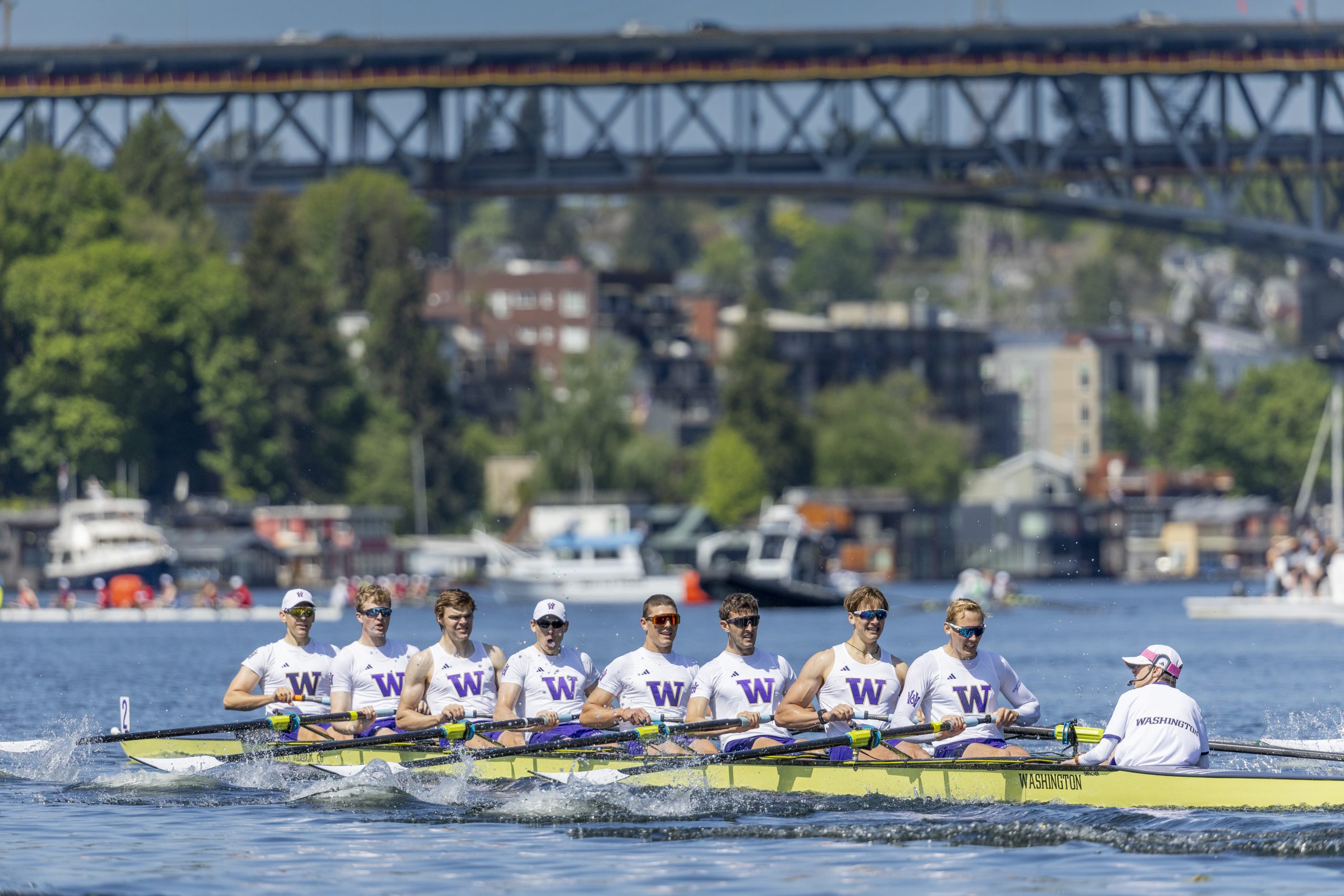
When the two crews slumped exhausted over their oars at the end of the Montlake Cut, the margin was only 0.165 seconds. But the ripples from Washington’s defeat of the British national eight spread a lot farther than the waters of the Dawgs’ Seattle lakes. If anyone needed proof that top university crews could take on and beat the best crews in the world, here it was.
The thrill of that win was summed up by UW cox Nikita Jacobs:
“It’s incredible to line up against full-time athletes who train year-round in national-team programs.
“What’s especially compelling is how, in recent years, university crews have been able to catch these world-class teams off guard and even come away with wins.
“At the core of that is belief that when you put nine people in a boat who genuinely trust that they can win, it changes everything. We didn’t need to be the fastest crew on paper, we just needed to be the fastest boat in that one race.”
After that epic contest, how could the rowing world not be hungry for more? Perhaps it’s time for our sport to stage more regattas where the world’s top university eights go head to head against the globe’s fastest national teams.
We set out to find out what the rowing community thinks of this idea. We talked to top coaches, rowers, and administrators and asked them three questions:
1) Are the top university eights fast enough to hold their own in World Rowing Cups?
2) What do you think of the top university eights competing in World Rowing Cup events?
3) How might this work?
Although World Rowing, rowing’s international governing body, currently has no plans to allow university crews to compete in World Rowing Cups, the will from the rowing community to develop something like this is most certainly there.
Simon Van Dorp, the new world-record holder over 2K on the Concept2 erg, an Olympic bronze medalist and proud graduate of the University of Washington, left no doubt as to where his sympathies lie.
“I always love seeing college crews getting a chance to race international opposition,” the Dutchman said.
He shared three memorable occasions when university crews raced national teams:
“The recent win by the UW Huskies over the British national eight is only one of many examples of a college eight holding their own against top opposition,” Van Dorp said.
Unsurprisingly, he mentioned the 2024 Holland Beker regatta win by the UK’s Oxford Brookes over the “Holland Acht.”
And the 2017 World Rowing Cup I win by Nereus, the Dutch student rowing club, over a British national crew.
This writer remembers that compelling race on Belgrade’s Sava river course. How could one forget it, when only the year before most of the Nereus crew had seen the Ladies Plate at Henley snatched out of their hands! The crew was disqualified, controversially, after having crossed the line first in the final. As it happened, most of their opponents from that day at Henley in 2016 were now–a year later—racing as the British national eight.
To make this rematch happen and get around the rule that only national teams can compete in World Rowing Cup events, the Dutch national team had picked the Nereus eight to represent The Netherlands in Serbia.
In that grudge match, the student eight, then stroked by current national-team coach Freek Robbers, beat the British by 0.68 of a second in the fast time of 5:30.98. What a story!
But perhaps Van Dorp’s most vivid recollection was of a defeat suffered by the Dutch Olympic eight in 2024 on their home course of the Bosbaan in Amsterdam. Then, a crew from a British university, Oxford Brookes, took on and beat the Dutch crew that would go on to win an Olympic silver medal in Paris.
It was a result that stunned the rowing world. It was made possible because the rules of the Holland Beker event allow student crews to compete against national teams. By a quirk of fate, one of the British athletes that day was Fergus Woolnough, who two years later raced in his country’s eight at the 2026 Windermere Cup.
That day, though, it was the 21-year-old’s turn to experience what it felt like to defeat a national team.
“It was an amazing opportunity,” said the Shanghai worlds silver medalist. “It was nerve-racking and exciting to compare yourself to the world’s best. Going bow ball to bow ball into the line [in Amsterdam], we found something in ourselves we didn’t know was there.”
As fate would have it, just a few days later, the Oxford Brookes eight beat Jacobs’s Husky crew in the final of the Grand Challenge Cup, Henley’s top event.
So much for male student crews racing national teams. What about top female student eights? On the waters of The Cut in May, the Husky women lost to the British bronze-medal eight from last year’s worlds in Shanghai by over three seconds, though they did manage to take the scalp of Canada’s national crew.
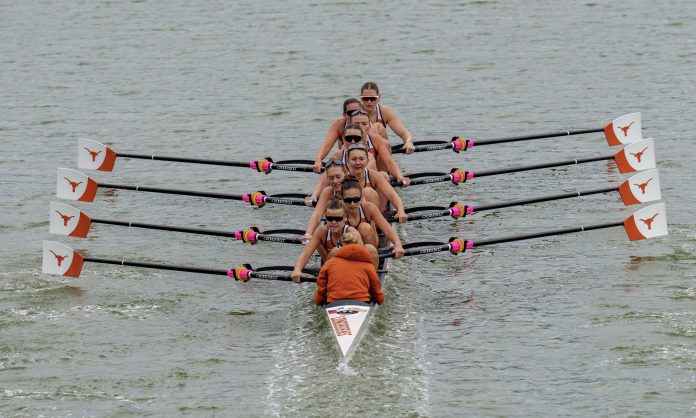
It doesn’t take much imagination to envision what might have happened if the current top-ranked U.S. schools—Tennessee, Texas, and Stanford—had lined up against the British women in Seattle.
This writer estimates that the top U.S. college women’s crews are three to five seconds ahead of their Husky rivals. That means the U.S. No. 1, No. 2, and No. 3 crews would have finished, at worst, level with Britain, and maybe with their bows just in front.
Of course, at the 2025 NCAAs, it was Yale that got its bow in front. Will Porter, who has led the Bulldogs since 1999, has no doubts about the speed of his eight.
“I have said for years that the NCAA grand final is a much faster race than the U23 world-championship grand final. National-team coaches wouldn’t think twice about entering a top-level U23 crew in a World Cup race. By that logic, why not enter a top NCAA crew? Especially in the women’s eight event at the world level.
“I am all for the positive experience of young athletes getting to race at the highest level. It is exciting for them and helps the growth process.”
One of Porter’s rivals, Texas coach Dave O’Neill, whose women’s crew was ranked No. 1 at the time, expressed similar views.
“I would love the opportunity for our top eight to race at the World Cups,” O’Neill said, “and I think it would be wonderful for our sport.
“I’ve always felt the winner of the NCAA final would win U23 worlds by open water, and I do believe they’d be competitive against senior national teams. The top NCAA eights might not win a Lucerne World Cup but they’d certainly make it more interesting, and possibly be on the podium in some years.”
Is this view shared widely?
Scott Frandsen, the Cal Bears coach whose team won the IRA title in 2022:
“I would absolutely love to bring a top crew to race in Lucerne [in a World Cup] at some point. The main benefit would be to line up next to national-team eights and test ourselves.”
For the former Canadian Olympic medalist, it would have to be a head-to-head contest pitting university crews against national teams.
“Racing in a separate university event wouldn’t be as attractive,” he said.
“I have made the claim that in years that we win the IRA, those crews would finish somewhere in the middle of the World Championships final. I’m not claiming that we would win but I think they could finish third, fourth, or fifth. It would be great to be able to test that prediction.”
Frandsen well may recall the days when university crews could compete on the Rotsee against national teams. In 2004, the legendary coach Harry Parker took his all-conquering Harvard eight (rowing as USA 2) to the Rotsee. With the likes of Cameron and Tyler Winklevoss on board—not to mention future Canadian Olympic eights champion Malcolm Howard—the Harvard crew made the final and finished sixth.
Howard remembers that season, when Harvard also raced an eight from The Netherlands in the finals of the Grand.
“Racing the Dutch eight in the Grand Challenge Cup at Henley in 2004 felt like a measure of where a top U.S. university crew stood against the best in Europe at that time. We were three-quarters of a length down at the end. It was popularized in the best Hollywood rowing scene in The Social Network.
“Every race between a college crew and a top international crew has a huge caveat,” Howard continued. “Unless it’s a blowout victory by the national team, it’s a win for the university crew. In 2013, our OUBC [Oxford University Boat Club] boat had a fixture against the Germans. We beat them decisively in the first piece. They went on to win a silver medal at worlds. We did pieces against the GB eight at Caversham; we held our ground and maybe beat them in a one-minute piece.
Howard saved his best story for last:
“In 2008, we are in Japan for our pre-Olympic training camp. We’ve just finished the hardest seven days of training I’ve ever done. We are out for our last workouts—4 x 2K. In our last 2K, in the last 500 meters, out of nowhere a Japanese university crew shows up. We barely beat them by a length. Less than two weeks later, we won the Olympics.”
Cambridge coach Rob Baker, now working part time with the team from The Netherlands, lamented that multinational university crews aren’t able to race in World Cups.
Baker, whose Cambridge eight recently beat an eight made up of Britain’s top oarsmen on the Thames, said:
“It’s a shame that the World Cup regattas in their old form changed some years ago to deny the opportunity for non-national teams to compete.”
While the man who has just racked up four straight Boat Race wins appreciates the way that the current World Rowing Cup series has developed, he argued forcefully that there should be a place for top universities to compete against international eights.
“Our goal at Cambridge is to race the best and put ourselves to the test. Racing the Dutch eight at Henley last year in the Grand was an honor and a privilege, and to run them close is something we take huge pride in.”
Having won back-to-back titles at the Head of the Charles, Baker is uniquely qualified to judge his university crew’s speed against the world’s best.
“Racing the Head of the Charles has been a fantastic experience. The quality of racing from the U.S. college crews is so high, this in itself feels like near international-team standard.”
Referring to three members of his 2025 Cambridge crew who capped a magical year by representing Britain in the Shanghai World Championships, Baker concluded:
“Last year, we had an exceptional group of athletes who went on to race and win for Great Britain in the four. When we have these years, it would be great to be able to race side by side with five international crews in the summer.”
Crucial issues must be resolved before multinational first varsity eights race in World Rowing Cups.
“The current World Cups are not configured [to allow for university entries],” said Vincent Gaillard, World Rowing’s executive director, “and as it relates to future World Cups—from 2029 onwards, with a format we’re currently developing—it’s quasi-certain that, however different the future format is, it will remain a nations competition in all cases.
“That is not to say that one day we might not want to get involved in the creation of a completely new competition for universities.”
Paul Cooke, head men’s coach at Brown University, while broadly supportive of university crews racing national teams, mentioned some problems.
“It’s difficult to keep a crew of a very high standard together for the summer, as the athletes typically want to row for their national teams. Henley is the exception, but even bringing a full crew there is not easy to do.”
The man who led the Brown Bears to an Eastern Sprints title in 2024 offered a suggestion Gaillard might consider:
“I’d welcome the opportunity to organize a World Cup-style race with university and national teams in Sarasota at the end of March next year,” he said.
Coach Frandsen also pointed to the difficulty of keeping his top 1V crew together.
“One of the challenges would be not losing one or five of them to national teams.”
An athlete Frandsen might have in mind is powerhouse Gennaro di Mauro. The Italian Olympian rowed as a sophomore in Cal’s 1V that took the IRA title and then returned to Europe to race in World Rowing Cup II in 2023.
Many national teams rely on getting their U.S. athletes back after the NCAAs and the IRAs. This is especially so in the last two years of the Olympic cycle when qualifying and the Olympic Games are priorities for both rowers and national-team coaches.
But in the first year of an Olympic cycle, there’s far more flexibility from national teams and, truth be told, that could stretch easily to the second year of an Olympiad.
Take, for example, three of the athletes who rowed for Cambridge in the 2025 Boat Race: James Robson, Douwe de Graaf, and George Bourne. They remained part of their university eight for the Grand Challenge Cup at Henley, in which they lost narrowly to the Dutch eight that went on to win the world championship.
Coach Baker is likely to have most of his winning 2025 Light Blue boat back to compete at Henley in 2026. They include Freddie Breuer, the German Olympian, IRA winner, and Golden Bear, and USA U23 team cox Sammy Houdaigui. After Henley, both athletes, and others, will hope to rejoin their national teams.
Conveniently, the timing of Lucerne Regatta–one week before Henley–would allow them to race there, should the rules be changed.
Camille Vandermeer, one of the USA’s 2025 world champions who rowed for Cambridge, also will remain rowing and training with the Light Blues until late June, early July of this year. She has been cleared by USRowing High Performance Director Josy Verdonkschot to return to the U.S. for the selection trials at the beginning of July. This year, crucially, these take place the weekend after World Rowing Cup III in Lucerne.
So while there are problems, there are also possibilities.
“Lots of challenges,” Frandsen said, “but I have definitely daydreamed about bringing a top crew over to race in Lucerne, and then Henley. What an amazing trip that would be!”
There are compelling reasons why having university eights race in World Cup events would be good for the sport—besides providing the media with great copy—both in Europe and the U.S.
Entries in men’s and women’s eights are down. These days, it’s rare that Lucerne, let alone other World Rowing Cups, attracts enough entries to run heats for both men’s and women’s eights.
At 2025’s World Rowing Cup III on the Rotsee, there were straight finals in both men’s and women’s eights. At the equivalent event in 2024, there were just five men’s eights and, sadly, only four women’s eights. In 2023, there were at least heats in the men’s eights, with seven entries (hardly optimal), but only four women’s eights were entered.
In light of these figures, allowing top university eights some kind of wild-card entry into a post-IRA or post-NCAAs World Rowing Cup would energize the sport no end.
Sholto Carnegie, the former Yale Bulldog who won the IRA championship and went on to win Olympic gold in the eights in Paris, has a unique feel for the strength of the U.S. college system.
“The numbers tell the story: 22 percent of the rowers in Paris came through the U.S. college system but they took home nearly 30 percent of the medals. That’s not a coincidence. It’s a system that throws the best young athletes from around the world into the same boats and makes them race each other every single weekend. You learn how to race and develop fast.”
Carnegie, who now runs Crew Connection, an agency that helps rowers make the best use of the opportunities offered by the U.S. collegiate system, has a clear idea of where the top crews might stack up.
“When people ask how top IRA and NCAA grand-final crews would stack up at a World Cup, my honest answer is fourth to sixth. Washington beating GB earlier this season tells you this. At peak form, GB would have the edge at a world championship or World Cup, but in early-season racing against a college crew that’s been together nine months? It’s close.
“Hats off to the Washington crew. They played it all out there and were not afraid!”
The challenge for our sport is to answer that call—to show no fear and let the great college crews compete against the national teams.
MARTIN CROSS is World Rowing’s race commentator. He rowed for Britain over 18 consecutive years, earning Olympic gold and bronze medals. He has commentated at six Olympic Games. He coaches rowing at Hampton School and interviews rowers and coaches on his Crossy’s Corner YouTube channel.
